 As he sees it, naturally
Creationists are notorious
liars. It's as though they can't help themselves when they consciously distort the words of evolutionists as they assiduously go
quote-mining for phrases they can cite out of context. I suppose it's okay to break the commandment against bearing false witness as long as you do it in a good cause.
Ad majoram Dei gloriam and all that (although I imagine most rock-ribbed creationists would blanch at my quoting the
Jesuit motto).
Therefore it is a rare treat to find a creationist who is almost painfully honest by comparison with most of his fellow believers. (I did say “almost”; even this sterling figure is not quite perfect.) The creationist in question has genuine scientific credentials—another rarity in the ranks of the
Genesis crowd. Jason Lisle holds a doctorate in astrophysics from the University of Colorado at Boulder. He's published research in solar astrophysics. Clearly he's not just another one of the disgruntled
engineers who get to call themselves “scientists” once they sign on as anti-evolutionists.
Dr. Lisle came to my attention when I picked up a copy of his book
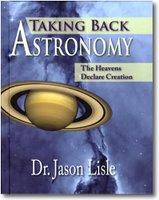
Taking Back Astronomy: The Heavens Declare Creation. While
TBA is not the first attempt to explain away the mismatch between the billions of years of history recorded in the sky and the paltry 6,000 years posited in the Bible, no other book appears to have an author of such reputable scientific pedigree. Young-earth creationists with Ph.D.'s in astrophysics are as rare as hen's teeth (if you'll forgive the evolutionary phrase).
Taking Back Astronomy won't help Lisle's reputation among his fellow scientists, but that may be moot anyway. He decamped from the field of real astronomy years ago to become, as
TBA's author blurb has it, “a research scientist, author, and speaker at Answers in Genesis in Kentucky, and is the planetarium director at the Creation Museum.” A planetarium in a young-earth creation museum? Well, if it were easy to explain then any fool could do it. Dr. Lisle exercises his book-learning and his smarts to do the impossible, reconciling
Genesis and reality.

So how well does he do it? And why do I remark on his truthfulness? Well, in the beginning—as they say—Lisle offers a cogent observation with which I entirely agree:
Glasses of the wrong prescription can make the world appear even blurrier than it otherwise would. Glasses can either distort or make clear, and so can a worldview.
However, Lisle's comment on the importance of a worldview shares the page with an illustration of a nice fat Bible, an illustration whose caption reads, “The Bible is the history book of the universe.” Well, so much for worldview. Lisle's view is that everything must be contemplated through the lenses provided by a strict literal interpretation of
Genesis. As they teach us in logic, you can conclude
anything from a false premise, so Lisle is off and running.
As a diligent scholar, however, Lisle doesn't restrict himself to
Genesis. No, he ponders other sources of knowledge, too. Like the book of
Isaiah, for example:
The Bible indicates in several places that the universe has been “stretched out” or expanded. For example, Isaiah 40:22 teaches that God “stretches out the heavens like a curtain, and spreads them out like a tent to dwell in.” This would suggest that the universe has actually increased in size since its creation. God has stretched it out.
Yes, Lisle is arguing that the Bible anticipates the discovery that the universe is expanding. While he said the Bible refers to this in “several places,” the
Isaiah quote is the only citation I found in
TBA. I presume therefore that it must be the best. Does the “like a curtain” simile put you in mind of something that grows and grows and grows? That's some curtain. How about the tent instead? God spreads it out and keeps stretching it, rather like a situation comedy camping trip, where you know the tent will come to no good end. If the God in
Isaiah is pulling tents out of shape as dramatically as all that, we can assume he never got the merit badge for camping.
Naturally I perked up when Lisle moved on to some numerical arguments:
The Bible often uses the “stars of heaven” to represent an extremely large quantity. Genesis 22:17 teaches that God would multiply Abraham's descendants “as the stars of the heaven, and as the sand which is on the sea shore.” Genesis 32:12 makes it clear that this represents a number which is uncountable by humans: “the sand of the sea, which cannot be numbered for multitude.”
Lisle follows this up by pointing out that the stars in the universe and the sand of the sea are approximately equal in number—somewhere around 10
22, thereabouts. But didn't the Bible say humans cannot count these? Oh, that's okay! Lisle hastens to assure us that they can be “roughly estimated” but never “counted exactly.” See? The Bible was using
figurative language! (Oh, wait a minute. Scratch that!) In any case, I have to say that Lisle's worldview goggles are working really well.

By the way, would Dr. Lisle care to enlighten us as to where we're going to put Abraham's ten billion trillion descendants? It sounds like planet Earth is going to get a little crowded. As for those preachers who like to piously express the hope that Jesus not tarry long in his return, need I point out that a lot of baby-making has to occur before Abraham's children number 10
22. For Christ's sake, I hope the waiting room has a comfy chair.
My copy of
TBA is from its first printing. Some errors survived the proofing process, but only one was deemed of sufficient significance to prompt the publisher to affix correction stickers on one of the pages. Lisle whips out some calculus to demonstrate that the recession of the moon argues against an old universe. No doubt the
proofers were entirely unable to make heads nor tails of the mathematical notation, so the original printing is a mess. One of the errors even survives on the correction sticker, where 10
29 is rendered as simply 1029. Quibbling aside, however, I can confirm that Lisle's computations are quite correct. However, a computation is only as good as the assumptions that go into it. Lisle adopts a caricature of scientific
uniformitarianism when he says that secular scientists assume that physical processes don't vary over time. (No doubt he's thinking about the assumption by mainstream science that radioactive decay rates and the speed of light really are constant, an assumption Lisle doesn't accept.) Thus he says we should assume, for the sake of argument, that the moon's recession rate constant is
k = 1.2 × 10
29 km
7/yr, as it was in the beginning, is now, and ever shall be. Amen.
The recession rate constant appears in a differential equation for the rate of change of
r, the earth-moon distance, with respect to time. Lisle says the equation is
approximately given by
dr/
dt =
k/
r6. Do you feel a pricking in your thumbs yet, because a wicked-awful argument is in the offing? Using the current lunar recession rate of 2.3 cm/yr as an initial condition, Lisle “proves” that the upper bound on the age of the earth-moon system is 1.5 billion years, “much less than the 4.5 billion years that evolutionists require.” First of all, getting this back-of-the-envelope calculation to come out within a factor of 3 of the accepted age of the earth is not exactly a miss. It's remarkably close, in fact, considering that the differential equation is only an
approximation anyway. Besides, the earth-moon system was quite different in the past, at least under the
principal hypothesis of its formation, so it takes no stretch of the imagination to suppose that
k was different eons ago. Nevertheless, Lisle brags
The recession of the moon is a problem for a belief in billions of years, but is perfectly consistent with a young age.
I guess he has a point. If the universe is only 6,000 years old, you sure don't have to worry about the moon going anywhere.
Lisle continues in this vein throughout
Taking Back Astronomy: When scientists offer hypotheses or explanations, he waves them away as if they were no more than Ptolemaic astronomers struggling to “save the phenomena” of the geocentric theory of the universe. When Lisle espies any feature of modern astronomy that is not explained to his complete satisfaction, it's a telling blow against mainstream science and the purported age of the universe. He appears completely sincere and open in his arguments, carefully building everything on a biblical foundation. Eventually, even though he might not think so, Lisle comes to ignominious grief when he cites the work of another credentialed creationist, physicist Russell
Humphreys. Mainstream astrophysicists have a big problem, Lisle explains, in understanding the strengths of magnetic fields detected during space exploration. In a solar system billions of years old, magnetic fields should be weak and attenuated. Creation science, however, offers a compelling explanation:
Dr. Russ Humphreys has produced a creation-based model of planetary magnetic fields. This model proposes that when God created the planets of the solar system, He made them first as water which God then supernaturally changed into the substances of which the planets are comprised today.
You see, water molecules are dipoles that generate a small magnetic field which just
might hang around after the water transmogrifies into other elements. Wow! This is working
way too hard. The moment
Humphreys came up with a “theory” that required God's direct intervention, William of
Ockham would have nudged him in the ribs and said, “Hey, buddy, why not just let God set the magnetic field strengths directly? I mean, as long as he's puttering around in the universe doing magic.”
After God transforms the water into other materials, the electric current maintaining the magnetic field will begin to decay as it encounters electrical resistance within the material.
Not if God doesn't want it to!
I'm sorry, Dr. Lisle. “God did it” is not a scientific hypothesis. You pass your own worldview test with flying colors. Your blinders are in excellent working condition.

























 Posts
Posts