Showing posts sorted by relevance for query language. Sort by date Show all posts

Monday, July 16, 2007

Et tu, comma?

Take that, prescriptivist!

Since language is a human activity, it shares all of humanity's foibles and frailties. Among these is the exasperating quality of living. Living languages change, sometimes leaving behind those who love them best.

Like many people who love language, I tend to be fond of the rhetorical forms and devices that are familiar to me. Not just familiar, in fact, but—dare I say it?—correct.

Yes, at heart I am a prescriptivist. I like to think that there are ways of expressing oneself that are correct, and ways that are incorrect. In a living language, however, correct and incorrect are moving targets. In addition, language is large. No one knows it all and no one can safely wave an admonitory finger and hold forth authoritatively on exactly what is right and what is wrong. That is a fool's errand. Anyone who tries too hard to fill the role of grammar police is certain to find him- or herself brought up on false arrest charges.

Yet prescriptivism has a certain snob appeal. I'm right and you're wrong. So there! There's the generational aspect, too, in which elders get to decry that sloppiness of the young people. This is great fun for old fogies, especially those for whom complaining is a much-indulged past-time. (I must increasingly plead guilty to that charge.)

Fortunately, as a teacher, I have a ready outlet for my didactic tendencies. Since my field is math, I do not get to hold forth at length about the language crimes in the writing of my students, but math is conveniently less forgiving than English. I content myself with correcting misbegotten calculations and erroneous use of standard notations. I take it easy on any language errors. I'm not alone in hesitating to come down too hard on language faux pas. Even my much-beset colleagues in the English department tend these days to be ecstatically happy when students attempt to express their thoughts and shy away from policing usage and construction too closely. They are most likely right to do so, since rigid enforcement of old norms is a cheerless occupation. I do, however, wonder sometimes if they have given up too much.

The absence of rules is chaos. I often feel a frisson of dismay when I see language rendered ambiguous by clumsy construction. Language Log provides us with the useful parable of a self-appointed grammar cop sparked into action by the civic pride pitch “Run easy Boston.” The Grammar Vandal inserts an appositive comma and renders the motto as “Run easy, Boston.” I admit that her action warms my heart.

Some freelance grammarian at the Boston Globe oversold the Grammar Vandal story by highlighting the “easy” in “Run easy Boston.” The Globe inserted a parenthetical comment:
(Grammar note: “Easy” is an adjective, which must never be used to describe a verb, such as “run”; that task calls for the adverb “easily.” A sentence addressing someone directly, such as “Run easily,” must separate that address from the party being addressed—in this case, Boston—with a comma.)
Go see Mark Liberman's definitive take-down of the “adverbs must end in ly” myth in his post at Language Log. The matter of the missing comma, however, resonates strongly with me. It takes me back a couple of decades.

I used to grind my teeth in dismay during the morning commute when I worked in the state legislature in downtown Sacramento. It wasn't the traffic. A freeway billboard on the approach to the capital city used to tempt people with promises of fun and frolic in Reno. Just keep driving and experience the delights of Nevada's legalized gambling! One of the billboard advertisers was Caesar's Palace. This establishment, as you may or may not know, subtly blends the ambiance of the late Roman Republic with twentieth century casino sensibilities—an incipient-empire-with-slots theme park. Caesar's Palace hires actors (or models who want to be actors) to portray Julius Caesar and Cleopatra. The models stroll about the grounds and mingle with the guests, many of whom eagerly buy the photographs depicting their make-believe brush with Roman or Egyptian despotism. Good clean fun.

One of the advertising campaigns mounted by Caesar's Palace included billboard-size head-shots of Cleopatra grinning seductively at the freeway traffic. The words on the sign (in a bold typeface, of course) shouted out, “Party on Caesar! Party on Cleo!” I think we were supposed to assume that Cleopatra was exhorting the dictator of Rome to “party on” and that Julius was echoing the same sentiment in return to the human avatar of the divine Isis. Cool.

The missing commas bugged me every time I saw that billboard. It did, of course, occur to me that I was wrong to think the appositive commas were supposed to be there. Perhaps the text was correct. Guests were being invited to party on Cleopatra. Or, if you prefer, Julius. (History suggests he was universally persuadable in that regard.) It may be that I just don't understand marketing. Perhaps, as Apple says, I should “think different.”

Saturday, February 10, 2007

Word to your brother

More weight than it can bear

The conversation had taken a turn and I had obviously missed it. The words seemed familiar, but they were heavy laden, carrying more meaning than I was accustomed to. It was an odd experience, since vocabulary is one of my strong suits. Matters cleared up when my interlocutor flashed his trump card. Apparently racism is a term that can be applied only to members of the majority—specifically, to white people. By definition, minorities could not be racist.

Whose definition? As an ethnic minority myself, I was perfectly well aware that there were members of my tribe who exhibited strong racial prejudices. Perhaps we, however, were white enough to qualify as racists (given that we met the other requirements).

I was talking to a white guy. When he finished his earnest explanation of the specific nature of racism, I asked for a clarification: Was it not possible for a black person to be racially prejudiced against white people? His reply was prompt: Of course, but they couldn't be racists because racism required power.

Couldn't you be a member of a powerless minority and still harbor racial prejudice? He agreed that you might have those prejudices, but he insisted that power was an absolute concomitant of racism. No power, no racism.

It would have been helpful to have known that at the start of our conversation on the state of our national culture.

Humpty Dumpty

Despite my political liberalism, I am quite conservative when it comes to language. No one has to tell me that language belongs to the people and that they have a right to tweak, twist, and transform it however they like. Language constantly evolves. I decline, however, to push its evolution along. Billions of people are heedlessly involved in that endeavor and they don't need my help.

I prefer that language evolve slowly, lest we lose our ability to communicate clearly with each other. It's a waste of time to complain about the atrocities that young people visit on the spoken word. That, after all, is one of their jobs—to craft language that transmits information to their peers while locking the old people out. Some of their youthful excesses will become domesticated and enter the vocabulary of the mainstream while other flights of fancy will pass out of fashion. It has ever been thus and I'm not troubled by it.

No, what bothers me is the artless distortion of language by adults who should know better—or at least appreciate the need to be more careful about it. When you insist that a word carries a cartload of connotations that reflect a highly specialized point of view, you lose the ability to use that word meaningfully with anyone outside your clique. The guy I was talking to was not using the same language as I was. If I had said “impotent racism,” he would have heard it as an oxymoron, since power was at the center of his definition. No doubt the word worked wonderfully well in his in-group, but the invisible connotations created confusion whenever he conversed with others.

I could appreciate the sentiments behind it (often stridently decried as “political correctness” by those who wish to continue to use racist, sexist, or homophobic language like in the good old days), but I also see the creation of genuine language barriers.

A term of art

My mind flashed back to that conversation, which occurred about fifteen years ago, when I perused the February 10, 2007, edition of the San Francisco Chronicle. A letter in the Datebook section gently chided a journalist for using a standard vocabulary word without realizing that it had fallen into disfavor among academics:
Editor—

As a daughter of the South and an academic who has published books and articles on slavery, I wanted to thank you for the well-composed essay in today's Chronicle....

One small detail I might point out in Winn's article, however, is his use of “master.” These days, academics who work in the field do not use this term except in very specific circumstances, when directly quoting or when describing a relationship where that power valence is operative.

To describe someone who legally owned or held another person in slavery, we say “slaveholder” or “slave owner.” To use the term master, many believe, affirms the nature of the relationship from the slaveholder's point of view, not the enslaved person's point of view.

To be someone's master, the objectified person must have consented to the terms of the relationship and self-identified as a slave. It may be a small, and to some a silly and insignificant, shift in vocabulary, but words do things and actions say things.

By choosing to view a historical relationship from the perspective of the vulnerable, not the entitled, is an act saying what we value; and by shifting our discourse to engage new language, our actions say we believe we can do better than re-inscribe the former paradigms of authority and privilege.

Again, many thanks for Winn's essay.

Kim Connor
Assistant professor
American studies
University of San Francisco
I think Professor Connor is off the mark if she thinks it's useful to promote general use of an academically nuanced definition of “master.” In fact, I'm not even sure how useful such an approach is within an academic setting. While precise definitions are critical in serious discourse, co-opting commonly understood terms by giving them painstakingly refined definitions is a good way to make one's work inaccessible outside one's field of endeavor. In such cases, we either accept that our research papers are for limited circulation and consumption, or we include a glossary in each paper that explains the common words we've turned into terms of art.

I'm not big on neologism, but it may be better to craft a new term for specific uses than to transform old ones. Furthermore, if you're brilliantly successful at transforming old terms, it will then become necessary to read old texts in full awareness of old definitions if we wish to comprehend their meaning. This will always be true, of course, and can't be avoided. My point is that we shouldn't exacerbate the problem needlessly. The less stability language has, the greater the confusion.

One more thing

As someone who tends toward prescriptivism, I cannot end this post without noting one additional thing about Dr. Connor's letter: the dangling participial phrase.
To be someone's master, the objectified person must have consented...
The phrase is clearly intended to refer to the slave owner, not to the objectified person. I go back to my original point: Communication suffers when clarity is lacking.

And now that I've carped about the tiny mote in Professor Connor's eye, I must try to be careful about the occasional beams in mine.

Monday, January 22, 2007

A GOP scam?

Less than meets the eye

When Media Matters first drew my attention to the goofy presidential biographies at the Presidential Coalition website, my reaction was simply one of amusement. Only Republican presidents are featured at the Presidential Coalition, whose declared mission is “to educate the American public of the value of having principled conservative Republican leadership at all levels of government.” Since the Coalition includes Harding, Nixon, and Bush the Lesser in its roster of “principled” leaders, one might suspect it's a parody site, but it seems its sponsors are serious—even if not very skilled at using the English language.

I asked Mark Liberman at Language Log what he made of such weird locutions as Bush's supposed effort to “beseech accountability” while providing “improved betterments.” Liberman guessed that the writer's original language might be Martian, although the omission of articles gave the prose a somewhat slavic tang. He asked Language Log readers to offer their suggestions, eliciting a generous response. I'm including some excerpts here, although you'll need to go to Liberman's article for the whole thing.

One common thread was the thought that someone had gone crazy with a thesaurus:
Liberman: The misuse of words might even be a native speaker with a poor vocabulary over-using the thesaurus—I see that from time to time in student essays.

Suzette Haden Elgin:I suspect that the author's native language _is_ English, and could provide you with additional examples in the same register, collected from local newspapers. Sequences like these come from people who are not academics but have as their goal the production of sizable stretches of Academic Regalian all the same. Their technique is simple but effective: Write the stuff in ordinary human-being English; take a thesaurus and choose a more AR-sounding word to replace as many of the ordinary human-being English words as possible; make the substitutions and send the result to the “Letters to the Editor” section of a newspaper. Matters such as meaning and appropriateness are not part of the process, and the authors are _very_ proud of the results.

Paul Bickart: My guess is that the management of the web site was outsourced to some Mumbai jobber, although the syntax reminds me rather more of Chinese-produced VCR manuals...
These comments and others were all very interesting, and even amusing, but then Liberman presented a correspondent's startling flash of comprehension:
The key insight, in my opinion, came from Mae Sander:
I'm not a linguist at all—though I'm a fan of Language Log. But I think the most revealing page of GOPpresident.org is the donation request page.

This page wants you to fill in all your possible credit card info, your employer, etc. So I think the native language of the GOPpresident.org is SPAM. They just tried a little harder than some spammers—maybe. Some of their bios of presidents verge on the incoherent or irrelevant, as well as revealing clues of nonnativeness.

Could she be right? Is the Presidential Coalition just a magnet for spam fodder? As Liberman notes, she could be on to something here. This may be simply a Republican scam operation.

There's more, thanks to a little background check by Liberman:
The site responseunlimited.com (“Mailing Lists and Creative Services for Evangelical and Conservative Mailers”) has a page for The Presidential Coalition, but this only tells us that they're willing to sell their mailing list (which is said to number 122,054 donors). At campaignmoney.com, they think that the “Republican Presidential Coalition” is a duly registered “527” Political Organization, with a contact person named “Matthew J. Palumbo”....

Back at compaignmoney.com's page for “The Republican Presidential Coalition”, the listings of contributions and of expenditures are both empty. So could it be that some spammers set this site up, registered a 527—and then took the money and ran?
One more postscript to this odd little story: Liberman received a message from Stephen C. Carlson, who offered him this tidbit:
According to Bob Novak, the (Republican) Presidential Coalition is an organization by a former congressional staffer David N. Bossie that is intended to go after Hillary (“Pelosi goes over the heads of energy, environmental committee chiefs”, Chicago Sun-Times, 1/21/2007)
This, of course, brings us full circle, since it was Novak's syndicated column that first drew the Presidential Coalition to the attention of Media Matters.

Yes, it's vast right-wing conspiracy time again. Those GOP scammers really do seem to be everywhere.

P.S.: Don't miss Liberman's follow-up post: The Presidential Coalition biographies may be examples of plagiarism.

Monday, May 23, 2011

Tossing a word salad

Dressing on the side

During a recent jaunt to San Francisco, I popped into the Books Inc. branch in Opera Plaza on Van Ness. While browsing the shelves, I encountered a curious book aimed at young readers. The slender volume was A Little Book of Language by David Crystal. The book flap identified the author as “one of the world's pre-eminent language specialists.” Never heard of him, I thought.

I read further. Crystal is the author of The Stories of English. Now that rang a bell. When I got home, I checked my library. Oops! The book in my collection was actually The Story of English (by McCrum, Cran, and MacNeil). It seemed likely that the title of Crystal's later book was a wry play on the title of its predecessor. I liked him already.

I purchased A Little Book of Language with the notion of giving it to a precocious nephew, but he's going to have to wait till I acquire a second copy. Crystal's book is staying in my collection. While written specifically for a young audience, A Little Book of Language is a gentle and conversational introduction to notions of language and linguistics. Within the compass of a slender volume, Crystal ranges widely from baby talk to tech talk, touching on texting, signing, slang, and speech versus writing. He pitches his discussions at an elementary level without condescension. There's the occasional wink as he presents some of the amusing idiosyncrasies of language and deflates a few pompous over-generalizations.

To add to the fun, Crystal is a British writer and the differences between American and British usage crop up in ways that he doesn't always identify—although he does point out several instances. One amusing American-British dissonance occurs in the chapter on “Developing a style,” in which Crystal discusses one's choice of wardrobe as a metaphor for selecting a a prose style. This paragraph give a nice sample of his conversational manner as well as an unconsciously(?) wry twist at the end:
If we look inside our wardrobe, what do we see? Most of us have managed to collect quite a range of different kinds of clothes. We have posh clothes for special occasions, casual clothes for everyday, clothes to wear if it's hot, clothes to wear if it's cold, clothes for messing around in, swimming costumes, and lots more. We don't mix them up. We'd be daft if we went out in the snow wearing shorts, or went to the beach on a boiling hot day in a mac. And if we've been invited to a swish party, we dress up for it.
A “swish” party? I'm sure I don't have a thing to wear!

Tuesday, December 26, 2006

The mother tongue

A dying language
‘Interpret, is it? As I told you before I do not speak—not as who should say speak—Portuguese. Still less do I understand the language when it is spoke. No man born of woman has ever understood spoken Portuguese, without he is a native or brought up to comprehend that strange blurred muffled indistinct utterance from a very early, almost toothless, age. Anyone with a handful of Latin—even Spanish or Catalan—can read it without much difficulty but to comprehend even the drift of the colloquial, the rapidly muttered version...’

—Dr. Maturin in Blue at the Mizzen, Patrick O'Brian
Major holidays in my family are always an excuse for people to converge on the home in which my parents reside, the house they originally built when they first got married over fifty years ago. Despite the numerous additions, it remains recognizable as the home in which I grew up. Inside, though, there is a notable difference—and I'm not just talking about the often-revised decor.

Everyone speaks the English now. When I was young, it was always Portuguese. I grew up speaking that language first. All four of my grandparents were early twentieth-century immigrants from the Azores and my parents and uncles and aunts all knew Portuguese as the mother tongue. Of course, I spoke it, too.

I picked up English later, as my second language, but I recall no particular difficulty about it. I plunged into kindergarten with no special communications trauma, so my English skills must have been adequate to the task. Perhaps our first television had something to do with that, arriving in our home a year or two before I started school.

My father and his siblings all married children of Portuguese immigrants, so all of my paternal cousins also spoke Portuguese—at least initially. On my mother's side of the family, however, no one except Mom married a Portuguese-speaker. My maternal cousins all grew up monolingual anglophones.

My brother has a Portuguese-speaking wife, so their daughters retain the language in fair measure. My sister and my Anglo brother-in-law, however, have English-only sons. Whereas my brother-in-law used to sit patiently through the incomprehensible Portuguese babble of family gatherings, his time in purgatory is over. English is the rule in family gatherings now. We hear the occasional burst of Portuguese vocabulary (mostly, it seems, when children are being admonished), but the trend is clear. Each generation knows less than its predecessor.

My own Portuguese language skills are rudimentary. It's been more than twenty years since my paternal grandmother died, the last of the Portuguese-only speakers in the family. I used to talk to her every week, even after going off to college. She insisted that I call her collect whenever I wanted, so I made a point of a regular weekend phone call. I haven't used Portuguese regularly since then, although I retain a modicum of fluency because the rudiments are so thoroughly ingrained.

But I said “rudiments,” and that's the right word. Portuguese is highly phonetic, so I can read it after a fashion, but an encounter with Brazil's O Globo or Portugal's Diário de Notícias quickly reminds me how limited my vocabulary is. When I speak English, I present myself as a highly educated person with a large (really large) vocabulary. When I try to express myself in Portuguese, I revert to my untutored childhood, conjugating verbs by ear (because they sound right—or not) and juggling the kiddie lexicon that sufficed for casual conversation with my grandmother. The natural consequence is that I avoid speaking Portuguese outside my family—where it's no longer used much anyway.

I do credit my childhood bilingualism as a major building block in my subsequent literacy and vocabulary. I've since studied (dabbled in, really) other languages, and that early experience of shifting gears in my head between Portuguese and English gave me an edge I gradually grew to appreciate. Still, I wish I could sound like a gentil-homem sofisticado when I open my mouth to speak Portuguese.

That, tal pena, is not to be.

Wednesday, February 01, 2012

The very confused voice of God

Sorry, I don't speak the language

Thanks to Language Log, it didn't take me long to dig out several examples of an old (possibly apocryphal, but definitely old) story:
   Prof. Adolphe Cohn of Columbia University recently, in discussing the teaching of French and German in public schools, said that the attitude of a good many people on that subject was explained to him very aptly by a remark he had once overheard in a street car. Two elderly Irish women were talking about their children, when one remarked: “I won't let my child be taught Frinch.”
   “Why not?” inquired the other.
   “Sure,” replied the first, “if English was good enough for St. Paul to write the Bible in it's good enough for me.”
—New York Time, January 15, 1905 (Sunday Magazine), p. 8
Makes sense. I mean, it's not as if we're better than St. Paul, now are we? As we know, St. Paul is a great figure in Christian history, the bachelor saint who gave tons of marital advice to those who chose to marry rather than burn. He's the saint that denounced the Judaizers for their continuing espousal of the practice of circumcision—not required for followers of Christ, he insisted—and then promptly turned around and sliced off Timothy's foreskin. No doubt Timothy's guard was down.

But Paul is not really the subject of this post. Ray is. I mean Ray Guarendi, a clinical psychologist who is a fixture on Catholic Radio and is usually called “Dr. Ray.” I recently heard him featured as a guest on Marcus Grodi's “Deep in Scripture” program. Grodi and guest were trying to parse St. Paul's teachings on love, as embodied in the apostle's first letter to the Corinthians (1 Cor. 13:4-7). Guarendi was stressing the difficulty of Paul's statements with some mocking banter: “Love is patient? Where? Love is kind? When?”

That, however, is not what caught my attention. I startled chuckling at a statement in Guarendi's amazing preamble, which immediately reminded me of the old “good enough for St. Paul” story. Check it out for yourself. At 6:45 in the video below, Guarendi offers this startling pronouncement: “You're familiar, Marcus, with the inadequacy of language to express truth. We have these infinite truths that God wants to give us, and he binds himself to the English language.”

The English language? Ha!

Saturday, April 22, 2006

Just between you and I

The biter bitten

You are never more likely to make a grammatical error than when correcting someone else's grammar. Call it “the Iron Law of Nitpicking,” if you will (or even if you won't). Its condign punishment rains down upon us know-it-alls who are always champing at the bit to help the less knowledgeable overcome their sad, sad ignorance. The Iron Law struck Dan Piraro this morning.

Bizarro grammar

In his Bizarro cartoon panel for April 22, 2006, Piraro takes a worthwhile shot at couples who inflict their self-written wedding vows on their guests. Good for him! We would owe him a debt of gratitude if his poke in the ribs incited a stampede away from self-indulgent do-it-yourself vows. What is a wedding but participation in a traditional form of public commitment, which becomes less traditional the more people insist on mucking with it? Too bad that the folks most likely to benefit from Piraro's gentle barb are the least likely to realize he's talking about them.

That said, take a look at the minister's words: “And now, having each recited the vows they have written themselves, we all realize the importance of education.” Whoa, what a burn on the feckless bride and groom! However, ... what exactly is the referent for the participial clause “having each recited the vows they have written themselves”? It's obviously supposed to be the bride and groom, but the actual subject of the sentence is “we,” the spectators and the celebrant at the wedding. Piraro has committed misplaced modification and left a participial phrase dangling. It would have been better for the minister say, “And now, the bride and groom having each recited the vows that they have written themselves, we all realize the importance of education.” All fixed!

Escape clause?

I dare say that not many people will incorrectly interpret the intent of the language in Piraro's cartoon. You'll note that I used the adverb “obviously” to describe the implied connection between the participial phrase and the bridal couple. In perusing ordinary prose, the average reader would have sailed through such a sentence with full comprehension and no frisson of confusion at the subtle ambiguity. However, nitpickers are more alert to opportunities for correction. Nothing gets our noses up in the air more quickly than the scent of a nitpicker at work. We devour our own, we do.

Having spoken my piece, I will now return to my usual post, lurking in the background, waiting for the next opportunity to pounce. I, at least, am a very lucky person. As a college professor, I enjoy an occupation that provides a significant (and even socially constructive) outlet for my tendency to correct others. Even better, I teach math, where the answers are seldom subject to debate. My occasional forays into English territory are not supported by professional qualifications. Let's say it's more of a hobby. A very risky one.

In the present instance, it behooves me to keep this post short, thereby reducing the likelihood that I will commit some egregious error therein. When you, Dear Reader, find the inevitable faux pas, please try to be gentle as you denounce my sin in the comments.

Update: Mark Liberman at Language Log took the above post as an opportunity to discuss the Bizarro cartoon in detail and my interpretation of it. He decided that Piraro probably made the grammatical error deliberately, with a nudge-nudge, wink-wink. I'm still inclined to think it was inadvertent. Go check out his article. Mark conducted a little poll among his readers and the latest results have 72% agreeing that “The cartoonist didn't understand that there is a linguistic problem in the caption.” Piraro himself, however, has not weighed in to clear the matter up.

To me, the most interesting part of the Language Log post was the history of what I called “the Iron Law of Nitpicking.” Thank goodness I was not so presumptuous as to call it “Zeno's Law,” as if I thought I had invented it. Mark runs through several previous incarnations, including a wonderful 1909 foreshadowing by Ambrose Bierce (wouldn't you know it?).

As for my making mistakes in the original post, two of my math colleagues quickly pointed out that I had misspelled a word (“themsleves,” already corrected) and used “therein” when “herein” would be more appropriate. (This second observation is echoed in the comment by attorney Neal Deesit, who notes that precision in legal documents would require the latter in preference to the former. Neal also reported the discussion on Language Log.) I caught the biggest mistake myself, one day after posting the original article: I gave the wrong month in citing the date of the Bizarro cartoon and made haste to correct it. (Mea maxima culpa.) Meanwhile, over at Language Log, Mark said that a number of his correspondents were concerned that I used the word “referent” in a casual way (as “the thing to which a reference was made”) at odds with the formal grammatical usage (”the thing that makes a reference to something else”). To that charge, I must plead guilty (as well as ignorance).

Wednesday, July 04, 2007

Going nativist

I'm related to these people?

My pungent replies to unsolicited mass mailings have had the beneficial effect of abating the flow of nonsense into my in-box. Except for the occasional fluke, my relatives no longer forward kitschy “inspirational” or political e-mail to me.

One of those rare flukes showed up this week, leaving me scratching my head once again. Was I adopted, or is my DNA a mutation of the family's dominant strain? How did my family members get to be so smugly benighted? The cousin who spammed me this week has a set of grandparents in common with me (that's what makes us cousins, you know). That means we have recent ancestors who got off the boat speaking a language other than English. Some of those ancestors acclimated relatively quickly, while others took refuge in Portuguese-speaking enclaves (which still exist in various parts of New England and California) where English skills are not paramount.

My cousin and I, however, were born and raised in California. We learned English at an early age (her first language and my second). We speak English naturally and fluently. We are both fully assimilated into anglophone culture, but she is now deeply resentful of anyone who isn't while I still remember our grandparents. She therefore thinks she'll get a receptive audience by forwarding an e-mail that I find insensitive and offensive—and just plain stupid.

The message bore the subject line “How the phone Should be answered,” in the usual semi-literate prose that is characteristic of extremist literature (even that dedicated to demanding that everyone master the English language). The text is, of course, rendered in a large font with bright colors—otherwise you might not get the message:


How ALL business phones SHOULD be answered!

Rules for the phone............

GOOD MORNING, WELCOME TO THE UNITED STATES OF AMERICA ....


Press "1" for English.


Press "2" to disconnect until you learn to speak English


And remember only two defining forces have ever offered to die for you.

Jesus Christ

and the American Soldier.

One died for your soul, the other for your freedom.


If you agree......keep it going


Embarrassing.

And what the heck is a “defining force,” anyway?

The peculiar assumptions of this message are manifold. The English language chauvinism (excuse me for using a French-derived term) is evident, but then it pokes you in the eye with some belligerent Christianity. Take that, Jews, Muslims, etcetera!

It's the sort of message that preaches directly to the choir and only to the choir. It is not a genuine attempt at persuasion, being clearly intended to stroke the prejudices of the recipient, who will then nod his head, get a smug expression on his face, and say, “Yeah! Right on!” (I hope no one in my pale family realizes that “Right on!” is an expression borrowed from black culture, but perhaps it's okay because it's in English.)

Another bizarre detail is the travesty of the American flag. The original image was an animated gif, which glittered as much as Liberace. Is it okay to bastardize Old Glory as long as you're a 100% true-blue English-only American? It's a peculiar characteristic of hyper-patriotism that you're permitted to do things that you would denounce as desecration if perpetrated by others. While that may seem out of place in an overtly Christian message, where “do unto others” is a cardinal rule, don't be too surprised. It's just another example of reflexive, thoughtless prejudice.

Monday, July 04, 2011

The constitutional option

In time of rebellion?

President Obama continues to act as though he thinks it's possible to hold meaningful discussions with the Republicans in Congress. He probably knows better by now, but hesitates to abandon his public expressions of confidence in the good faith of the GOP opposition. He should have stopped the pretense months ago, especially since the Republican majority in the U.S. House of Representatives care nothing about negotiation. They want only to have everything their way, as if the 2010 election nullified the results of 2008 (please ignore the inconvenient fact that the Democrats retained a majority in the U.S. Senate), and they're perfectly willing to cripple the economy in hopes of reaping a further political windfall in 2012.

Of course, if Obama were to call out the Republicans and denounce them for their obstructionism, they would undoubtedly scream and tear their hair, decrying the president's partisanship. We can always count on them to over-react. It's the one ploy of which they never tire. They might even work up such a fervor that they would impeach the president. Certainly they have ample grounds,having already pointed out that the president is an unconstitutional tyrant, Marxist, socialist, communist, and foreign usurper. At least one of those must be a high crime or misdemeanor, right?

It is therefore rather delicious to consider that the U.S. Constitution contains a possible remedy for the current Republican posturing over the nation's debt limit. GOP senators like Cornyn of Texas are pre-emptively denouncing the notion that the 14th Amendment trumps the statutory debt limit and kicks the props out from under the Republican attempt to hold the nation's economy hostage.

I'm not a constitutional scholar (and neither is Cornyn, for that matter), but we can all read the fourth section of the 14th Amendment to see if we can understand it:
4: The validity of the public debt of the United States, authorized by law, including debts incurred for payment of pensions and bounties for services in suppressing insurrection or rebellion, shall not be questioned. But neither the United States nor any State shall assume or pay any debt or obligation incurred in aid of insurrection or rebellion against the United States, or any claim for the loss or emancipation of any slave; but all such debts, obligations and claims shall be held illegal and void.
Its language is rather strong. Without significant qualification, it says that “the validity of the public debt of the United States ... shall not be questioned.” As long as the debts are incurred by law, the U.S. will not and cannot default. Is there any other way to read that?

I suppose someone could point to paragraph 5 (“The Congress shall have the power to enforce, by appropriate legislation, the provisions of this article”) and try to argue that the national debt is under legislative authority, but it merely empowers Congress to devise the ways and means to meet the country's obligations. It doesn't say anything about debt ceilings or caps or any such thing. If the House of Representatives want to lower the national debt, it need merely spend less. All appropriations must originate in the House anyway.

The neglected clause

I am certain that the Republican House would squeal like a stuck pig if Obama were to invoke the provisions of the 14th Amendment to empower the Secretary of the Treasury to service the national debt without regard to the statutory debt limit. (The Constitution, after all, is superior to anything that is merely statutory.) The GOP might even add it to their list of impeachable offenses, which in their fevered imaginations must be remarkably long by now.

Let me give them something else to fuss over:

No one has been talking about an exceedingly interesting clause in the 14th Amendment. The language about legitimate debts incurred by the U.S. includes the language “bounties for services in suppressing insurrection or rebellion.” This is evidently simple acknowledgment that the 14th Amendment was enacted in the wake of the Civil War, but it does not specifically cite the war between the states. It speaks generically about insurrection and rebellion. Therefore, if President Obama were to deem it necessary, the 14th Amendment gives him an unlimited line of credit to pay for putting down rebellion.

Oh, oh. Watch out, teabaggers! As Glenn Beck has often informed us, the FEMA concentration camps must be ready for occupancy now. It's just a matter of finding traitors to incarcerate in them. I can't imagine that it would be difficult. We have seen plenty of Republicans and teabaggers calling for the overthrow of the federal government.

If we go back to the Constitution, we find the following language:
Treason against the United States, shall consist only in levying War against them, or in adhering to their Enemies, giving them Aid and Comfort. No Person shall be convicted of Treason unless on the Testimony of two Witnesses to the same overt Act, or on Confession in open Court.
Is advocating secession an overt act of treason? Let's ask Rick Perry what Abraham Lincoln would say! Gov. Perry has espoused the notion that Texas could leave the Union (although he might prefer that we forget his remarks, now that he is maneuvering into the presidential race).

Let's make a list of treacherous people for the president to round up. He needs to be ready to apply the Constitution more effectively!

Sunday, January 02, 2011

Of two minds

Reflexive code-switching

Quentin Crisp once gave some encouraging advice about maintaining one's residence: “There is no need to do any housework at all. After the first four years the dirt doesn't get any worse.”

I have occupied my current domicile for more than a quarter-century, so I'm well past that initial quadrennium. Unfortunately, I do not have Crisp's strength of character. Once or twice a year I feel compelled to do—or at least try to do—some serious cleaning. The big problem, of course, is the clutter created by my ever-growing collection of books and papers.

At the conclusion of every semester, I feel the pressure of the responsibility to tidy up after myself. Stacks of books need to be picked up from tables and chairs and floors (and any other surface that is at least approximately flat) and shelved (occasionally with some attempt at an organizational rationale). Stacks of papers need to be picked up from those same locales and sorted into the filing cabinets or recycling bins.

The room I call my library is usually an especially grueling undertaking. It has long served as my home's emergency reservoir, its pressure-release valve, a place where random items get shoved out of the way. The shelves of the library's bookcases are packed to overflowing—those shelves that I can see, anyway. The lower ones are obscured by stacks of miscellany. I recently made an effort to cleanse the Augean library.

A funny thing about housework: I sometimes find myself channeling my paternal grandmother, who was always tidy as a pin (whatever that means). Hands on my hips, I'll gaze into the turmoil of the library and say, “Credo! Tal lástima!” Loosely translated, it means, “Can you believe it? What a disaster!” Another good word is porcaria, which means filth and evidently owes something to pigs (porcos).

In this frame of mind, it's easier to get down to work, occasionally muttering Avó’s favorite imprecations to myself under my breath. It's just a little weird, but it's okay. Whatever works. But I noticed something the other day that gave me pause.

I dug my fingers under a stack of old school papers and tugged at it, preparatory to lifting it up and moving it to a desk for sorting. My right hand slipped and I received a sudden and sharp paper cut on my index finger. I cried out involuntarily, but I did not shriek “Ow!” or “Ouch!” What I said—rather loudly—was “Ai!”

I was in Portuguese mode and I used a Portuguese cry of distress. As I sucked on my finger, distressed but bemused, I pondered this curious occurrence. Cries of pain, you know, are reflexive. You don't think about them. You just say them. (Thus a painful mishap could give away an undercover operative in a foreign land.) I tried to remember if this had happened before, but I could not recall for certain. I imagine it was standard operating procedure when I was little and Portuguese was my principal language, but my childhood memories are not that detailed.

In graduate school a few years ago, I learned for the first time about code-switching, the blurring of the boundary lines between languages in the speech of multilingual people. For me, it was just a new name for a phenomenon I had long been familiar with. Sometimes we grind the gears in our language transmission box as we shift among the languages we know. Since English has long been my dominant tongue, I don't experience this as often as I did in my youth, but apparently it's still there. Or, at least, my first language remains so embedded in my nervous system that I can still use some elements of it reflexively. I just need to be in the right mode.

Grandma would be so proud. (But not about the state of my library.)

Tuesday, September 30, 2008

Prissy Percy protests politely

Don't go there!

It was an informal after-hours gathering at a colleague's house. We lapsed into talking shop, cheerfully describing the foibles of absent colleagues and the sins of wayward students. I began to recount the tale of a peevish student who got upset near the end of the semester that I would not guarantee his A in the class.

He was one of those extremely bright and extremely lazy students who had never had to break into a sweat in any of his previous classes, so he was offended that matters were proving to be just a little more difficult in calculus. He also liked to arrive late or skip class, so it was extremely unfair of me to average in zeros for all the assignments and quizzes he had missed. He was at risk of getting a B if he did not blow the doors off the final exam. It made him very unhappy.

Could I guarantee his A? No. Could he withdraw from the class? No; too late. He did not come back to class after our discussion and I noticed that he had magically vanished from my class roster. Somehow he had finagled special permission to wipe the slate clean despite having missed the drop deadline. I was deeply dismayed that someone had been willing to pull strings on the little prima donna's behalf, ensuring further postponement of a lesson in responsibility that he seriously needed to learn. In fact, I was more than dismayed. I was angered by his success at gaming the system. I told my colleagues:

“That little shit worked some angle and managed to talk a lamebrain flunky in administrative services into preserving his delicate little butt from the risk of getting a demerit on his transcript.”

My complaint was greeted with knowing chuckles. My colleagues had all met such students. One of my listeners, however, had a bemused smile on his face for a different reason.

“Hey, didn't anyone notice? Zee said ‘shit.’ Jesus Christ, Zeno, how much did that little fucker piss you off if you're starting to swear now?”

Busted! My exceedingly observant colleague was correct. I probably have the cleanest mouth in the math department. Perhaps the entire school. Hell, in all of North America, with the possible exception of a few convents. It rather sets me apart from my fellow math professors. It sure as hell sets me apart from my students. (Notice how I use “hell” for emphatic stress as if it still retains some currency as a profanity? Heck, how sad is that?)

My students, both male and female, litter their language with the f-word and don't even bat an eye. They stroll by with their cell phones stuck in their ears and the profanity flows freely and casually. Fascinating. That's how denatured profanity has become. F-bombs used to create shock waves in my youth. Today there's barely a tremor.

I never use the f-word myself (see how demurely I use the euphemism?), with minor exceptions for when I'm quoting others (see above, for example, or Dick Cheney). And the time when a young friend died as we sat vigil in the intensive care unit. On that occasion I combined it with some suitable blasphemy, which might have offended God if only he had remembered to exist.

It's perhaps even worse that I am a liberal blogger. I don't fit in. My leftish peers are decidedly more pungent in their prose than than those who describe themselves as wingnuts—I mean, conservatives. (Sorry.) The right-wing blogs even take quite a bit of pride in how clean their language is. Frankly, I think they should pay more attention to what they say than how they say it, but that appears not to concern them. (I guess it's okay to support torture if you say it nicely.)

My Listerined language is yet another item on the tally sheet that suggests I could be a repressed right-winger. I don't drink. I don't use drugs (except for those which are duly prescribed by a physician). I don't sport any tattoos or piercings. My hair is short. I often wear ties. I am thoroughly white-bread retro-conventional. I could infiltrate a Republican gathering without anyone being the wiser. (Of course, I'd have to bone up on my profanity if I were slipping into a meeting of McCain's campaign leadership.)

I was even mistaken for a Mormon once.

Even so, I have no big plans to change. I'm perfectly happy with my clean-mouthed lifestyle, supplemented as it is by a simply enormous vocabulary. There may even be advantages. For example, an epithet like “shithead” would just roll off my kid brother's back, but “microcephalic imbecile” always seemed to offend him quite satisfactorily.

My avoidance of Carlin's notorious seven dirty words may be a slight handicap, and will surely prevent my becoming a celebrated rap artist, but I'll manage somehow. And frankly, my dear, I don't give a damn.

Monday, April 10, 2006

Reality is liberal

Or hadn't you noticed?

We are an empire now, and when we act, we create our own reality. —The Bush administration

The conservative moment is over. The experiment has failed, crashing down in the face of reality. The Republican Congress and the Bush White House set themselves up in opposition to the most basic truths in a display of hubris that historians will puzzle over forever. Even arithmetic is the enemy of today's shameless scions of the conservative legacy: Tax cuts and spending increases do not add up to a balanced budget. Such a surprise.

Not long ago it seemed that reality was more unpopular in the progressive community. Leftists like Alan Sokal decried the tendencies of his political allies to fall prey to extreme social constructivism: everything is relative, truth is personal, and objectivity is only a myth. Sokal famously demonstrated the willingness of the anything-goes crowd to swallow the most absurd nonsense by expressing New Age cant in the language of physics and getting it published. His lesson was that critical thinking should never go out of style. Who knew that our political opponents in the hard-headed conservative movement would turn out to be the wackiest postmodernists of all?

Nothing exemplifies this reality drift better than the GOP's behavior in Congress. The long-entrenched Democratic majority in the U.S. House of Representatives was dramatically ousted in the general election of 1994. The Republican “Contract with America” promised a series of good-government reforms, but in merely a dozen years the GOP majority has descended to a level of sleaze that exceeds anything the House Democrats managed in their forty-year reign.

Texas Democrat Jim Wright was Speaker of the House in 1989 when he was hounded from office for corruption. He was accused of bundling his old speeches in book form and selling them in bulk to circumvent limits on speaking fees. Wright was also said to be evading the limits on gifts by directing the contributions through a job his wife had. Wright's case was an example exploited by the GOP in the 1994 elections. Today we have California Republican John Doolittle, a member of the House leadership, directing campaign contributions through a company headed by his wife; she skims off a 15% commission (for no discernable work) before the contributions go into the congressman's political fund. Doolittle, however, isn't resigning in disgrace. No, he's running for re-election. Times change.

One of the planks in the Contract with America was fiscal responsibility. With the nation under the stewardship of a moderately liberal president, the House Republicans were even able to enact a balanced federal budget. However, once Bill Clinton was succeeded by George W. Bush, the doors of the candy shop were flung open and the U.S. plunged into a spending spree from which we have yet to emerge. The betrayal of conservative principles of management has been so dramatic that more authentic conservatives have felt compelled to speak out. The book Impostor by Bruce Bartlett is one notable example; in case you didn't know, George W. Bush plays the title role.

Can the conservative moment come to an end without a liberal resurgence? Some of us appear to be standing quietly by the sidelines in the hopes that the GOP implosion will continue unabated. We'll stroll in once the self-destruction is complete. That passive approach, however, could leave us holding a very empty bag. The conservative collapse is an opportunity, but mandates must be earned. To that end, liberals need to prepare themselves to take command.

The progressive on-line community is already marshaling its troops. We fell short in 2004, but that simply heightens the importance of not failing again. The nation pays a price every day that the Bush administration continues with its mendacity-based domestic and foreign policies. The truth campaign is under way, as exemplified by such manifestos as Chris Mooney's The Republican War on Science and Crashing the Gate by Jerome Armstrong and Markos Moulitsas Zúniga. Get both and get ready to be part of it.

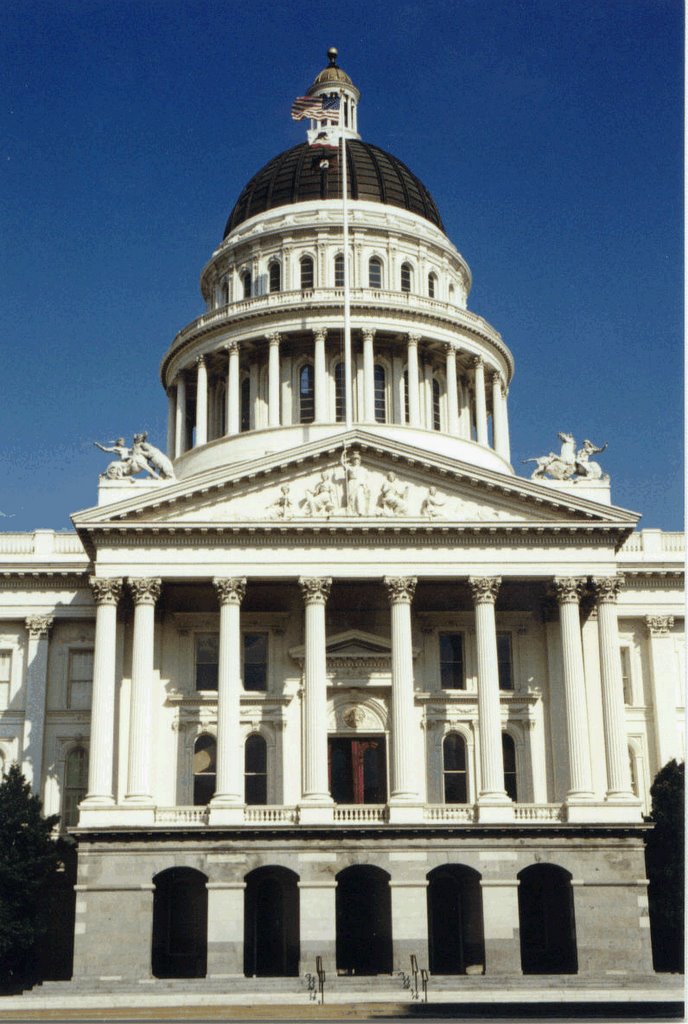
There is work for everyone to do. What will your role be? While I am only a bit player myself, I do have a story to tell. Today I'm a math teacher who ventures in from the political sidelines occasionally to write a letter to the editor, e-mail a candidate's campaign, pony up some contributions, and participate in local rallies. (I'm tall. At one rally a campaign aide gave me the job of holding up a large sign between some banner-waving half-drunk GOP frat boys and the TV cameras. It was fun.) Before getting my faculty appointment, however, I served under the golden dome of the California state capitol as a legislative aide. I watched who pulled the levers of power and I saw some of the techniques they used. These people are accessible by citizens who take the trouble to learn some things about the system and how to work it.

Let me share that with you. First, I'll give you an example of pure serendipity, an infamous story in my academic discipline. After recounting my own initial encounter with the legislative process, I'll generalize a bit and suggest that you, too, can play the part of our humble protagonist.

A wedge of pi

Clarence Waldo did not usually spend his days at the Indiana state capitol building. A professor of mathematics at Purdue University, Waldo was checking in on the progress of an appropriation earmarked for his school. On this occasion in 1897, however, Professor Waldo unexpectedly found himself acting on his mathematical expertise and not just lobbying on behalf of his university's special interest.

House Bill No. 246 offered the state of Indiana the right to use a new and improved value of pi in its public schools—royalty free! Schools in other states would presumably have to pay a consideration and apply to Dr. Edwin J. Goodman (a physician) for permission to use his new value of pi. The debate in the Indiana State Senate was in full swing when Professor Waldo happened to look in, much to his surprise. The State House of Representatives had already passed Bill No. 246 unanimously. Waldo buttonholed some legislators, explained what they were on the verge of doing, and succeeded in getting Bill No. 246 sidetracked. On its second reading in the State Senate, the measure was “indefinitely postponed”; Bill No. 246 languished in the senate's suspense file until it died at the end of the legislative session, never more to be seen or acted upon.

Professor Waldo fell accidentally into the role of citizen lobbyist. His story illustrates how technical expertise in the right place at the right time can nudge the behavior of a legislative body. The story of Indiana's pi legislation shows us what one person can do, but in one significant aspect it fails as a cautionary tale. Bill No. 246 was ultimately trivial and it would soon have been ignored and forgotten had it been enacted into law. Today we face issues of science and technology that could powerfully shape what we learn in school, how our environment will change, and the resources we need to live. We need to find Waldo's successors, but too few of us are inclined to take up the challenge.

We live in the world that government makes for us, whether we participate in that government or not. It's time to participate—and we know where the need is.
Legislators don't know science

It was the late seventies. As the first mathematician with a California legislative fellowship, I expected that my services would be eagerly sought. My experience during the placement interviews taught me otherwise. I quickly learned that the legislators and their staffs didn't know what to do with me. An aide to the chair of the reapportionment committee said, “Well, we do use a lot of numbers.” My training as a problem-solver was assumed to be limited to number-crunching. Eventually, though, I landed in the office of a senior legislator whose staff showed more savvy. One aide laughed at the notion that his counterparts in so many of the other offices thought I wanted to sit and solve math problems all day: “It just seems to me that if you apply for a job in a butcher shop, you must be looking to cut some meat!”

I then proceeded to “cut some meat” for the next couple of years. It was the real beginning of my education in the sausage factory that is our form of government. It wasn't always pretty and it wasn't always important, the bills that were debated and the laws that were enacted, but some of the measures dramatically affected the way of life of millions of California residents (both for good and for ill).

My boss was a classic liberal who thought it was the government's responsibility to protect the rights and freedoms of the individual against the disproportionate power and influence of giant special interests. He held a Ph.D. in history from Stanford and had been a college professor before his election to the legislature. He was one of the last of a vanishing breed.

The gentleman scholar in the mold of Thomas Jefferson no longer appears in the legislative or executive ranks. Although my boss would be embarrassed beyond words to be compared to Jefferson, it is entirely fair to say that he was a man of ideas who was accustomed to thinking things through. As a professor, he had put in many hours expounding on history, political science, and economics, discussing the issues with his students. Today's politician is more likely to pore over the latest poll results than read a treatise on, say, the role of regulation in a free economy. A modern politician's expertise lies in getting elected. All other expertise is relegated to staff aides and consultants.

Very few scholars are elected to public office. In particular, there are virtually no scientists serving as state or federal representatives. Successful scientists, of course, are much too busy applying for grants, doing their research, and writing their papers. Running for office would involve giving it all up. People with science training who don't pursue research careers can find more lucrative careers as consultants in the business sector than as candidates for office. A few may, of course, serve as consultants on legislative staffs, but we're still talking about a relatively small number. I knew good people in California's Senate Office of Research, but they had to keep up with the demands of forty state senators and their legislative committees and staff.

Those who know science best are largely outside the process by which science is funded, regulated, and promoted. The end result is that policies strongly affecting pure and applied research are informed more by political considerations than by standards of scientific excellence. Nowhere has this made more clear than in the wrong-headed federal approach to stem cell research, global warming, and energy resources.

These and other crucial topics in health, education, and welfare underscore the degree to which our potential problems mandate the effective use of government policy to address them. Problems of such broad scope require collective rather than individual action. Government is the instrument for joint action, which is why we cannot ignore it even if we disdain its excesses. The government is controlled by those who bother to take part in it. We cannot surrender it to the know-nothings.

A primer on the three C's

Most states have laws regulating the activities of professional lobbyists, but citizens always have a right to petition their government. If you operate without pay, you do not fall under these regulations. (Just to be safe, you can check what activities fall under your state's rules by checking into your local equivalent of California's Fair Political Practices Commission.)

Anyone who wants to be successful as a citizen lobbyist should keep three key ideas in mind:

Context: Opportunity knocks at unexpected times, so you have to be alert as circumstances change. I once took advantage of the national frenzy over our bicentennial in 1976 to promote in the California legislature the bicentennial of a famous mathematician's birth. In the wake of the fireworks and celebrations to commemorate our 200th year as a nation, it was easy to draw legislators' attention to another bicentennial and get a resolution adopted in the mathematician's honor. When the resolution was featured in a regional newspaper, one of my math professors said, “Is this how the news really happens?” Yes, it is. (And I think it later led to my fellowship at the state capitol.)

Right now northern California has been drenched by a continuous stream of rainstorms, wreaking water damage and threatening levees across the state. It's the perfect time for hydrologists and civil engineers to help their legislators understand what the priorities are, and how best to achieve them. Left to themselves, the legislators don't know. Some of them will simply believe the last lobbyist they talk to, particularly if the lobbyist represents a good source of campaign funds. We have seen especially egregious abuses in the House of Representatives, where the Republican leadership has permitted special-interest lobbyists to write the bills that regulate their own industries. (This is not exactly an innovation. Remember the scene in The Aviator where Pan Am's lawyers provide the language of a senate bill to regulate airlines?)

Content: In the example of the Indiana legislation on pi, the text of the measure was far beyond the mathematical ability of the typical legislator. (In reality it was also beyond that of Dr. Goodman, the sponsor, but that's beside the point.) If the bill's sponsor had not been willing to provide the content of the bill, it would never have been introduced. When an informal advisor to a legislator does the work of providing the language and details of a needed bill or policy, that bill or policy is much more likely to be considered for action. When I sponsored a resolution in the California legislature, the entire body of the measure was cribbed from the proposal I submitted to my state senator and state assemblyman.

Perhaps you know a technical issue in great detail and want to lend your expertise to a legislative solution, but you don't know how to frame it in language that could be incorporated in a bill. That's when you look around for allies, because there are public-interest groups in most areas of concern. If you have mastery of the technicalities, you can work in concert with someone who knows the right words and forms to use. The citizen lobbyist doesn't have to do it all alone.

Credit: The famously liberal Ronald Reagan is reputed to have said, “You can get a lot done in this town if you don't care who gets the credit.” The citizen lobbyist seldom gets any credit for his or her efforts, but that's okay. Your real concern is to get things done. The credit can go to whoever's name is on the piece of legislation that gets enacted into law or the policy that gets announced. What's more, if you're not trying to elbow your way to the front of the crowd, your work will gain credibility. Legislative halls are full of people who want to take credit for stuff. Some of them will regard you as a mark to be taken advantage of when you do most of the work and get none of the acclaim, but you're operating according to a different standard. Success is what counts.

My boss in the state legislature was famous during his tenure in the state senate for his success at shepherding legislation into law, but the truth is that many of his greatest accomplishments carried the names of his colleagues rather than his own. He was a master of the rival bill, a measure introduced to promote his approach to a state issue even when the issue was supposedly “owned” by a colleague. The colleague would keep an eye on my boss's bill, frequently cannibalizing it bit by bit, incorporating its language into his own bill until my boss would pronounce himself satisfied and quietly drop the rival measure. Many statutes in the California code books contain my boss's words but some other legislator's name.

Remember, success is what counts.

Further reading: The sad tale of Indiana House Bill No. 246 is told in Legislating Pi, a chapter of Underwood Dudley's Mathematical Cranks. Dudley points out that Dr. Goodman's definition of pi was so confused and contradictory that it is not possible to tell from the language of the bill (which Goodman undoubtedly wrote) what value he intended. Petr Beckmann gives a detailed accounting of Professor Waldo's successful lobbying in A History of Pi (see chapter 17, The Modern Circle-Squarers). Former California state senate president pro tempore James R. Mills wrote a book about the crucial Brown-Unruh years in state politics. Its title is A Disorderly House and it's out of print, but used-book sellers can easily get it for people who want to know more about California politics from an insider's perspective. Jesse M. Unruh, for whom I was privileged to work in the 1980s when he was state treasurer, presided as speaker of the assembly during the creation of the professional staff system that still supports the work of the California legislature. In an era of term limits, Unruh's staff system now has more continuity and collective expertise than the legislators who rapidly cycle in and out of the state capitol.

Saturday, November 26, 2011

A tale of two churches

Catholicism in transition

This is the weekend when Catholics in the United States begin to use the third edition of the English-language Roman missal, which makes several changes to the text of the mass. It is, overall, a more traditional translation, reinstating such things as the thrice-spoken “mea culpa” (rendered in English as, “through my fault, through my fault, through my most grievous fault”) and reverting to “And with your spirit” as the rendering of “Et cum spiritu tuo” (instead of the more mundane “And also with you”). Except for the hardcore ultramontanes who still pine for the old Tridentine mass in Latin, most conservative Catholics are gleeful, correctly seeing the new translation as further evidence of reactionary retrenchment in the Church—and a further diminution of the influence of Vatican II. Can veils for women be far behind?

In the past few months I have had occasion to step into two Catholic churches. (Before anyone asks, I will note that in neither case did anything shatter or burst into flames.) Both churches are modern constructions and had some notable features in common. In particular, they represented a big step back toward a more traditionally Catholic presentation, a far cry from the nearly featureless dark-paneled rectangular box that is St. Aloysius in Tulare.

I visited Our Lady of the Assumption on the occasion of a Portuguese festa in Turlock. The pastor's brother gave me a tour of the facilities. As someone old enough to have been an altar boy in the days of the Latin Mass, I have seen enough Church history to recognize a regression toward the mean. I told my guide that his brother's church represents a successful fusion of modern construction with traditional decor. My guide beamed, acknowledging that the Portuguese community in Turlock had aimed at that exact result when planning their church.

More recently I joined some family members at Holy Spirit Church in Fresno for the baptism of a nephew. The christening would follow the conclusion of the mass service, so I thought I was safe when I made a late arrival and loitered in the lobby. However, my eagle-eyed sister was too alert for me, noted my presence, and came out to collect me and take me inside. (As previously noted, no supernatural phenomena attended my entry into the sacred circle of mystical incantations and wafer transubstantiation.) The first thing I noticed was that Holy Spirit departs from the traditional parallel rows of pews in the same way as Our Lady of the Assumption. Unlike the Turlock church, however, the Fresno church has placed its crucifix so that it is invisible to those sitting in the side pews. From that perspective, where I was sitting with my sister's family, you might as well have been sitting in an Episcopal church. Holy Spirit's altar was a Protestant-compatible table and I'm sure the motley collection of art screens behind it provided ample peek-a-boo opportunities for the servers (both altar boys and altar girls at the service I attended).

The churches in Turlock and Fresno had another thing in common, and I regret not having any photographs to show you. Both of them have the Stations of the Cross (the “Via Dolorosa”) represented in mural form as a kind of frieze on the interior wall above the main entrance. In traditional churches, the fourteen Stations are usually wall plaques depicting the crucifixion of Jesus, seven of them equally spaced on the north wall and the other seven on the south wall (many old Catholic churches were preferentially oriented so that the altar was at the east end). The mural in Our Lady of the Assumption is dark and stark, graphically conveying the pain and anguish of the Savior's execution. I commented to my guide that it seemed more intense than some parishioners might prefer. He admitted that a few people in the community had lobbied to have the mural painted over after it had been unveiled, but that it was now generally accepted. The artist had had plans for other artwork in the interior of the church, but those had been shelved after the mural of the Stations of the Cross had been judged to sate the community's appetite for the artist's work.

By contrast, the Stations mural in Fresno's Holy Spirit is an exercise in kitsch, a truly unfortunate and distracting collection of excessively bright images in different sizes, cartoonish in conception and execution. The color palette appeared to be inspired by sidewalk chalk. If any venue cries out for disciplined and respectful depictions, I should think a church interior does. While the Our Lady of the Assumption mural pushed hard against the bounds of tradition in its display of angst (Jesus is amazingly serene in most of the crucifixion scenes in Stations of the Cross), the composition had a unity of purpose and conception. The Holy Spirit mural was a collage of disparate scenes united by garish colors and amateurish execution.

The results were occasionally unintentionally amusing (unless the artist was being deliberately subversive). The fifth Station depicts Simon of Cyrene, an innocent bystander, being impressed into service to help Jesus carry the cross lest the condemned prisoner die of exhaustion before the authorities get to nail him to it. The Holy Spirit mural makes it look as though Jesus is copping a feel of Simon's butt. In the tenth Station, Jesus is stripped of his garments. This scene in the Holy Spirit mural is so badly composed that it could be subtitled “Jesus flashes his Roman guards.” Both of the guards have stunned expressions on their faces, so they appear to be quite impressed. I made it through the service without chuckling aloud, but I suspect it looked like I was having a better time than the mass warranted.

It will take a few Sundays for practicing Catholics to work the kinks out of the new Roman missal, but I expect the complaints to be few. Regular mass-goers will quickly pick up on the changes and infrequent attendees (Easter and Christmas, anyone?) won't care. For former Catholics who outgrew religion and “put away childish things,” it's mostly a matter of curiosity and perhaps just a bit of nostalgia. The third edition of the Roman missal is yet another signpost that conservatives are in the ascendant in the Church, but we already knew that, didn't we?

Addendum

In searching the web for photos of the Turlock and Fresno churches, I ran into the following dyspeptic reaction to Our Lady of the Assumption, posted by someone who thinks highly enough of himself to use “St. Christopher” as his handle:
What madness! A Catholic Church that has mostly Portuguese Mass. Oh yes — a TLM [traditional Latin mass] thrown in, at the Chapel at odd times on Sunday. Having cultural loyalty is a fine thing, and Portuguese is a wonderful language — but this focus on whatever is prevalent (Klingon Mass, anyone?) obliterates the meaning of what the Mass is supposed to represent. There is no question but that the Church must return to Latin, and a single, uniform Order of the Mass, as soon as is possible. Let those that wish to participate in something else, go to something else.
Is there any chance that “St. Christopher” might consider taking his own advice? No one is making him attend a Portuguese-language mass. For my own part, however, I think it might be fun to attend a Klingon mass. Once, anyway.

Post-Addendum

The diligent searching of my friend Gene O'Pedia has uncovered a pair of on-line images of the Holy Spirit mural. The colors are more muted in the photos than they appeared to me in real life, but I recognize the compositions and can confirm that these are the Stations of the Cross that I saw in Fresno. Their resolution is not high enough to zoom in too closely on the panels of particular interest, but they can still convey a sense of what I was talking about. The first image depicts, right to left, Stations 6 and 7 (“Veronica wipes the face of Jesus” and “Jesus falls for the second time”). The flat perspective of Station 7 (not Station 5, as I said above) makes it look like Jesus is patting Simon on the behind. The other photo shows Stations 10 and 11 (again, right to left: “Jesus is stripped of his garments” and “Jesus is nailed to the cross”). Again, the resolution is limited, but you can just tell that the two Roman soldiers are gaping at the undraped Jesus in Station 10. It's a fine example of religious kitsch.