Monday, June 05, 2006

Darwin in Davis

Inquiry-based instruction in evolution

The Davis campus of the University of California is one of the largest of the nine general campuses of the state's premier public university, both in area (5,300 acres) and enrollment (30,000 students). Founded in 1905 as the University Farm, an agricultural satellite of UC's flagship campus in Berkeley, UC Davis became a full-fledged educational institution in the 1950s and today awards more degrees in the biological sciences than any other institution in the United States.

One of my younger colleagues is a recent UC Davis graduate in mathematics and math education. He advised me that some of his erstwhile classmates and mentor teachers were participating in a spring symposium to present a progress report on a National Science Foundation research project. The topic was collaborative classroom-based inquiry in K-12 schools. My curiosity piqued, I traveled along Interstate-80 to the university to see what our fellow educators had in store for us. It was worth it.

Naturally I paid a lot of attention to the results of the math participants, who are trying to raise algebra success levels above the traditional (but extremely disappointing) 50% level. One of their more interesting results was that students love to have teachers give them “practice exams” before a test, but that such rehearsal tests have no significant impact on student performance on the real thing. Although topic-specific worksheets were more effective in raising student scores, the students themselves continued to be much enamored of the practice exam. I'll be curious to see what other details the teacher-researchers come up with next year after the third and final year of the NSF-sponsored investigation.

It stood to reason that there would be a major biological component to an education research project based at the old University Farm, and we were not disappointed. I pricked up my ears when I heard the title of the biology teachers' presentation: Facilitating student understanding of evolution through the synthesis of Darwinian arguments. It must be nice to be in California! Although there is a localized creationist infestation in Roseville, only about 35 miles away, at least UC Davis doesn't have to worry about an ID-obsessed state board of education or creationist pressures from its Board of Regents.

The biology component of the NSF project was conducted by teachers at Dixon High School, a rural secondary institution just a few miles from Davis. The two instructors had a heterogeneous student population in grades 9 through 12. They were particularly concerned by the low level of scientific literacy manifested by their students and hoped to inculcate principles of “scientific argumentation,” which they described as “supporting conclusions with evidence,” as opposed to bald assertion or appeals to authority. The teachers knew that evolution is often poorly understood by their students and they had designed lessons for a four-week unit devoted to scientific argumentation about biological change.

The teachers explained to us that at each stage during the evolution unit they gradually withdrew more of the supporting components of the lessons, giving them an opportunity to judge the degree to which the students were generating the arguments themselves or just following a template. The first two lessons (lizards and Galapagos tortoises) were complete with a model of the components of Darwinian natural selection, reiterated instruction on modes of argumentation, and repeated opportunities to synthesize Darwinian arguments based on authentic observations of biological change. The Darwinian model was reviewed during the third lesson (polar bears), but no example model was given. During the lesson on pigeons, which was given during the fourth and final week, the students were on their own, relying on their earlier work.

The students produced and submitted written arguments to their instructors for each lesson. The teachers subjected the arguments to an evaluation rubric that judged the arguments on their quality (sketchy vs. elaborate) and logic (consistent vs. inconsistent), as well as compatibility with recognized biological principles. To no one's surprise, the teachers discovered that most students have trouble providing evidence for their conclusions. However, the lessons were successful in fostering improvement in the students' argumentation skills. At the end of the four-week curriculum, 57% of the students were writing arguments compatible with principles of natural selection (versus only 30% at the mid-point) and their arguments became both more elaborate (detailed) and higher in quality.

The teachers gave a PowerPoint presentation from which I drew most of the items in this post, as well as a printed abstract containing the following lines:
Students were able to synthesize arguments compatible with accepted scientific thought immediately after receiving direction instruction, but required three additional opportunities to synthesize Darwinian arguments before generating compatible arguments independently. These findings demonstrate that reiterative instruction, models of scientific arguments, and opportunities to synthesize arguments based on authentic observations of natural phenomena can facilitate student understanding of biological concepts.
At the end, though, many students still did not grasp the essential notion of evolution. As one teacher-researcher told symposium attendees, several high-schoolers continued to confuse Darwin's idea of natural selection with Lamarck's idea of acquired characteristics. Given the trouble that most adults have with evolution, it's actually encouraging that the high school students did as well as they did. The teachers already have some ideas on refinements to their curriculum, which they'll be testing during the next academic year. I have but little doubt that at some point there will be publications in education journals on the Dixon High School investigations. I'll keep my eyes open for the announcement of the symposium that I expect to mark the end of the NSF research project next spring, probably near the end of May. It should be worth attending.

Note: Educators who are interested in finding out more concerning the Collaborative Classroom-Based Inquiry Project should contact the UC Davis School of Education. The principal investigator is science education professor Cynthia Passmore.

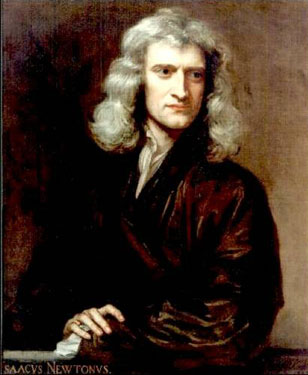
Sir Isaac Newton, feminist?

Newton won't bite that apple!

This weekend I read a book just because everyone else is doing it. To me, this is one of the least persuasive reasons for reading a book. My friends can tell you that keeping up with current fads is at the bottom of my priority list (though why should you accept the testimony of such a small group of people?).

In this case, however, I have many excuses, the main one being that Dan Brown's The Da Vinci Code relates to topics (religion, Catholicism, codes) that are actually interesting to me. When a friend lent me a copy of the book at last Friday's lunch group, I buckled down and dashed through it. The experience was relatively painless. I found The Da Vinci Code entertaining, cleverly plotted, and often amusing (although not always in the places that Dan Brown probably intended).

My opinion on Brown's sincerity in his promotion of a suppressed feminist past for Christianity is unimportant. There are certainly many misrepresentations of historical fact (e.g., Constantine created the Bible, the Council of Nicea first promulgated Christ's divinity), but fiction writers are specialists in pretense. Edgar Rice Burroughs took pains at the beginning of Tarzan of the Apes to depict himself as merely the editor of a mysterious manuscript that had come into his possession:
I had this story from one who had no business to tell it to me, or to any other. I may credit the seductive influence of an old vintage upon the narrator for the beginning of it, and my own skeptical incredulity during the days that followed for the balance of the strange tale....

I do not say the story is true, for I did not witness the happenings which it portrays, but the fact that in the telling of it to you I have taken fictitious names for the principal characters quite sufficiently evidences the sincerity of my own belief that it may be true.
Sir Arthur Conan Doyle did the same thing with his tales of Sherlock Holmes, just as Laurie King continues the tradition today with her own contributions to the Holmes legend. Dan Brown is in good company.

Good fiction requires plausibility, of course. If the reader can't suspend disbelief, the novel fails. If the reader explodes in incredulous laughter, we may reasonably infer that a faux pas has been committed. I can cite two such instances. One is Professor Langdon's lecture on phi, the Golden Ratio, a risible episode which I will save for a later commentary. The other is not entirely Brown's fault, although he falls into the trap of making it a significant plot point.

I refer to the inclusion of Sir Isaac Newton in the list of grand masters of the Priory of Sion. Given the Priory's supposed role in preserving the shocking secret of Jesus Christ's marriage to Mary Magdalene and her intended role as leader of the Church, Sir Isaac is one of the unlikeliest candidates imaginable for the job of grand master. A lifelong bachelor and overt misogynist, Newton would have been horrified at the notion that Christianity's true history included equality between the sexes. At least once, during what may have been a spate of mental aberration or melancholy, he directed paranoid rages at friends, apologizing at one point to John Locke for declaring “that you endeavoured to embroil me with women.” Imaginary or not, it seems that Newton numbered matchmaking among the cardinal sins.

Historians tend to agree that Newton died a virgin and that he may have been the kind of repressed homosexual who remains compulsively unattached throughout life. In any case, the “repressed” seems apt. One might expect that a requirement for the position of grand master of the Priory of Sion would be a robust heterosexuality, especially in light of the essential role of hieros gamos in the sect:
Langdon had read descriptions of this ceremony and understood its mystic roots. “It's called Hieros Gamos,” he said softly. “It dates back more than two thousand years. Egyptian priests and priestesses performed it regularly to celebrate the reproductive power of the female.” He paused, leaning toward her. “ And if you witnessed Hieros Gamos without being properly prepared to understand its meaning, I imagine it would be pretty shocking.”
No doubt Newton would find it so! One might also, therefore, question the role of Leonardo Da Vinci, who filled his art and his sketchbook with portraits of his favorite male model, the “little devil” Salai. There are definite problems with the roster of grand masters of the Priory of Sion.

One final thing, this one more of a head-shaker than a belly laugh. Langdon and Neveu roam London in search of “a knight a Pope interred,” at first not realizing the reference is to Newton, over whose funeral Alexander Pope presided. The second line of the poetic clue is “His labor's fruit a Holy wrath incurred.” Although I'm not especially good at mystery novels, I had already twigged to the fact that it was a reference to Alexander Pope, Sir Isaac Newton, and his famous apple, although I was put off the scent a bit by that “Holy wrath” business.
“Newton is buried in London,” said Langdon. “His labors produced new sciences that incurred the wrath of the Church.”
Excuse me, Mr. Brown, but are you confusing Sir Isaac with Signore Galileo? Newton incurred no Church wrath. His works in mathematics, optics, and physics were epochal, but they provided a new foundation for the system of the world rather than upsetting the existing order. The Church of England had no complaint with him (provided he kept prudently quiet about his unitarian tendencies) and he was beyond the reach of the Roman Catholic Church (to which “Church” usually refers in Brown's novel).

No, Isaac Newton doesn't fit Dan Brown's scenario very well at all.

Saturday, June 03, 2006

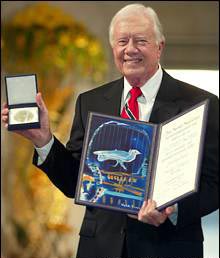
Cashing in on Jimmy Carter

Shake the right-wing money tree

Clio is notoriously fickle. The muse of history frequently changes her mind about the men and women she records in her diary. In the longer run, however, her opinion tends to settle down a bit. In recent times, Clio has been warming up to Jimmy Carter, who once seemed a strong contender for worst president ever.

Carter has been helped by two major factors. His much-maligned energy policy, with its emphasis on conservation and alternative fuels, is now seen as visionary. When an oil-stained wretch like George W. Bush feels forced in the light of current circumstances to give lip service (though little else) to alternative fuels, you know a seismic upheaval has occurred. Bush himself, of course, is the second factor: a president of such breathtaking incompetence and mendacity that people are now nostalgic for the virtues they once mocked in the peanut farmer from Georgia.

No doubt today's circumstances are a nightmare to the right-wing parasites who cling like unsated leeches to George Bush's body politic. Where will they suck up their sustenance if their host is running dry? In the great tradition of the classic Republican ploy “Look over there!”, some of the conservative extremists who wagered on Bush's continued success are now hedging their bets by seeking to milk the paranoia of the ignorant masses who propelled Reagan and Bush into office. To this end, they are trying to resurrect the old animus toward Jimmy Carter and exploit his status as a long-time bête noire of the right.

Melanie Morgan of KSFO radio in San Francisco, a hectoring voice of right-wing extremism throughout the Bay Area, is one of the leaders of a campaign to censure Carter. She and her allies accuse the former president of what amounts to treason:
Since leaving office, President Jimmy Carter has repeatedly undermined U.S. foreign policy, criticized the missions of the men and women of the United States Armed Forces, as well as embracing known terrorists and terrorist organizations.
Given that Bush's foreign policy has consisted of unilateral and irresponsible adventurism at the expense of our armed forces and the national treasury, we should be grateful there are still some adults around to criticize it. Morgan, however, prefers to use Carter's opposition to the Bush administration to do a little fundraising. She and former California assemblyman Howard Kaloogian created Move America Forward as a lobbying group whose ostensible purpose is to rally public support for the troops (as if anyone is actually against our men and women in uniform, in a clear distinction to being opposed to our commander-in-chief). While Move America Forward tried to garner media attention with publicity stunts such as a national tour in opposite to Cindy Sheehan (the “You Don't Speak for Me, Cindy” road show), the participation of Howard Kaloogian was certainly a negative component of its effort. He tried to use his position in Move America Forward to promote his candidacy for a congressional in the special election to succeed convicted felon Duke Cunningham. He drew unwanted attention, however, after posting a picture taken in Turkey on his campaign website and claiming it was evidence he had toured a pacified downtown Baghdad. Having been exposed as either an incompetent or a liar (or at least someone who employs same), Kaloogian garnered a mere 7.4% of the vote in April's special primary election.

In a flurry of May e-mails to the Move America Forward mailing list, Morgan hyped the supposed progress of the Censure Carter effort: “The Censure Carter campaign is about to make a lot of noise.” While the Move America Forward junk mail campaign continues, it may be having trouble gaining traction with such items as the “Bush Was Right” music video. (Although pretty funny, it's not an intentional comedy skit. The music is performed by the Right Brothers, who sing of our glorious leader's “successes” in foreign and domestic policy.) Just as with Move America Forward, each Censure Carter message concludes with a solicitation for funds. Some of them even begin with money-begging. Here's the subject line of the May 18 e-mail: $3,127 to Stop “Blame America First” Liberal.

Is it all about the money? Frankly, I think that Melanie Morgan is probably a completely sincere right-winger who abhors Carter and wishes she could have George Bush's bastard children. But, yes, it's also all about the money. Look at what she's doing with it:
On Sunday, May 21st we will have a Censure Carter message delivered in an email message sent to over 350,000 subscribers to the online news journal, Newsmax.

On Monday, May 22nd we will launch our TV ad blitz on the CNN and CNN Headline News television networks reaching several hundred thousand households.

Also on Monday we will launch online "Censure Jimmy Carter" banner ads on the Drudge Report and Human Events Online websites.
Excuse me, NewsMax? Who reads this purveyor of faux news except for committed rightists and the occasional slumming liberal? (I confess!) Talk about preaching to the choir! The exact same thing is true for Drudge and Human Events. These sites would have promoted Melanie Morgan's campaign for free, treating it as if it were a legitimate news story. (In fact, they have.) If it weren't for the spots on CNN, the Censure Carter campaign would be doing nothing more than shaking down the paranoid brethren for more contributions.

When the steam runs out of the Censure Carter effort and the contributions slow to a trickle, what will the stalwart right-wingers do next? No doubt Melanie Morgan and friends will have something to say about the California governor's race, although they're not big fans of Arnold (but his opponent will be a liberal! maybe even a devil worshipper!). Since Arnold is not a pro-lifer, perhaps Morgan will focus on the parental notification initiative that California voters rejected last year but is being recycled by its proponents. I do hope that Morgan stays active in politics, because her support is always a reliable indicator that something is worthy of opposition.

Friday, June 02, 2006

Alastair cracks a joke

In space, no one can hear you giggle

I am working my way through Alastair Reynolds' Redemption Space series of science fiction novels. As I mentioned in an earlier post, I like Alastair's hard-science bent and his ability to build it into his plots, instead of using it as mere gee-whiz embellishment. In that same post, I sadly reported on the egregiously abused science in a young-adult sf novel that I had read in grammar school, namely, comets of flaming gas and sound waves propagating through vacuum. It's like spacecraft roaring across the screen in cinematic space operas, complete with ear-shattering explosions in full Dolby Digital sound. Fun, perhaps, but bogus.

Near the end of Redemption Ark, I found Reynolds slipping a sly barb into his prose. Let's join Antoinette Bax on the bridge of Storm Bird as her spacecraft approaches a battle scene where dozens of smaller craft are swarming about a huge interstellar vehicle:
Pinpricks of light within the swarm signified smaller armaments detonating, and very occasionally Antoinette saw the hard red or green line of a laser precursor beam, caught in outgassing air or propellant from one or other of the ships. Absently, cursing her mind's ability to focus on the most trivial of things at the wrong time, she realised that this was a detail that they always got wrong in the space opera holo-dramas, where laser beams were invisible, the sinister element of invisibility adding to the drama. But a real close-range space battle was a far messier affair, with gas clouds and chaff shards erupting all over the place, ready to reflect and disperse any beam weapon.
What do you think? Could it happen this way? We always have among us the hypercorrect, the type who insist on saying “between you and I” because it sounds formal, never realizing how wrong it is. Perhaps one day they'll be making sf movies in just the way Ms. Bax anticipates. But stuffy enough to forgo dazzling light effects just because they once heard that vacuum doesn't scatter photons? Probably not.

Thursday, June 01, 2006

Contextual Comics: Lío

Shared experience is funny!

Don't snort Cheerios. It's bad for you. Of course, that's one of the risks naturally attendant on the practice of reading the comics while spooning up breakfast. Beware.

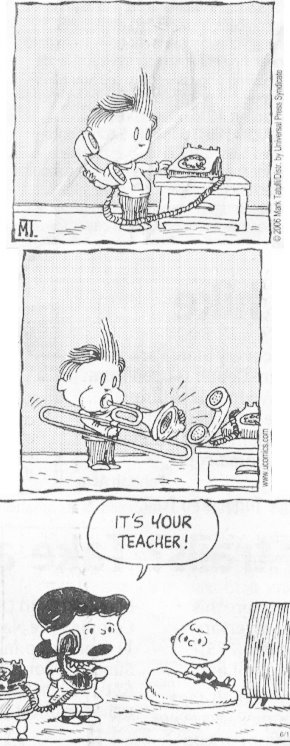
My loudest laughs this morning were provoked by Lío, a new comic strip by Mark Tatulli. Lío debuted in May with more than 100 newspapers participating in its launch. The June 1 installment showed Lío, the little boy who provides the strip's title character, placing a crank call to Charlie Brown of Peanuts fame. First I laughed. Then I started thinking.

Humor is highly situational. Not just the situation described in a joke or depicted in a skit or drawn in a comic strip, but also the situation of the participants in the humor, the joke-teller, skit-actor, comic-strip artist, and the person who hears the joke, watches the skit, or reads the comic strip. We're all in it together and the impact of the humor depends crucially on our shared experience. You don't “get it” unless in some respect you already have it.

The Lío strip was composed of several layers. Let's peel them apart and consider for a moment what you needed if you were going to laugh at the punch line.

A kid playing a trombone into a telephone is pretty funny all on its own, so there's a visual gag almost anyone can appreciate. Hmm. Why the mute? What's going on with that? It's funny to see Lucy Van Pelt and Charlie Brown in the last panel, the cartoonist's homage to Charles Schulz, but what does it take to catch the real gimmick of the comic strip? The reader must not only recognize the Peanuts characters, he or she must also have seen and remembered at least one of the many animated Peanuts programs that appeared on television. It was only in the TV programs and not in the comic strip that the wah-wah sound of a muted trombone was used to represent the voices of the off-stage adult characters (especially the teacher in the frequent classroom scenes).

Lío is asking a lot of its readers, but it's talking to my generation. After decades of reading Peanuts comic strips and no doubt dozens of viewings of animated Peanuts specials (A Charlie Brown Christmas, etc., etc.), I was perfectly prepared for cartoonist Tatulli to push my buttons, as indeed he did. Humor is conditioned by our shared experiences, which is something to keep in mind the next time you try to tell a joke and someone just doesn't get it. It might not be your fault.

There were two other things I noticed about this installment of Lío. Although the strip is less than a month old, it's already departed from its announced format:
First LIO has no dialog. It tells stories only with images—a “pantomime strip” says Mark Tatulli, the creator.
As you can see, today's strip definitely contains dialogue. If the aim was to make Lío a universally entertaining comic strip, independent of language, it seems that Tatulli has given up on that goal rather quickly. I noticed, however, that the “only with images” claim had already been breached in other ways. In the Sunday strip where Lío is enjoying a stimulating round of The Game of Life with a morose Death, we're expected to read the name of the game from the label on the box. In the daily strip where a spider helps Lío ace an exam, we're supposed to understand the meaning of “A+” on his paper. Trying to do it all with sight gags is apparently too much of a straitjacket for Tatulli. I can hardly blame him, but his publisher, Universal Press Syndicate, may have put the cartoonist in a tight spot:
“The fact that there is no dialogue and that everything is art-driven is exceptional,” added John Vivona, vice president of sales at Universal. “If there were ever a strip that knew no demographic boundaries, this is it.”

Universal also thinks “Lio” has strong international potential because there are no language barriers. So far, the Brussels, Belgium-based Bel De Morgen newspaper has picked up the comic.
Do they give letter grades in Brussels?

I said I noticed two things, the first being the prompt lapse in the original premise of the comic strip. The second was the appearance of Charlie Brown and Lucy in that last panel. In particular, Lucy's depiction conforms to the earlier Lucy model of the 1950s rather than her later look. Check it out. I think Tatulli made a deliberately retro choice and it adds charm to his strip. If you share my experience of having seen the Peanuts characters in the newspaper when they were brand new and before they had become a cultural phenomenon, perhaps you'll agree.

I look forward to future appearances of Lío in the funny papers, pantomime or not. This is clever stuff.

Tuesday, May 30, 2006

Markos in Sacramento

Crashing the state capital gate

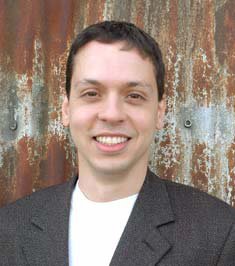
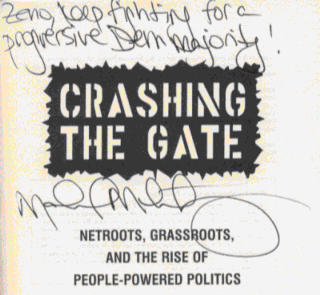
Markos Moulitsas Zúniga ended his promotional tour for Crashing the Gate in California's state capital today with a book signing at Tower Books on Broadway. I visit Markos's eponymous site, DailyKos, at least once a day. It's not easy to keep track of all of the posts and diaries on the left blogosphere's most active site. In fact, it's not really possible. You do well to skim it on a regular basis. When I checked in this afternoon, I saw the note posted by Markos about his trip to Sacramento. I immediately adjusted my schedule accordingly. (Good thing the spring semester is over and Sacramento's not too far away!)

Tower Books on Broadway in Sacramento is the flagship of the Tower world empire, now a fading shadow of what it once was. I had not been there in ages, although I used to haunt the place in its glory days. When I worked at the State Capitol in downtown Sacramento, more than twenty years ago, I loved to stop in and browse the books on my way home. Lots of the older books on my shelves are from Tower, but Tower has no bookstore where I live now and it's easier to go on-line for books and CDs and DVDs. It was a nostalgic return visit. I picked up a copy of Crashing the Gate while I was there, of course, along with copies of Eric Boehlert's Lapdogs: How the Press Rolled Over for Bush, and Ethan Rarick's California Rising: The Life and Times of Pat Brown (California's last successful progressive governor).

I don't think the locale was intended to be a metaphor for the sorry state of progressive politics today, but that thought persisted in the back of my head. A few dozen people turned out for Markos's appearance, overflowing the folding chairs that had been set up and prompting the Tower staff to set out a few more seats. Some of us got our books signed early, as Markos casually chatted with people and waited for the time to begin his presentation. He opened by remarking that the Sacramento crowd was the first (in some forty cities) to be in place on time; he was more accustomed to waiting till ten minutes after the announced time before he could begin. We weren't sure whether it was praise or not (and Markos probably didn't particularly mean it one way or the other).

He launched into his well-practiced patter concerning the plight of progressives in today's neocon-ridden political environment, castigating the poobahs of old-school Democratic campaigning for becoming complacent with their role as losers. Traditional campaign consultants manage losing candidates and then go their merry (and well-remunerated) way to advise other defeat-doomed Dems. What does it take to lose one's credibility today? It's sad. And pathetic.

Markos castigated ossified political bureaucracies such as the Democratic National Committee, too laden with careerist hacks to ever stir up the troops into winning electoral battles. Howard Dean may be shaking it up somewhat, but old habits die hard. Markos cited the example of a friend who went to work for the DNC full of optimism that Governor Dean would make things right, but lasted only six months before he felt he had to decamp.

The book Markos coauthored with Jerome Armstrong (of MyDD) is a political manifesto, highlighting the continuing failures of the old way of doing things and pointing the way to generating a vigorous political renewal by means of communications. It's not just blogs, said Markos, but also other devices like cell phones that will drive political activism in the future. In fact, it's already happening, since cell phone contacts were a key tool in generating the massive and essentially spontaneous demonstrations against the anti-immigrant legislation sponsored by the House Republicans. (Let's be clear here: “Spontaneous” means “natural”; it doesn't have to mean haphazard or disorganized.)

During the Q&A session, Markos was asked about getting young people involved. That's an area where political organizing via text messages will be a key tool. Markos mentioned that minority youth were especially partial to cell phones, demographic data showing that the largest percentages of cell phone users were among young Latinos and African Americans. I asked him which candidates were the best role models in their use of websites to promote their campaigns. Markos singled out Mark Warner and his Forward Together political action committee, whose site is the work of Jerome Armstrong. “I know Jerome, so I know that's the best one,” said Markos.

We were also treated to a small example of the time-wasting quibbling that occurs when the old politics doesn't quite understand what the new politics is trying to say. Markos expressed his concern about the special election in California's 50th Congressional District, where Francine Busby is waging a fierce campaign to succeed disgraced Republican Representative Duke Cunningham. He mentioned that off-year elections tend to draw only the hardcore political activists and that the 2006 turn-out data was bearing that out in the elections held so far this year. The results of such elections are therefore a measure of whose base is more fired up. In that sense, Markos continued, Busby's votes in the first round of voting was disappointing because she was unable to get a bigger percentage of the votes cast in the 50th Congressional District than John Kerry had achieved in last year's general election. If the Democratic base was more inspired than the GOP base, then Busby should have garnered a higher percentage (even if the actual vote totals were smaller). A long-time Democratic Party worker took Markos to task and said that there was no way that Busby could have gotten a bigger vote than Kerry because it was a special election, and special elections always have low turn-outs. Markos tried a couple of times to explain that he was talking about percentages, but couldn't get it to stick. Amid general and growing grumbling in the audience, Markos gave up and moved the discussion to other topics. It was an exasperating incident and a microcosmic representative of a larger problem, I think.

A whole new ball game

One attendee wanted to know whether web tools and modern communication could be used to shut down the country in one-day wildcat strikes, such as one he had witnessed in Italy a few years ago. Markos described the idea as old-style politics, the sort of thing that might have worked when labor unions were strong. However, the protests against anti-immigration legislation provided a modern model of activism in which self-organizing groups had spilled into the streets in big demonstrations that attracted media attention. Markos was pretty certain that the mass media of today would shrug its collective shoulders at an effort to call a national strike, but they were nonetheless fascinated by the scope of the national protests on immigration policy. The media are unfortunately hung up on spectacle, but if it takes stunts to get their attention, then stunts must be provided. He recounted how the office of Senate Democratic Leader Harry Reid has complained to him that no one covered their press conferences, to which Markos replied that press conferences were too ordinary and dull to attract the desired attention. A better example, unfortunately not yet repeated, was Reid's shut-down last year of the Senate, which was a dramatic gesture that no one could ignore. That's the sort of media-savvy approach the Democrats need today. And that's the kind of thing that Markos and his netroots allies are trying to provide.

Markos gave one example of the power of net media that I had difficulty following because it was full of names I didn't recognize. His good friend Tyler Bleszinski operates Athletics Nation, a blog devoted to the Oakland Athletics baseball team. Apparently there was a furore over the owner's decision to trade a couple of pitchers. Markos said that the uproar faded away quickly when the usual sports media were bypassed and some guy named Billy Beane went directly to Athletics Nation to lay out the reasons for the decision. Once the hardcore fans were placated, the air went out of the “scandal” balloon. (Full disclosure: The only professional sports event I ever attended was an Oakland Athletics home game at the Coliseum. I think the other team was the New York Yankees, but I'm not sure. It was a family outing back in the days when I was a teenager and I was dragged there by my father, who found it difficult to comprehend why this special “treat” bored me to tears. I spent the entire game reading a copy of the Oakland Tribune, which I was able to get from a news rack in the stadium. I read it cover to cover, including the classified ads, skipping only the sports section. Ah, purgatory!)

A recurring theme of Markos's presentation was that only close attention to day-to-day work can lead to success in the long run. In the shorter term, get out there and vote on Tuesday if you're in California or another primary election state. There's Francine Busby's election in CA-50 as well as propositions and candidates to vote on. And don't neglect the down-ballot stuff, because long-term plans are built in short-term stages, and one of the most important short-term considerations is who we choose for school boards and city councils. As Markos warned us, those candidates will be tomorrow's congressional and gubernatorial candidates. If we make sure progressives win today, they can provide the strong bench we need for success in the future.

The truth about atheists!

Did you know they're godless?

There's been another round in the never-ending battle between believers and nonbelievers. P.Z. Myers aimed some pointed barbs at Rabbi Avi Shafran, who has resurrected the old argument that morality comes from God. In short, atheists are capable of most any atrocity because they do not, by definition, “fear God.” This is a wonderfully straightforward and simple argument. It is also simple-minded.

We've all see Shafran's argument before. It keeps popping up in various guises, most of them pretty transparent. I was reminded of a particularly cloying example that appeared in the pages of a Central California newspaper at the end of 2004. A student at Fresno State University had submitted a letter to the editor of his hometown paper. I was in the area for a visit to my parents for the Christmas holiday. Thus I was privileged to read the following closely reasoned essay (the reference to PG near the end relates to a local nonbeliever who writes frequently to the newspaper):
A look at atheism using logic

As I am currently typing this letter, siting [sic] in the computer lab at Fresno State and with the fall semester now over for me, I have come to learn a lot of new things in life.

One of the biggest lessons came from one of the most difficult philosophy classes on campus called ethical theory. I learned that it is meaningless for an atheist to claim to be moral without some interacting force, namely a loving God.

I have also come to learn that the Ten Commandments are the basis for human morality without having destruction in society. The last part of the Ten Commandments are boiled down to Jesus's words that we should love our enemy as ourselves.

As a student in Professor W's philosophy of religion class, I found it amazing that Christians are the only group professing these standard morals for society, and these Ten Commandments were not only kept with the advent of the new covenant but simplified by our savior Jesus Christ.

Taking ethical theory has taught me that to claim to be a moral atheist is as meaningless as it gets as there is no intervening force that makes it solid what philosophers call “analytic a priory” [sic]), since morals are determined by human reasoning alone. And as I have learned there are many cultures that approve of sexual and physical abuse, and even murder by their own reasoning.

No one has to be believe [sic] in a loving God, but the main lesson has been told, which to claim to be moral without a belief in God is meaningless.

Philosophically, there are three logical proofs for God's existence. One is the theological argument or the great design theory which is commonly appealed to by many people. Another is the cosmological argument which was appealed to the other day, which is there is no uncaused cause.

Lastly, I want to comment on the problem of evil, and the name calling by some atheists. If everything was perfect then we could not have free will, since our happiness would always be determined. By having evil we come to repent our sins. If one still does not choose to believe in God or they are pluralists like [Professor] W, then having evil lets us work for something in life.

But let me mind the atheist again. They have no morals whatsoever when they claim to have it since their morality has no solid support. Secondly, it is wrong to be putting down one's faith-based belief, and this is a very evil activity, although it looks like PG (don't get me wrong—Christians are sometimes guilty) has calmed down in the past couple of months. He still needs to be corrected.

Shawn C.
See, this is what book-learning can do to you!

As a professor myself, I could not resist getting a little didactic on Shawn's ass. Here's the body of my letter, published a few days later:
Shawn says, more than once, that he has now learned that “to claim to be moral without a belief in God is meaningless.” Apparently he now believes that the nonbelievers in his neighborhood are kept from heinous behavior through mere laziness or perhaps fear of the police power of the state. How fortunate for us all. But isn't more logical to believe that agnostics and atheists share with believers a preference for a well-ordered and moral society?

Shawn also claims to have learned that only Christians espouse the philosophy that “we should love our enemy as ourselves.” Although it is good to hear that Shawn presumably wholeheartedly loves nonbelievers, I doubt that his professors at Fresno State taught him that the golden rule is unique to Christianity. Even the simplest Google search reveals that the golden rule is honored in Buddhism, Hinduism, Islam, Judaism, and other religions. Confucius, for example, said “Do not do to others what you would not like yourself.” It's worth noting that both Confucius and Buddha predate Jesus.

By the use of rigorous logic, Shawn concludes that “If everything was perfect then we could not have free will, since our happiness would always be determined.” This simplistic equation of perfection with determinism suggests that in a perfect world Shawn would not be able to choose what to have for dinner, since only the perfect choice would be possible. A more interesting consequence comes from the fact duly recorded in the Bible that Adam and Eve had free will. The power of free will was given to them by their Creator, so it follows that God created an imperfect world. Shawn may want to talk to God about that.

I presume Shawn is in the early stages of his education at Fresno State, so there is still hope for him. He can take some nice classes in logic from the math department and round it out with comparative religion from the philosophy department. In the meantime, a little Christian humility can keep him from beating his breast in public like the Pharisee in Luke 18.

Professor Zeno
As it says in the Good Book (I mean Shakespeare, of course), “The devil can cite Scripture for his purpose.”

Saturday, May 27, 2006

Statistics: Math for self-defense

The Newsweek fiasco, 20 years later

I need to teach statistics again. It just hasn't fit into my academic schedule very well in recent years (which needed to accommodate my graduate classes at a nearby university), so I've been teaching lots of algebra. I make no apologies for algebra, which is your essential passport to math, science, and engineering classes, but statistics has a special cachet all its own.

It's not just that statistics is a discipline distinct from mathematics, although its underpinnings are highly mathematical. No, the special quality of statistics lies in its immediacy. We are bombarded by numbers, from the proverbial “three out of four doctors recommend” to the polling data that flood into our daily news media. (Quick! How unpopular is Bush today?) Marketing people understand that quantitative sales pitches (“preferred 2 to 1”) carry more weight than qualitative statements (“better than the others”), and so they assault us with numbers. Numbers are powerful. People armed with statistics are better able to understand the numbers and give them appropriate weight. Statistics is math for self-defense. Get some.

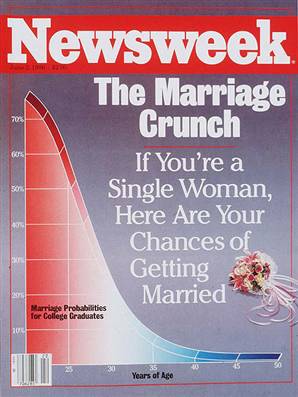
I am reminded of the impact of statistics by Newsweek's 20th anniversary mea culpa. What are they apologizing for? Simply one of the most egregious statistical statements ever perpetrated on a vulnerable public:
[M]any women who seem to have it all—good looks and good jobs, advanced degrees and high salaries—will never have mates. According to the report, white, college-educated women born in the mid-'50s who are still single at 30 have only a 20 percent chance of marrying. By the age of 35 the odds drop to 5 percent. Forty-year-olds are more likely to be killed by a terrorist: they have a minuscule 2.6 percent probability of tying the knot.
That quote from the latest Newsweek is a faithful account of what the news magazine reported in Too Late for Prince Charming in its June 2, 1986, issue. The impact was cataclysmic.

That copy of Newsweek remains safely stashed in my office, two decades after it originally arrived in my mail box. I haul it out as Exhibit A whenever I need to show my statistics students the benefits they might derive from mastering the course material. While statistically competent women gave the story a well-deserved raspberry, the more innocent experienced stark panic:
“Everybody was talking about it and everybody was hysterical,” says Bonnie Maslin, a New York therapist.
Now that Newsweek has beaten its chest black and blue in penitence, shall we forgive them? That's up to you. It is, of course, the perfect opportunity to revisit old wounds and beat up on the ludicrously incompetent reporters who penned this travesty. They deserve it.

For my part, however, I'd like to take a moment to consider a simple calculation—well within the ability of any competent adult, I hope—that would have instantly exposed the spurious nature of Newsweek's claim. Look at the number: 2.6%. If you were a college-educated single woman forty years of age or older, that was supposed to be your chances of getting married. You were allegedly more likely to be blown up by terrorists. How many women were in this demographic cohort in 1986? After noodling around at bit at the website of the U.S. Census Bureau, I found a table for March 1985 data on years of school completed by various demographic categories. It's not a perfect match for our question in terms of the age groups it provides, but close enough for a back-of-the-envelope calculation.

According to the U.S. Census Bureau, in 1985 there were 216,000 single women in the 35 to 54 age cohort with 4 years of college education and 289,000 with 5 years or more. In the 55 to 64 age cohort, there were 39,000 single women with 4 years of college education and 55,000 with 5 years or more. If you add all of these up, you get 599,000 single women with college educations between the ages of 35 and 64. If you have a better than 2.6% chance of getting blown up by a terrorist, we should expect at least 15,574 woman as casualties.

Even allowing for that fact that we weren't supposed to include women between 35 and 39 in our sample, I think we can draw a lesson from our bit of number crunching. If you had told a college-educated single woman over the age of 40 that she would be less likely to find Mr. Right than to be one of the nearly 16,000 American women doomed to destruction by terrorists, I hope her reaction would have been incredulity: “Sixteen thousand? Are you crazy?” Maybe not crazy. Just very, very silly. And innumerate.

If you want even more information on the infamous Newsweek article and comments on its twentieth anniversary, you can check out Newsweek's own retrospective, a detailed post at Feministe, and an article by Jeff Zaslow (cited in the Feministe piece).

Let me give the last word to one of my statistics students, who looked at the original Newsweek article and quickly caught on. With mock concern in her voice, she cried out: “I'm more likely to get blown up by a terrorist?” She paused for a long pensive moment. Then she said, “Would he at least be a cute terrorist?”

Hey, another research question!

Friday, May 26, 2006

I don't hate Bush

No, I just despise him

The president's shrinking cohort of defenders still love to use the “Bush hater” epithet to dismiss the attacks of critics. The label is losing some of its potency as more and more people realize how bad a president Bush is, but it's long been a misnomer. I have never hated Bush, but I have long despised him. Check out the significant distinction with a little help from Merriam-Webster:

Main Entry: hate
Function: verb
transitive senses
1: to feel extreme enmity toward [hates his country's enemies]
2: to have a strong aversion to : find very distasteful [hated to have to meet strangers] [hate hypocrisy]
intransitive senses: to express or feel extreme enmity or active hostility

Main Entry: de·spise
Function: transitive verb
1: to look down on with contempt or aversion [despised the weak]
2: to regard as negligible, worthless, or distasteful

There. Does that help? While I may hate (have a strong aversion to) the president's policies, I do not hate (feel extreme enmity toward) the president himself. No, him I merely despise (look down on with contempt). I realize that it is possible to hate and despise Bush at the same time, a feat he has worked hard to make easier for millions of Americans, but I prefer to maintain the distinction. After all, the term “Bush hater” is meant to imply an irrational animus that drives out dispassionate thought and reason. But we have reasons, all right.

The administration is dishonest. Fundamentally dishonest in all of its respects. The Bush White House lies about everything, both in words and in numbers. We shook our heads and rolled our eyes when Bill Clinton plaintively complained that it all depended on what the meaning of “is” is. Clinton, of course, was trying to avoid entrapment by Ken Starr for marital infidelities. (Funny how people who consider Hillary a witch from the pit of hell never thought it sufficient to leave Bill's punishment to her; they insisted on making a federal crime out of it.) Today, however, the misrepresentations of the Bush administration are designed to cover up more nefarious schemes:
  • twisting intelligence into a casus belli for war in Iraq;
  • looting the Federal treasury with tax cuts labeled as economic stimuli;
  • pretending political cronies (even college drop-outs) have qualifications for their appointed offices;
  • gutting environmental standards while claiming the exact opposite;
  • subjecting scientific research and results to ideological tests and religious dogma.

The stolen election of 2000 is already being recognized as one of the great turning points in American history, ending the Clinton era of peace and prosperity and plunging us into a period of acute profligacy. Bush is on his way to being enshrined as the worst president in U.S. history (watch out, James Buchanan, your niche is no longer secure!). The last five and a half years give us ample reason to despise the man responsible.

The propped-up politician

Surely a lousy president merits our derision. Jimmy Carter had abuse heaped on his head when he failed to sufficiently inspire the nation during the energy crisis or when our embassy personnel were held hostage by the Iranian ayatollah. (Now that the energy crisis is making a big comeback, so is Carter's reputation. He was a prophet without honor in his own country.) But I can think of other reasons to despise the current president. It's the disgust of the teacher who sees lazy and lack-witted students showered with success in spite of their loutish indolence. Many of us in the teaching profession see education as the great democratic engine of the meritocracy. Earned merit, that is. To me, Bush is the perfect example of the boozy frat boy who ends up in a position of privilege because of who he is, not because of anything he's done to deserve it. Bush has “legacy” written all over him. That's hard to stomach.

Some scions of wealthy families have a sense of noblesse oblige, giving back something to the society in which their fortunes have prospered. This attitude can be gratingly patronizing, but at its best it represents a respectable basis for public service in preference to the life of the idle rich. One could even argue that George Herbert Walker Bush fits this pattern, following the footsteps of his father, U.S. Senator Prescott Bush. I decline, however, to give George W. Bush similar credit. As the most recent politician inflicted on America by the Bush family, George W.'s rise to prominence was not based on the brilliance of his academic career as a cheerleader and “gentleman scholar” at Yale. There his presence in a classroom was best known as a sure indicator of a cream-puff course. He spent his years in school in pursuit of good times rather than preparing himself for any future vision of his role in society.

There have, of course, been vigorous efforts to make George W. Bush's rise to the pinnacle of American politics into something more than the slight lifting up of someone who was already pretty high. Bush is given much credit, in some corners, for overcoming his wastrel youth and making something of himself. There may be a grain of truth in this. While his business “successes” were another symptom of his sterling connections, George was well on the way to destroying himself with drugs and alcohol when he found religion, as they say, and supposedly straightened out his life. Dr. Stephen Mansfield, author of The Faith of George W. Bush, spoke to this point in a talk recently broadcast on D. James Kennedy's Truths that Transform radio program. The installment for May 25, 2006, carried the title The Call of the Warrior (Part II) and included the following remarks by Mansfield:
Would you let me talk for just a moment—if I'm not playing politics—about George W. Bush? When we were writing this book, I sent a research team out to Midland, Texas, and Odessa. And do you know, when they talked about George W. Bush, you know what word they used more than any other? They used the word “lightweight.” He was the lightweight at the end of the bar who thought he was increasingly humorous the more whisky that he had. Everybody thought he was a joke. His marriage was failing, his business was failing, and he was absolutely a fool in comparison to his famous father. That's what everyone told us.

And then, by his own words, somewhere around the age of 39, he had a born-again experience. Now all I know is this: twelve years later he was the Republican nominee for president of the United States. Something happened in his life. From the man who was the lightweight to the man who—whether he is your president or not is not the issue, I mean, in the sense that you endorse him—but a man who at least is living a life of significance in our generation. And I've got to tell you George Bush entered the presidency with the thinnest résumé in American history. I'll leave it to the ladies as to whether he's the best-looking president that we've ever had. He's probably not the most intelligent president that we've ever had, and I mean no insult.
These words, mind you, are by an admirer and supporter, a biographer who uses Bush as an example of the benefits of religious conversion. In a small way, that may be true, but Mansfield doesn't seem to realize what it really meant when George W. decided to become clean and sober. Whether it was religion or simply hating the feeling of being a joke to everyone that enabled Bush to rehabilitate himself, the end result was a man with the right name and the right connections for a political career. The GOP apparatchiks quickly took over the management of George's career and his handlers turned him into a viable candidate, first for governor of Texas and then, to our eternal regret, president. Since then, George W. Bush has been completely and utterly faithful. That is manifestly true.

I'm not speaking of his religion, because I have no idea whether his faith is genuine or merely a useful political prop. I mean that George has been completely faithful to the moneyed interests that engineered his career. Even as his policies create wrack and ruin in all sectors of the country, Bush never waffles, never varies from serving his benefactors.

That takes faith.

Amen.

Thursday, May 25, 2006

Prechewed mathematics

Disagreeing with Feynman

Word problems are the domesticated beasts of burden of school mathematics. They would never survive very long on their own in the wild, but they do a good day's work in the service of giving students practice in basic problem-solving techniques. Does it matter that classroom word problems are so weak and denatured?

Permit me to lay out some of the difficulties that led me to the question I posed. The problems we give our students in math classes are highly idealized. Their answers are typically whole numbers or, at worst, simple rational numbers with small denominators. There's the rub. It means that many of them (most of them?) can be readily dispatched with a few desultory rounds of guess-and-check. Does x = 1 work? No? Then how about x = 2? Lots of students know this approach and even get instruction in guessing strategies in their elementary math classes.

This makes me unhappy. Students end up wanting full credit for answers that they snatched out of thin air. It's the right answer, damn it! Give me my points! I tell them that we can make a little deal: Either I will devise problems with fairly nice answers (like 2, 5, or 3/2) and they will show me their work in careful steps, or I will devise problems with less nice answers (like –17 and 41/29) and they can find the answers however they damned well please. With a certain amount of grumbling, a large majority then concedes that they prefer to show their work and find rather “nice” answers.

Process & product

Unfortunately, we often train our students to focus too much on product (the answer!) and neglect the process (the solution algorithm). I've tried very hard, but with only mixed success, to persuade my students that we care how the answer is found as much as we care about what the answer is. This position produces cries of dismay from students who want to do things their own way. One student complained at RateMyProfessors.com about a teacher who insisted on “showing your work”: “The last time I checked, math was all about finding the right answer!”

Sorry, kid. I don't know where exactly you “checked,” but it's not that simple. Sure, answers are important and you won't get full credit without a correct answer, but I expect more from you than just answers. I expect a demonstrated ability to apply the processes that I teach you.

It might appear that the answer-focused students have an ally in the late Richard Feynman, the famous Nobel-laureate physicist. In a delightful video interview (at the 9 minute mark), Feynman relates his cousin's unhappy experience with algebra:
My cousin at that time—who was three years older—was in high school and was having considerable difficulty with his algebra. I was allowed to sit in the corner while the tutor tried to teach my cousin algebra. I said to my cousin then, “What are you trying to do?” I hear him talking about x, you know.

“Well, you know, 2x + 7 is equal to 15,” he said, “and I'm trying to figure out what x is,” and I says, “You mean 4.” He says, “Yeah, but you did it by arithmetic. You have to do it by algebra.”

And that's why my cousin was never able to do algebra, because he didn't understand how he was supposed to do it. I learned algebra, fortunately, by—not going to school—by knowing the whole idea was to find out what x was and it didn't make any difference how you did it. There's no such a thing as, you know, do it by arithmetic, you do it by algebra. It was a false thing that they had invented in school, so that the children who have to study algebra can all pass it. They had invented a set of rules, which if you followed them without thinking, could produce the answer. Subtract 7 from both sides. If you have a multiplier, divide both sides by the multiplier. And so on. A series of steps by which you could get the answer if you didn't understand what you were trying to do.
Hmm. Feynman was a lot smarter than I am, so should I now stroll away, whistling casually, as if I had never argued against the primacy of the value of x? Uh, no.

I believe that Feynman and I are talking about rather different things. Or different contexts, at least. I share Feynman's disdain for the blindly memorized algorithm, which is guaranteed to generate the correct answer whether the student understands the process or not. I want my students to understand why an equation remains valid when you add the same quantity to both sides, or divide both sides by the same nonzero number. (I like content in addition to process and product.) On the other hand, I'm dismayed when students (college students, no less) refuse to learn how to follow instructions. Carefully rehearsing algorithms and practicing problem-solving processes should permit almost any student to achieve the minimum level of expertise that we require for a passing grade. In reality, however, approximately half of the students who take elementary algebra at the community college level fail the class. What's going on?

Too bad there's no simple answer. But I think part of it lies in Feynman's story about his cousin's problem. He was able to tell at a glance what the value of x had to be, provoking his cousin into accusing him of using mere arithmetic instead of the required algebra. Feynman seems to agree that he did not solve the problem in an “algebraic” way. Let's consider that for a moment. What do you think passed through Feynman's head when he saw 2x + 7 = 15? Here's my guess. First, he saw that 2x had to equal 8, because that's what you add to 7 to get 15. Second, with almost no elapsed time at all, he knew that x had to be 4 because that's the number you multiply by 2 to get 8.

Does that seem right to you? If that's what occurred in a split-second in Feynman's head, he could readily agree that he didn't need algebra to solve the problem. However, my imagined first step is nicely equivalent to subtracting 7 from both sides, the rote algorithmic process that Feynman cited with disdain in his interview. As for the second step, it matches with the process of dividing both sides of the equation by the multiplier in front of the variable. To Feynman's cousin, however, Feynman was just blurting out a number without doing any work, but algebra by any other name is still algebra. I don't believe for even a second that Feynman found the answer by running through lists of numbers until one happened to work. Yeah, he was doing algebra.

If you know anything about Feynman, you know that he was a prodigious problem solver. He puzzled over problems both great and small. (In the video interview he recounts the famous story of the spinning dinner plate that eventually led him to the work that won the Nobel prize. That started out as a very small problem indeed.) Feynman was not interested in rote processes, although he used them subconsciously over and over again whenever he was making computations. For him, the subroutines of calculation were submerged at a very low level while the novel aspects of each new problem remained uppermost in his mind. Algebra students, by contrast, exist at the level of those basic subroutines and may be puzzling over them quite as much as Feynman did with the problems at his much higher level. Who's to say?

Earlier I asked whether it mattered that the problems in our math classes are so lame. Part of the answer lies in the fact that most students meet these problems at a very elementary level of mathematics. We are nowhere close to the Feynman level of relativistic physics in our applications exercises. Heck, we're not even at the level of Newton's basic law of gravity. It's all very well to be told that a thrown object traces a parabolic trajectory, but a real-life projectile problem would have to factor in the aerodynamic properties of the thrown object as well as the effects of any wind. You can be quite sure that the result would not be a problem suitable for introductory algebra. Yes, we draw the teeth of the application problems before we give them to our students. When they suspect that I'm holding something back, I cheerfully admit that there are always additional complications that can be thrown in later if they ever grow up to be a range officer at an artillery field. In the meantime, we are clearing the playground of dangerous obstacles so that they can run and jump safely. Sometimes, unfortunately, the result is an extremely flat and boring space. I promise to stay on guard against overdoing it.

It's a conversation

As an algebra teacher, I frequently fear that I am in the position of punishing creativity. That can happen when one is dealing with a highly prescriptive syllabus for a course that is a prerequisite for practically every health, science, and technology class on campus. I take some refuge in my practice of showing alternative approaches to problems, giving students some flexibility in finding the method that works best for each individual. I'm not very prescriptive on exams either, sharing my students' negative attitude toward problems that demand a specific technique. Thus my students are free to solve their quadratic equations by factoring (if possible), completing the square (always possible), or applying the quadratic formula (after it's been introduced, of course: no fair using it before it's been presented to your classmates!). But even if I try to keep algebra from being a straitjacket, it is nevertheless a tight fit. Not a lot of wiggle room.

Sometimes I invoke Feynman's name when I want to make a point about problem solving, and I particularly recommend his compilation of autobiographical anecdotes (“Surely You're Joking, Mr. Feynman!”) as a wonderful introduction to the life of one of the twentieth century's greatest thinkers. I don't know, though, if I'll risk sharing with my algebra students his remarks about how their class is a “false thing” invented to permit the clueless to solve math problems. It's an intriguing thought. I will, however, continue to work on my answers to those students who want to do things “their own way.” My usual answer is to apologize in advance if they are creative geniuses whom I have failed to recognize and to suggest it will be amusing to report my myopia in their autobiographies after they are famous. When they stop laughing (and if they don't laugh then you have completely misread the class and made a huge mistake!), I move on to my next point: Human endeavors don't exist in a vacuum. Even math is a form of communications that can be used to convey information if applied in ways that other people will understand. Here I can invoke Feynman once again, who recounts in the first chapter of his autobiography how he once went astray with his highly personal and idiosyncratic approach to trigonometry:
While I was doing all this trigonometry, I didn't like the symbols for sine, cosine, tangent, and so on. To me, “sin f” looked like s times i times n times f! So I invented another symbol, like a square root sign, that was a sigma with a long arm sticking out of it, and I put the f underneath.... I thought my symbols were just as good, if not better, than the regular symbols—it doesn't make any difference what symbols you use—but I discovered later that it does make a difference. Once when I was explaining something to another kid in high school, without thinking I started to make these symbols, and he said, “What the hell are those?” I realized then that if I'm going to talk to anybody else, I'll have to use the standard symbols, so I eventually gave up my own symbols.
See, kids, sometimes even Feynman had to go mainstream.

Wednesday, May 24, 2006

The Skeptics' Circle again

Skeptico hosts No. 35

The latest edition of the Skeptics' Circle, the 35th, has just been posted at Skeptico's eponymous blog. Once again, Halfway There is represented in the roster of skeptical articles. Our entry is Garbage in, garbage out, a somewhat unrefined look at bowel hygiene—from a wacky evangelical Christian perspective, no less. Head over to Skeptico for the other entries in the 35th Skeptics' Circle and check them out!

Anti-Catholicism revisited

It's not persecution if you deserve it

Inside the Vatican is a magazine of news and commentary from the traditionalist end of the Roman Catholic spectrum. The members of its editorial staff are champing at the bit for a universal indult (permission) to celebrate the Tridentine Latin mass in all Catholic venues around the world. They are perhaps a bit disappointed that Benedict XVI has not used the first year of his papacy to rush back toward the Ultramontane days of Pius XII, but their hope springs eternal.

The writers and editors of Inside the Vatican detect a wariness—or even an outright hostility—toward the Catholic Church among their fellow journalists. Witness this excerpt from an article titled The Media and the Question of Responsibility in the May 2006 issue:
Inside the Vatican subscribers are doubtless familiar with horrendous accounts of how certain leading newspapers and magazines, notably in North America, constantly assail their readership with editorials and other features dealing with priestly malfeasance. Although their cause is fuelled when their content is based factually, both balance and perspective often become casualties when such reporting is as harsh as it is relentless. There seems to be a determined overall objective behind what may be tantamount to media assault: to completely distort and devastate Catholicism's credibility.
The writer of those words, Father Bernard O'Connor of the Vatican's Congregation for Eastern Churches, genuflects briefly toward reality when he admits that stories of priestly sins are “based factually,” but he quickly invokes the notion of a media-wide conspiracy against the Roman church.

I get your point, Father, but concordance is not the same thing as collusion. The pious plea for “balance and perspective” is a reversion to the relativist excuse that other people are guilty of the same crimes you're accused of. That is hardly good religious practice. The mass media focus on the priestly pederasty scandals not simply because there is an animus against the Church (even though I stipulate that it exists in many quarters) or because journalists conspire together (although they are certainly copycats who hasten to jump on each other's lead stories). It is because the tale of priestly sins is irresistible. Frail humans enjoy few things more than the toppling of authority figures, all the more so when stern finger-waggers are discovered to be committing the sins against which they inveigh.

Father O'Connor is by no means alone in his defensive posture. Honduran Cardinal Oscar Rodriguez Maradiaga, considered a contender in last year's papal conclave, denounced media coverage of “sexual scandals that happened forty years ago.” Maradiaga declared that forces opposed to a Palestinian homeland were exploiting the priest scandals to divert attention away from “injustices directed against the Palestinian people.” An obviously anti-Semitic subtext provoked an uproar and Maradiaga hastily apologized.

The winner of the last papal election is, if anything, even more direct than his erstwhile rival. Before his selection as John Paul's successor, Cardinal Ratzinger made a very clear statement.
At the height of the scandal of priestly pedophilia in the United States, he blamed the uproar on a media conspiracy. “I am personally convinced,” he told an interviewer, “that the constant presence in the press of the sins of Catholic priests, especially in the U.S., is a planned campaign.”
Such foolishness beggars the imagination, but I'll not question the pope's sincerity in voicing his delusion. He says “a planned campaign,” indicating that he really believes there is some kind of formal agenda and coordinated action in the media barrage.

Get a clue, Your Holiness. Reporters were climbing all over themselves to ferret out and document the details of the priest scandals because the scandals were news of the most compelling kind. The Boston Globe didn't produce its multiple-part series titled Betrayal because it had an anti-Catholic agenda or had received orders from some conspiracy's central committee. The Globe published it and numerous earlier stories because the Roman Catholic cardinal of the archdiocese of Boston, the ironically named Bernard Law, protected molester priests and shuffled them about to hide them from the legal authorities. Cardinal Law was not, unfortunately, alone in that effort. Many prelates saw a higher priority in protecting Holy Mother Church from scandal than in protecting the children of their parishioners from predators in clerical garb. The hierarchy richly deserves the condemnation which came its way.

We sometimes hear that similar scandals have occurred in other religious denominations. No doubt that is true, so where are the articles and headlines about abuses by Protestant clergy? (How soon people forget Jimmy Swaggart, Jim Bakker, and Peter Popoff.) To the Catholic clergy who deplore the disproportionate coverage, permit me to suggest that you can't have it both ways. If you and your predecessors spend many hundreds of years holding up the banner of “the one true church,” don't complain when your faults attract more attention than those of the also-rans. To quote some of the priests who tried to face down their accusers: “You asked for it.”

Tuesday, May 23, 2006

Danny Dunn, pseudoscientist

Danny, I hardly knew ye

They say you can't go home again. Well, I can. And do. Several times a year. I have the rare privilege of possessing long-lived parents who still live in the home they built when they got married over fifty years ago. That's stability for you.

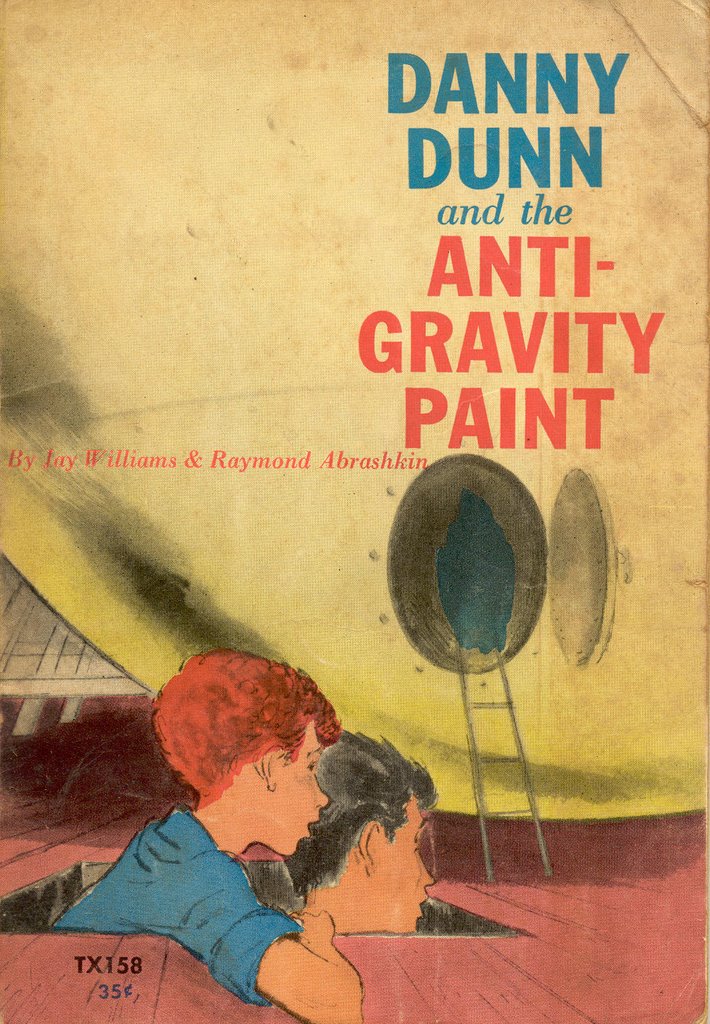
Time has taken its toll, of course, so a trip to Mom & Dad's isn't really a return to childhood. It is, however, akin to a scavenger hunt in which the items to be scavenged are all bits and pieces of my youth. While scrounging up the old science fiction magazine containing that negative review of Michael Crichton, I ran across a number of other old publications. Stashed in my parents' basement are bookcases and chests of drawers stuffed with books I read decades ago. I was particularly delighted to turn up an intact copy of Danny Dunn and the Anti-Gravity Paint, a young-adult science fiction novel that I remember having enjoyed in grammar school.

What a disappointment to read it again! I'm not naïve enough to have expected to recapture the old thrills I experienced the first time through, but I really did think it would stir some happy memories. Instead I learned how uncritically I must have read it when I was but a lad. I sure didn't demand much of kid lit in my preteen years. There is not even a glimmer in my memory banks of dimly remembered outrage at the dreadful science in Danny Dunn and the Anti-Gravity Paint. I'm not quibbling about the notion of anti-gravity paint. If we let H. G. Wells invent Cavorite for the use of his First Men in the Moon, we can give authors Williams and Abrashkin a pass for their similar device in their young-adult novel. No, the problems in Danny Dunn go far beyond that. Here is an egregious passage:
[Dr. Grimes] snapped on the TV camera. One of the screens lit up.

Both Danny and Joe yelped involuntarily. A blazing ball of gas almost filled the screen.

“A comet!” the Professor exclaimed.

“And we are near its path,” Dr. Grimes added.

Wh-wh-what'll happen if it hits us?” asked Joe.

“That depends,” said the Professor. “A comet's head is mainly chunks of meteoric material which give off flaming gas. Its tail is composed of gas and dust particles as well. If the head should pass within a hundred miles of us, we might be boiled alive. If the tail along comes near—well, I don't know—”

Danny said, “Shouldn't we close the shutters?”

“By all means. The light might blind us.”

Danny touched the control, and the steel shutters closed tight over the port. Even so, the light from the TV screen was dazzling.

“Close your eyes!” the Professor commanded.

They did so. Even through the closed lids the glare penetrated, although the comet was thousands of miles away. Faintly they could hear a hissing, crackling sound like a distant forest fire.
I should have chuckled at the nonsense of a flaming comet and the notion that sound can travel through a vacuum. In those days, the Mercury and Gemini space programs were under way. Many kids like me, who had heard President Kennedy call for a landing on the moon, were stuffed to our eyebrows with astronautical lore. I must have been pretty forgiving if I don't remember tossing Danny Dunn across the room. (In a later and more cynical age, the movie Capricorn One portrayed a hoaxed Mars mission that unravels when someone finally notices the absence of a time-lag in communications with astronauts who are supposedly millions of miles away. In reality, hordes of teenagers would have caught the mistake immediately, sparing everyone the ordeal of watching O. J. Simpson being chased across the desert by black helicopters.)

It turns out to be extremely convenient that sound waves can propagate through vacuum in the Danny Dunn universe. The Professor fixes a stuck electrical relay on the anti-gravity spacecraft by playing a makeshift bull fiddle over the speaker on the outside of the vehicle. (I'm not kidding!) Once the relay is working again, the space travelers are able to return to earth for the requisite happy ending. Imagine that.

Hard versus soft

I like my science fiction the way I like my ice cream: hard. Leave that soft-serve stuff for the romance novels. My disappointment upon rediscovering Danny Dunn reminds me of happier experiences with Heinlein's young adult novels, especially Starman Jones, Have Spacesuit—Will Travel, and Red Planet. While I've read and enjoyed Ray Bradbury's The Martian Chronicles, no one should mistake them for actual science fiction. For me, a science fiction novel needs to convey a sense of reality—speculative reality, of course, but still a potential reality.

The author who does that for me today is Alastair Reynolds. While his novels are amazingly inventive, everything in them has an extremely high degree of verisimilitude. Very few people possess the special combination of talent and training that permit the creation of such wonderful novels as Revelation Space and its sequels. Reynolds is an erstwhile employee of the European Space Agency and holds a doctorate in astronomy. Fortunately, his talents as a writer permit him to use his profound knowledge of spacetime physics without baffling the reader with verbiage better suited to a treatise.

Here is an example of completely hardcore physics put in the service of a thrilling fight to the death. The psychotic Nagorny has ambushed Volyova and is marching her to the elevator shaft that runs the length of their kilometers-long spacecraft:
Volyova had tried resisting, but Nagorny's strength was that of the psychotic and his hold on her might as well have been steel. Still, she assumed a chance for escape would present itself as Nagorny took her to wherever he had in mind, once the elevator arrived.

But Nagorny had no intention of waiting for the elevator. With her gun, he forced the door, revealing the echoing depths of the shaft. With nothing in the way of ceremony—not even a goodbye—Nagorny pushed Volyova into the hole.

It was a dreadful mistake.

The shaft threaded the ship from top to bottom; she had kilometres to fall before she hit the bottom....

She was going to die.

Then—with a detachment which later shocked her—part of her mind had reexamined the problem. She had seen herself, not falling through the ship, but stationary: floating in absolute rest with respect to the stars. What moved, instead, was the ship: rushing upwards around her. She was not accelerating at all now—and the only thing that made the ship accelerate was its thrust.

Which she could control from her bracelet....

She could stop her fall—her apparent fall—by ramping the ship's thrust into reverse for however long it took to achieve the desired effect. Nominal thrust was one gee, which was why Nagorny had found it so easy to mistake the ship for something like a very tall building. She had fallen for perhaps ten seconds while her mind processed things. What was it to be, then? Ten seconds of reverse thrust at one gee? No—too conservative. She might not have enough shaft to fall through. Better to ramp up to ten gees for a second—she knew the engines were capable of that. The maneouvre would not harm the other crew, safely cocooned in reefersleep. It would not harm her, either—she would just see the rushing walls of the shaft slow down rather violently.

Nagorny, though, was not so well protected.
Volyova ends up having to scrape Nagorny's remains from the ceiling of one of the ship's chambers.

That physics is deadly stuff, if you know how to use it.

Sunday, May 21, 2006

Getting on God's case

Not exactly open and shut

God has been good to Lee Strobel. Or perhaps I should say the God business has been good to Lee Strobel. The former journalist has a lucrative franchise going, a “nonfiction” series of case books. Case books? Yes, I think you can call them that.

Strobel inaugurated the series with The Case for Christ, the 1998 book that purports to be a hard-headed journalist's investigation into the evidence concerning the basis for Christianity. The success of that first Case book inspired Strobel to follow up with The Case for Faith in 2000, The Case for Easter in 2004 (at 96 pages it's more like a pamphlet than a book), The Case for a Creator in 2005, and The Case for Christmas in 2005 (another 96-page quickie, just in time to battle against the phony war on Christmas). Each bears a subtitle along the lines of “A Journalist Investigates....” See? It's okay because a journalist rather than some preacher wrote it.

Strobel's prose is quite serviceable and highly readable, so no one can say that his years in the vineyards of journalism were wasted. However, one finds in Strobel's work merely the pretense of journalistic skepticism rather than skepticism itself. These days Strobel is simply an apologist for a narrowly literal reading of the Bible accounts of the origins of Christianity. I haven't read The Case for a Creator, so I don't know whether Strobel is a Genesis fundamentalist of the young-earth-creationist stripe. I do, however, have my own copy of The Case for Christ, presented to me with more hope than sense by a devout acquaintance. The book is organized as a series of interviews, with Strobel playing the role of a journalist trying to get to the bottom of a big important story. He presents the subjects of his interviews as expert witnesses, almost as if they were testifying in a formal inquest.

Many believers assume that nonbelievers simply lack the knowledge that they possess. It bewilders them beyond all measure to encounter nonbelievers who know more Bible verses than they do. How could someone know such things and still not believe? This was the nonplussed perspective of the conservative Christian acquaintance who gave me Strobel's book. Since I already knew the Bible pretty well, it was obviously necessary to present me with a closely reasoned discussion of the evidence whose logic would ineluctably lead me to the truth. He was bitterly disappointed when I found Strobel's literary endeavors to be no more persuasive than the original gospel accounts. The Case for Christ is just Strobel's brief for the defense, all of his interviews chosen to showcase scholars who will support the preordained outcome. It's not aimed at the knowledgeable skeptic. Rather, the book is well-designed to reinforce the faith of those who already believe and perhaps tip the balance of those who are already teetering on the cusp of faith.

It is highly instructive to compare the evidence that Strobel adduced for Christianity with discussions of the same material by other sources. Here is Strobel with Professor Craig Blomberg of the Denver Seminary:
“Let's go back to Mark, Matthew, and Luke,” I said. “What specific evidence do we have that they are the authors of the gospels?”

Blomberg leaned forward. “Again, the oldest and probably most significant testimony comes from Papias, who in about A.D. 125 specifically affirmed that Mark had carefully and accurately recorded Peter's eyewitness observations. In fact, he said Mark ‘made no mistake’ and did not include any ‘any false statement.’ And Papias said Matthew had preserved the teachings of Jesus as well.
Blomberg identifies Papias as only “a Christian writer,” which doesn't tell us very much. Perhaps Strobel and Blomberg shy away from irritating their predominantly Protestant readers by identifying him as the Roman Catholic bishop of Hierapolis, even though that might seem to strengthen the authority of his pronouncements. On the other hand, perhaps it is best not to dwell too much on the role of Papias in the history of Christianity. Randel McCraw Helms treats Papias at greater length in his book Who Wrote the Gospels?, which, by a curious coincidence, I was reading at the same time I was presented with Strobel's book. Helms cites the comments of Eusebius, who is sometimes called “The Father of Church History.”
In Book III of his work [History of the Church], Eusebius reports that in the fragments of the writings of Papias, the second-century Bishop of Hierapolis, this figure remarked that he was always interested in what any Christian visitor to his city might tell him about the old days of the first-century church:
And whenever anyone came who had been a follower of the presbyters, I inquired into the words of the presbyters, what Andrew or Peter had said, or Philip or Thomas or James or John or Matthew, or any other disciple of the Lord, and what Ariston and the presbyter John, disciples of the Lord, were still saying. For I did not imagine that things out of books would help me as much as the utterances of a living and abiding voice. (150)
Papias was, in other words, a collector of oral lore about early Christianity, of which there was a great abundance. Eusebius notes that Papias “reproduces other stories communicated to him by word of mouth, together with some otherwise unknown parables and teachings of the Saviour”; indeed, Eusebius continues, Papias apparently got his “notions by misinterpreting the apostolic accounts,” since he “seems to have been a man of very small intelligence, to judge from his books” (152-153).
Strobel later cites Eusebius in support of the four canonical gospels, noting that he dismissed other so-called gospels as “totally absurd and impious.” Thus the testimony of Eusebius is deemed valuable when it's not tearing down the statements of a star witness like Papias. The conclusion is clear, although it's not the one intended by the author. The Case for Christ is an exercise in Christian apologetics and that is all it is. The book assumes the guise of a journalistic investigation, but that is merely stage dressing. The deus ex machina is already poised, suspended in the flies, ready for the stagehands to crank into view when the cue comes for the big finish.

Applause! Author! Author!

Or maybe not.