Saturday, June 24, 2006

The care and feeding of trolls

First you take a 2 × 4 ...

Like any ecosystem, the blogosphere is inhabited by a wide variety of species, each highly adapted to its own specialized niche. Many of the blogosphere's residents are timid lurkers who scuttle about as quietly as possible. There's a smaller group, however, whose denizens are more visible, leaving their spoor behind them as they track through the blog environs that suit them best. A tiny group sits at the top of the blogosphere ecology, holding sway over vast domains, the über-bloggers who attract the most attention, adulation, criticism, and hits.

One of the tiniest groups of all, however, comprises the creatures commonly known as trolls. While they might spend much of their time lurking, when the impulse strikes them they cannot resist bursting out from the underbrush and raising a cacophonous wail. Some even appear to have the power to maintain their screeching without ever drawing breath. In some cases, the only way to deal with them is to put them quickly out of their misery. However, that runs counter to the prevailing culture in the blogosphere, which is strongly inclined toward maximizing free speech and the untrammeled exchange of ideas. The true troll, however, doesn't have any ideas to exchange and engages in the mere semblance of debate. It can be a wonder to behold.

The troll is not an entirely new phenomenon. He appears to be a lineal descendant of the crank, a genus whose species can be found infesting almost every field of human endeavor. Martin Gardner documented many cases of scientific cranks in his classic Fads and Fallacies in the Name of Science, first published in 1952. In his introductory chapter, Gardner looked back at one of his distinguished predecessors, recounting an example whose implications for today are as significant as they were a century ago:
Even on the subject of the shape of the earth, a layman may find himself powerless in a debate with a flat-earther. George Bernard Shaw, in Everybody's Political What's What?, gives an hilarious description of a meeting at which a flat-earth speaker completely silenced all opponents who raised objections from the floor. “Opposition such as no atheist could have provoked assailed him”; writes Shaw, “and having heard their arguments hundreds of times, played skittles with them, lashing the meeting into a spluttering fury as he answered easily what it considered to be unanswerable.”
Today's blog troll has the same thick skin as the crank of old and often retains the crank's skill of leaving his opponents spluttering in frustration. So far as answering questions is concerned, however, the modern troll is less concerned with answering them as evading them. This convenient adaption makes it possible for the troll to forage among the comment threads and leave his imprint even though the teeth of his arguments are very dull indeed.

A fascinating case of a lumberingly impervious troll occurred recently on Pharyngula, the biology and science blog maintained by Professor Paul Z. Myers of the Morris campus of the University of Minnesota. Professor Myers styles himself as “PZ” and almost everyone follows suit in so addressing him. PZ subjected himself to the ordeal of reading the anti-evolution chapters in Godless, the new book by right-wing demagogue Ann Coulter. Coulter's stock in trade is unbridled screeching at the top of her lungs, preferring heat to light. Her act has reaped monetary rewards from the extremist fringe of society (which unfortunately has way too much political power these days), and I suspect it's opportunism rather than sincere belief that motivates her. No matter. Coulter decided to enlist in the evolution wars on the side of the creationists and PZ thought it reasonable to dissect her arguments. None of them survived PZ's deft vivisection.

Enter the trolls

PZ was immediately attacked by droves of Coulterites, at least those able to type out quick messages on their keyboards before their drool short-circuited the electronics. Without exception, the attacks lacked any intellectual heft. They offered abuse rather than reason. PZ responded with a challenge, which he discussed in a follow-up post:
Responses to my challenge at the end of this article are trickling in, but so far, none of them are filling the bill. Let me explain what is not an appropriate reply:
  • Cackling that Coulter must be right because she's got “liberal panties in a twist” is not cogent.
  • Telling me that the “WHOLE BOOK PROVES LIBERALS ARE THE PROBLEM WITH AMERICA” is not cogent.
  • Promising to pray for me, or assuring me that I will burn in hell, is not cogent.
  • Explicit details about how Ann Coulter is sexier than “fat harry hippie jew girls” is not cogent.
Here's the simple summary. Ann Coulter has written this long book full of creationist gobbledygook. I can't possibly take the whole thing apart, so I'm asking the Coulter fans to get specific in their support. Pick a paragraph that you agree with and that you believe makes a strong, supportable point about science—anything from chapters 8-11 will do. Don't be vague, be specific. I'll reply with details of my disagreement (or heck, maybe you'll find some innocuous paragraph that I agree with—I'll mention that here, too.)

Because the letters I am getting suggest that those fans have some comprehension problems, I'll spell it out.
  1. Read Coulter's book, Godless. (uh-oh, I may have just filtered out 90% of her fans with that first word.)
  2. Pick ONE paragraph from chapters 8-11 that you think is just wonderfully insightful, and that you agree with entirely.
  3. Open up your email software, and compose a message to me. You can use a pseudonym, but please do use a valid email address. I won't publish your address, but I'm not going to reply to people I can't contact.
  4. Type in the paragraph that you think is solid and believable. Yeah, it's a tiny bit of work, but it'll save me the trouble of typing it in myself. You're a believer, it's worth it, right?
  5. Explain briefly why you think this paragraph is good stuff. If you want to explain a little bit of the context in justification, that's good too.
  6. Send it to me.
That's not so hard now, is it? I'm finding that Coulter fans are fervent and enthusiastic and insistent, so asking them to take baby steps with me and show me the simplest first fragments that will lead to my comprehension of the wit and insight of the faboo Ms Coulter shouldn't be too much to ask.
PZ's clarification was just what the doctor ordered. The results were practically instantaneous and virtually miraculous (not actually miraculous, because there's no such things as miracles—except possibly for the fact that Coulter still has any credibility left):
Coulter Challenge status, day 4

Official number of attempts to address my challenge of the science in Coulter's book:

0

I seem to have drawn in one Coulter fan in the comments who can't shut up, but he hasn't got the guts to stand up for anything specific that she has said.
As you can see, PZ was essentially correct when he surmised that the conditions of his challenge were too restrictive. The Coulterites were fulsome in their praise of their harridan heroine, but they hadn't actually read her book or—if they had—deduced any reasons why her arguments might have any actual validity. However, as he noted, one lone, brave Coulter fan had not quit the field. Sure, he hadn't read the book and he couldn't offer any reasons why her point of view had any merit, but he lumbered bravely into battle time and again with PZ's minions. As epics go, the struggle of Tumbler against his goddess's detractors was more like a saga in its stubborn length than it its stirring clash of arms, but it had its amusing moments. Herewith are some excerpts, beginning with insults hurled by some of the Pharyngula commenters, including yours truly:
You gave them a five or six step procedure. Word is they're busy setting up research on how to count beyond three.

Posted by: Arun Gupta | June 20, 2006 08:38 PM

Has everyone seen the footage of Coulter running, arms akimbo, hands flapping in fear, away from that thrown pie? (Not that I advocate throwing things at speakers, mind you.) I guess that's what her defenders are doing now—bravely running away.

Posted by: Kristine | June 20, 2006 09:08 PM
Word is they're busy setting up research on how to count beyond three.
To be fair, you know, the Coulterites are very, very devout. How can they count beyond three when they always try to obey holy scripture?

Three shall be the number thou shalt count, and the number of the counting shall be three. Four shalt thou not count, neither count thou two, excepting that thou then proceed to three. Five is right out.
Posted by: Zeno | June 20, 2006 09:09 PM

Funny, Zeno. After reading Kristine's comment I was think[ing] “brave Sir Robin.”

Digby also has a post up from a troll who sent a long defense of Coulter.

Posted by: Unstable Isotope | June 20, 2006 09:25 PM

Giving credence to Gupta, Zeno and Kristine is blanket endorsement of the modest university standards they've taken for an education. At least Coulter had no qualms about quoting from Mein Kampf, banshee that she is. That means she reads sometimes. They grow bored when they try to read. C students and party animals who have but one rule. Cheap shot.

Over at Arianna's blog some of the others thought they had Ann's number: calling her a tranny, a man, a beast with an Adam's-apple; you know. Constructive criticism. Nobody had any rebuttal of her outrageous opinions. Just diatribe and vituperation.

Posted by: tumbler | June 20, 2006 10:49 PM
Tumbler's arrival in the thread looked at first as if it might just be a quick exercise in solemn finger-wagging. We were to learn different. While Tumbler has a point about the value of invective when it comes to making an argument, he has entirely missed the key fact that Coulter's diatribe had already been demolished by PZ. We were merely dancing about the funeral pyre. Tumbler, however, was not ready to give any evidence that it was still alive.

Attack of the party animals
Over at Arianna's blog some of the others thought they had Ann's number: calling her a tranny, a man, a beast with an Adam's-apple; you know. Constructive criticism. Nobody had any rebuttal of her outrageous opinions. Just diatribe and vituperation.
Are you seriously expecting that? Constructive criticism in the comments of a blog that already provides enough criticism? I can't help but wonder what your point is. Are you saying that random commenters haven't done much more that comment randomly (surprise! and welcome to the Internet), or are you saying the because goofballs from around the world say goofy things nobody has provided any real criticism of Ann Coulter? (Psst! The comments are preceded by the actual posts. And welcome again to the Internet. You'll find that it's nothing like your strange assumptions. Also that there's lots of porn.)

Posted by: pough | June 21, 2006 02:03 AM

Dear me, I've been outed as a party animal! I have to share this with my tiny group of friends, who will be much amused. Anyway, tumbler is totally wrong: I was a B student! At Caltech. (Yay! Party school!)

Posted by: Zeno | June 21, 2006 02:08 AM

Zeno:

I know you went to Caltech and all, so I feel compelled to clear this up:

"We deliver kegs" on every store within two miles of campus (including stationers and TV repair places): Party School.

30-year-old D&D games continuing under Fleming: not so much.

Posted by: Llelldorin | June 21, 2006 05:27 AM

Welcome to the club, Zeno, for I've been outed as a party animal malapropist with a C average. News to me, and to my transcripts.

BTW, I have read Mein Kampf. All English Lit party animals have to. I will admit that it put me right to sleep.

Posted by: Kristine | June 21, 2006 08:51 AM

Let us get this straight. Just because Ms. Coulter quotes Mein Kampf, that absolutely does not mean she has read it. She is the quote miners quote miner. If a snippet of text, totally out of context or not, will fit her thesis, she will use it.

Posted by: DouglasG | June 21, 2006 09:46 AM

I'm sure I have the greatest respect for Ann Coulter :-) :-) ; but I don't think her supporters can count beyond three.

BTW, Greetings, Zeno, I too was a Caltecher—a graduate student, though.

Posted by: Arun Gupta | June 21, 2006 09:39 PM
Tumbler came back for more. We were perfectly willing to oblige, but the exchange was beginning to pall:
I can't call myself a Coulterite, but I'm liberal enough to put some anti-Coulterites here down.

These are the diversity set; in favor of all diversity except Republicans and Christians. They'll defend my right to say something when they really hate what I say. —Not.

She's a piece of work. No, I haven't yet read Godless: But every Thursday she has her column featured in Drudge, and I love to read that. Makes me happy because she's on my side, at a comical tangent.

Tons more clever than Doonesbury, whose work is certainly insensitive. Was she shocking; about the Jersey Girls, etc., —? ? ? A little. George Clooney made light of another man's Alzheimer's diagnosis (Chuck Heston) and there was no Liberal hissy-fit. He makes more money, and has many admirers. I like George. Cool Ann is entitled to some money and fans for her tactless barrages.

Posted by: tumbler | June 21, 2006 11:28 PM
Greetings, Zeno, I too was a Caltecher—a graduate student, though.
Oh, a Tech grad student! Arun, I humbly make obeisance before my master and render the sign of the Big T. ;-)

Posted by: Zeno | June 21, 2006 11:33 PM
They'll defend my right to say something when they really hate what I say. —Not.
My, my, my; tumbler is wrong again. Card-carrying ACLU member here, buddy. I staunchly defend your right to say any silly-ass thing you wish to say (unless you're keen to offer sectarian prayers at a public school graduation, in which case, screw you). Defending your right to speak whatever you like, however, is not the same thing as agreeing to refrain from pointing out its silly-assness.

P.S.: About that “Not”, buddy. The post-fix negation operator is so over.

Posted by: Zeno | June 21, 2006 11:39 PM

Dear Zeno:

I wasn't accusing the ACLU, of not caring. The defenders of diversity (It makes us strong) is who Um talking about. Have I said a silly-ass thang? I never say much else. But take it for what it's worth.

I defend your right to undress too. Ugh.

Posted by: tumbler | June 22, 2006 12:53 AM
As one might have expected by now, Tumbler insisted on missing the point of my remark about my defense of his right to prate nonsense. Oh, he wasn't talking about me, he wasn't talking about the ACLU, he was talking about some other people. Those “diversity” people over there. Not any of the nice people who were whomping on him at Pharygnula.
The present-day Democrat party numbers many demagogic members like Kristine; always purloining somebody else's wisdom (Hoffer) in order to smear you. It's just a wonder she's not laying genocide, in fact, at Cool Ann's doorstep. But it's enough for now to say, “That's Coulter, I agree.” This is called a lock-step to that old party-line.

It's past her to identify the left she upholds now as Lenin's useful idiots of old-timer's Life mag.

Speaking for myself, I admire the Soviet society that lived under a despot, consumed by fear that the children in their own house would denounce them to the NKVD. It actually happened, and so did gulags.

Thanks to Reagan's bold negotiations and John Paul II's spiritual leadership in Poand, better times arrived for them. In fact, religion, which the Comintern thought was cooked forever, is reborn in that society. (Must be caused by the next stage in evolution of the species.) I like to contemplate these events as I do here now. I've been listening to Shostakovich's Leningrad Symphony as I surf Kristine's erudition; conducted by, of all musicians, a German born in the late 30's.

Anyway, Coulter and I do not deserve being associated with Hitler's or Mussolini's crimes. We're Americans. And we have the first ammendment to keep us safe from demagogues' futile finger-pointing.

Posted by: tumbler | June 22, 2006 11:10 AM

I most certainly did not associate you with Hitler, tumbler, and I would advise you to be very careful how personal that you decide to get in this forum.

Posted by: Kristine | June 22, 2006 11:39 AM

Dear Dylan,

I thank you for sending me a link to the interview by Mr. Paxman. I enjoyed that.

Ironically, my considered opinion is, Yes; he was never aggressive or antagonistic with Ann Coulter.

I even appreciated his Brit pronunciation of Coulter; using my own preferred style. I call her Cool Ann and Paxman says Cool-tair. Obviously to my taste.

But for someone to say he disparaged her, or made her seem a fool; and “she was unprepared—” isn't remotely true. Her replies showed NO qualms, no hesitation and were even startling in their relentless calm.

You say she's hardly known in Britain. But if her book moves, and it will, it'll explain clearly what she's all about. Considering that England is much more a reader's country than ours, where nobody likes anything but bodice-busters—the public will appreciate Coulter. I know I do.

Posted by: tumbler | June 22, 2006 11:42 AM

Dear Kristine:

You yourself only agreed with PaulC. He went far along those demagogic lines, or maybe I'm over-reacting. All he says is, “Maybe they would not have gone along with genocide, but it's easy to imagine Coulter in an earlier day gushing over parades of those ‘wholesome’ young people in Italy and Germany.” To which you say, “Yeah. That's Coulter.”

You know it's a weasel's way of defaming Coulter and her “ilk”—as others around here say—as Neo-Nazis. Her American style, popular enough today everywhere, is made to seem outrageous and fascist. Only Coulter isn't at war with liberalism as much as she's satirizing it. People like Whoopi Goldberg and Chris Rock and a few others do it every day. They do it to Republicans, religious Americans, and talk show hosts. These are your gang; folks Ann calls Godless. And many are. Not all, but VERY many.

Posted by: tumbler | June 22, 2006 12:00 PM

“Being associated” is such a vague term that I'm not sure anyone can escape it. The GOP's favorite comic Dennis Miller never lost an opportunity a few years back to associate people like me with Neville Chamberlain's appeasement and indirectly Hitler's invasion of Poland. I mention him rather than Coulter only because I don't have any handy citations from her comparing Iraq war opponents to Chamberlain, whereas it was a well known part of Miller's schtick.

Speaking of what the first amendment actually does as opposed to what you think it does, its effect is to keep Miller safe from any repercussions to making this kind of “association” whether I deserve it or not. And that's a good thing. I'm not sure what part of the constitution you think keeps us safe from demagogues; the Bill of Rights allows demagoguery because suppressing it would hurt other forms of political speech. The first amendment is not a scapular that one wears to ward off those pesky demagogues, but a very brave declaration that rights will be upheld even when they cause us inconvenience.

Obviously, neither you nor Coulter is responsible for the rise of Hitler. For that matter, I think very few people that have ever lived (including Ann Coulter) would be able to countenance Hitler's crimes with full understanding. It is, however, a matter of historical record that a lot of people rationalized the worst bits away at the time and admired the parades, the industry, and up to a point the anti-semitism. Before the US joined WWII, there were all too many Americans among them. So declaring oneself an "American" is no protection from being associated with Hitler. The fact that Coulter, myself, and probably you were not alive at the time is sufficient protection.

Note: there were many foolish people on the left who admired Stalin and were willing to soft-pedal the atrocity that was China's cultural revolution under Mao. Again, I wasn't alive and don't “deserve” to be associated with them. Oddly, that doesn't seem to stop Coulter from somehow linking everything she does not like to “Darwinism” in her latest opus.

Posted by: PaulC | June 22, 2006 12:06 PM

Very good rationalzations, Paul;

OK— you're clearly a man whom I could trust. If you conceded such a trait to me, you'd be half-way to understanding Ann Coulter. The fact you don't understand her, and have cast her in the meanest possible mold, leads me to think you find evil traits sticking out all over us conservatives.

I find conversing here with you, above-average intelligent as you seem, very stimulating. You're entitled to your prejudices. Ann Coulter is also entitled. I am almost 70 years old now, and have a great depth of experience to share; as well as an above average way of understanding. And it's mainly because I recall as a 7 yr-old, the pressures upon our country which WWII exerted. I remember Pearl Harbor; and my mother sending a box of fudge to my uncle in the Solomon Islands, etc., —and so— I'm amused at Coulter stating balls-out, “Invade their countries, kill and conquer and convert them to Christianity ...” She speaks like a brat without fear. It's funny!

Just like referring to W as “chimp” and “shrub” is meant humorously. It also descends into stupidity as we hear many Dems and Libs saying vile things about Barbara Bush, or making it appear we went to Iraq only for OIL. It hasn't even an appearance of good humor to say the things they all say at Huffingtinpost Blog. Every fourth word filthy and filled with loathing. (And, yes. They're protected by the 1st ammendment. But they AREN'T amusing, as Ann Coulter is amusing. They're dirty.)

Posted by: tumbler | June 22, 2006 12:55 PM

All good things must come to an end—bad things, too


Although Tumbler had poured many, many words into the comment thread (I haven't even included all of them here in these excerpts!), people at PZ's blog are mostly smart enough to notice when we're getting lots of sound and fury, signifying nothing.
It seems to me this thread has strayed very far from PZ's original intent; he wants a Coulter fan (that eliminates me) to offer up a passage from chapters 8-11, and then show why he/she supports said passage.

Here's your opportunity, tumbler. I humbly suggest that you have your chance, right here and now, to show us.

I cannot do so, because in spite of reading 10 or so books a year, I refuse to buy a Coulter book.

Let's right this ship and allow tumbler to defend Coulter in the manner PZ described. That's what this thread is all about, right?

Posted by: MikeM | June 22, 2006 06:45 PM

Quite right. Money, mouth, etc.

Posted by: Righteous Bubba | June 22, 2006 06:54 PM

Good point. I thought it was a fairly straightforward request, yet Tumbler babbles on and never makes the effort to address it.

Posted by: PZ Myers | June 22, 2006 07:18 PM

Holy cow; I haven't bought a single one of Cool Ann's books. I only read her out of a weekly column on Thursdays.

Why do I have the sneaky feeling this is a big BREAK for youse guys? For P.Z., apparently a person of integrity and good instincts; who had expected nobody on earth could save Cool Ann from his dissecting skills. Just bring it on! Now that I—Moi, cannot deliver her creepy character up for him to carve up, —off the page, as it were— Coulter can't be touched. Unless another reader can supply PZ with the material. I hope so; in order for me to play referee while she's tag-teamed in this Pharyngular match.

Posted by: tumbler | June 22, 2006 07:31 PM

Tumbler, you are incoherent; you are deranged; you are making random noises.

If you haven't read Coulter's book, shut up. Trying to defend her when you haven't read it is just obnoxious.

Just for you, though, you could try citing something from those articles by her that you read for free. Extract some of her ‘science’ and defend it—but keep up this vapid twittering about nothing and yeah, I'll ban your butt.

Posted by: PZ Myers | June 22, 2006 07:48 PM

Bloodied, but unbowed, Tumbler continued to talk past everyone who tried to discuss things with him. The topic of Coulter's arguments against evolution were continually evaded. He was a most attractive nuisance to many of the commenters on the blog, people who wanted to engage in a debate and kept trying even after Tumbler's numerous demonstrations that he had no intention of ever addressing the substance of the issue before the assembled multitudes. He jumped to another thread, where he finally copped the “more in sorrow than anger” attitude, and shuffled out the door. For the dwindling number still reading, it was a kind of conclusion, but you still felt that someone who could string words together should also be able to engage in an argument. As one commenter noted, however, it was like the Monty Python sketch. We were saying, “I came here for an argument!”, whereupon Graham Chapman politely informs that we're talking to the wrong man: “Oh, I'm sorry. This is abuse!”
Please, PZ, I haven't shut up thus far—because in these grounds no one except me has the ability or impetus to keep you honest. Everybody's your liberal crony. You'd crow with wild abandon were it not for a single voice HERE, opposite this narcissism you consider above repoach [sic]. As for guts; I've given Pharyngula enough hell for one man; and you & your cohorts never seem to bring me to heel; you only retort with animosity. While I, because I realize this is private property, take care not to be too feisty or abrasive. You'd just silence me the same as Arianna has; knowing perfectly well there's no reasonable way to rebut me. You'd axe my entry into this blog like cowards. Can't face honest competition. And I'm not even pretending to be a doctor or professor. Strange how you've had to recoil at the straightforward posts of one self-educated Christian & conservative. You were supposed to bang me up with flair, and you whimper because I don't “shut up.” OK, if I haven't read the book we're quarreling about—it's not on account of you. You haven't intimidated me. But why are you claiming to be unchallenged? Do you think this blog had national importance enough to draw fire from all 52 [sic] states? Don't flatter yourself. Take what you're offered.

Posted by: tumbler | June 22, 2006 11:58 PM
Gee, what exactly did Tumbler think he was offering? A lively but brief discussion ensued concerning the possible identity of the two extra mystery states cited by Tumbler. He stuck around for a while longer, persistently offering his credentials and quoting some Italian phrases to demonstrate his expertise in opera. He didn't exactly clear the room (hey, I like opera!), but it was more of the same—always off-point and always impervious.

Tumbler really needs to find a nice bridge to live under. Venturing into the light certainly did not suit him.

Update: Good old Tumbler found himself a second wind. I declare it takes him longer to say goodbye than Cher's farewell tour. At last count, the Coulter Challenge status, day 4 post has 180 comments, with Tumbler still in excellent form for dodge-ball. “Bang! You're dead!” “No, you missed me!” “No, I didn't!” “Yes, you did!” The rest writes itself.

Friday, June 23, 2006

The fumbling finger of God

His mysterious ways

Colorado state legislator Ted Harvey is a “pro-life hero” according to Barbara McGuigan, the host of the anti-abortion segment of EWTN's Open Line talk-radio program. A resolution was pending at the state capitol to recognize and honor the 90th anniversary of the founding of the Rocky Mountain branch of Planned Parenthood. Harvey saw an opportunity for a publicity stunt, stealthily arranging to have an anti-abortion activist appear as his guest at the legislative session. Harvey's guest was a young woman who had survived being prematurely born as the result of an attempted late-term abortion; she had grown up to become a singer. After Harvey arranged to have her sing the national anthem at the Colorado House of Representatives session, he turned his introduction of her into an attack on the Planned Parenthood resolution before being gaveled down as being out of order. (He was using the time granted for introduction of guests to address measures pending before the house.) His account of his ploy was soon thereafter featured on his campaign website, where he said the whole event was “orchestrated” by God.

McGuigan devoted a large chunk of her June 20, 2006, broadcast to a phone interview with Representative Harvey, lauding him for his efforts to oppose what she called the “heinous resolution” to honor a “legacy of genocide.” She gushingly introduced him and welcomed him to the program:
I can't thank you enough and let's try to get all the details. We want to hear it all, Ted. I remember a very wonderful priest that I know always says nothing happens by accident.

[Noise]

Whoops! I think we might have lost him. Hopefully he'll be able to get us back.

Anyway the holy Russian priest that I just met said he who believes in accidents does not believe in God, so that was not an accident that we lost Ted Harvey. So hopefully he will be able to get back to us.
A little while later, Harvey was able to re-establish his phone connection to Open Line, after which the interview continued without further intervention by God. McGuigan chortled with glee throughout the conversation, celebrating the initiative that Harvey had taken against the Planned Parenthood resolution. After devoting a quarter hour to her lovefest with Representative Harvey, McGuigan moved on to her next guest. Curiously enough, however, neither hostess nor guest thought to share with the radio audience “the rest of the story”:

Senate Joint Resolution 06-044 was passed by both houses of the Colorado legislature despite Ted Harvey's supposedly divinely inspired ploy.

Thursday, June 22, 2006

Lost & found in the Bermuda Triangle

It's Skeptics' Circle #37

Never mind the sea foam, the spinning magnetic compass needles, and the amphibious UFOs. It's the 37th meeting of Skeptics' Circle and it's right in the middle of the Bermuda Triangle. Our hostess is the Autism Diva of California, so we should all be grateful that she was willing to travel all the way from the Golden State to the perilous waters of notorious geometry.

Speaking of geometry—to say nothing of golden—and matters mysterious, we are pleased to report that Halfway There is on the roster for this skeptical outing. The diva chose to include Phi: Good to the last decimal, a discourse on the use and abuse of the golden ratio in Dan Brown's recent bestseller. (Sorry, I forget its title.)

Go join the fun!

Sunday, June 18, 2006

Forgetting David

Erased from history

David's been gone for about fifty years. Sorry, but I can't even give you accurate numbers. About fifty years is the best I can manage. This goes back to a time, very early in my life, when my memories are vague and inchoate. It was similarly very early in David's life, but also very late. The people who know the details aren't talking, and I dare not ask them.

It was startling to remember. More accurately, to remember that I don't remember much of anything. The reminder, if it comes at all, comes in the form of news reports. The start of the summer is always the time for news media to carry the first sad reports of children drowning in swimming pools, lakes, or rivers. In the rural community of my childhood, the extensive system of agricultural irrigation canals would routinely claim a few lives each year. Swimming pools were relatively rare, but there was one near David's house, next door in his grandparents' back yard.

He was not yet three when he discovered that he could reach the latch on the front gate of the fence that surrounding the home he shared with his parents and infant sister. That fence was the only thing separating him from the swimming pool, where he was found after it was already too late.

The decades of my life have been wonderfully insulated, for the most part, from tragic loss. It is not for me to judge how people deal with their grief. From my outsider's perspective, it seems that David's family decided he had never really existed. My family and his were quite close, visiting each other frequently, taking vacations together. I never saw a picture of him in his family's house and I never heard his name mentioned by his parents. It was a bit of a surprise to me when his third sister was born a few years later and I heard my parents comment that it appeared that their friends would never have “another” son. The remark was a shock to me, because I didn't remember him. Once, when her parents were out of the room, David's oldest sister confided that she thought she might have a tenuous recollection of her elder brother, but it could well have been her imagination.

Throughout my childhood, the swimming pool near our friends' home remained unfenced, a popular location for parties in the grandparents' back yard. In later years it finally acquired a chain-link fence. No one else ever drowned in it. I remember being in that pool a couple of times, but not often. I'm rather phobic toward bodies of water large enough to be immersed in. It's not at all clear to me that this aversion can be linked to any one particular cause, but I wonder.

David is gone so thoroughly from all of our lives that literally years can pass without my remembering that he once existed, although I did today. I doubt if the same thing is true for his parents or his three sisters, although only one of them has the least chance of recalling him from personal experience. You have to find a way to go on, and they have done that.

Saturday, June 17, 2006

Blogger sure is screwed

June 17, 2006: Uploading pictures continues to be a hit-or-miss thing with Blogger, at least when I'm using Internet Explorer as my browser. I decided to try Firefox again and discovered that everything is smooth sailing. It's ridiculous that Blogger doesn't always work with IE, but one might speculate that part of the problem is IE's.

Rooting for the Enemy

A quagmire revisited

It was spring semester in 1971. I was sitting in the college library reading newspapers. After scanning Herb Caen's column in the San Francisco Chronicle, I read Art Hoppe. Suddenly the morning became memorable:
The radio this morning said the Allied invasion of Laos had bogged down. Without thinking, I nodded and said, “Good.”

And having said it, I realized the bitter truth: Now I root against my own country.
Even if you lived through the era of the Vietnam war, you may not recall the invasion of Laos. Although Hoppe cited the “Allied” invasion, it was a predominantly American endeavor, as with every other major military action in Indochina. (Sounds familiar, doesn't it?) In the third year of his presidency, Richard Nixon had decided the best way to win the Vietnam war was to expand it into adjacent nations, hence the incursion into Laos. With a fine lack of appreciation for the nature of the insurgency and guerrilla warfare, Nixon expected our troops to find and root out military sanctuaries sheltering North Vietnamese troops and Viet Cong from the south. They found no such thing.
I have come to hate my country's role in Vietnam.

I hate the massacres, the body counts, the free fire zones, the napalming of civilians, the poisoning of rice crops. I hate being part of My Lai....

And I hate my leaders, who, over the years, have conscripted our young men and sent them there to kill or be killed in a senseless cause simply because they can find no honorable way out—no honorable way out for them....

It is a terrible thing to root against your own country. If I were alone, it wouldn't matter. But I don't think I am alone. I think many Americans must feel these same sickening emotions I feel. I think they share my guilt. I think they share my rage.
We are frequently told it is a mistake to try to draw comparisons between Vietnam and Iraq, but comparisons are inevitable. Both conflicts were launched on pretexts later exposed as false (the Gulf of Tonkin incident in the case of Vietnam, the infamous “weapons of mass destruction” in the case of Iraq). In both wars critics of the federal administration were accused (and are being accused) of favoring the enemy. As Art Hoppe explained, however, “I don't root for the enemy.” Rather, “I hate what my country is doing....” Hoppe was rooting against the war and against the mendacious leaders who took us into it. The bitter truth is that the liars who lead us into disaster suffer no great consequences from their incompetence. We cannot take much satisfaction in being proved correct in our positions when confirmation comes in the form of casualties and body counts. George Bush ends up with lower approval numbers in the polls. The men and women in uniform end up dead or maimed in mind and body. Their suffering leaches all the smugness from shouting “I told you so, asshole!” at the president and his minions. We have anger. We do not have joy.

The super-patriots in the my-country-right-or-wrong crowd have a much easier job as they wave their flags and sing out the national anthem (getting the words wrong, of course). They viciously accuse war critics of demoralizing the troops (even though we receive messages from soldiers praying for a swift withdrawal) and encouraging us to work for the war's end. Some soldiers, of course, do hate it when the war effort is criticized, but they may be forgetting that the military used to be devoted to protecting American freedoms, not shutting them down when dissent becomes inconvenient. The super-patriots prefer instead to fetishize our unitary president as an undifferentiated amalgam of war leader, chief executive, and autocrat. All hail the great leader!

Bush in fantasy land

It would, in a way, be wonderful if the Bush idolators were correct and we were wrong. I don't for a moment believe that's true, because there is no credible evidence to support that happy conclusion. Such evidence would entail success in at least one of Bush's endeavors. Is the quick collapse of Saddam Hussein's regime an example of Bush success? In a limited way, yes, although the short-lived glow from that victory vanished in the chaotic aftermath. Furthermore, it raises a question. Why did Rumsfeld insist that a small military force was sufficient for this bold stroke? It suggests he knew that Saddam had no weapons of mass destruction to unleash against the American troops.

Is the death of al-Zarqawi an example of Bush success? Only if you forgive the administration for sparing him in the run-up to the American invasion because his activities in northern Iraq were seen as an additional argument in favor of the Bush war plan. We could have taken him out much sooner.

Was Bush's quick trip into Baghdad the victory lap that his supporters said it was? Unfortunately for the administration's spinmeisters, the president's mad dash into and out of Iraq's capital city underscored the dangerously unpacified environment through which he scampered. There were ironic historical parallels, too, as noted in a Kos diary:
The Bush WH always rejects parallels to Vietnam. It's ironic, accordingly, that it created one of its own yesterday as part of its ongoing propaganda effort for an utterly misbegotten war.

W has, of course, made 2 visits to Iraq. Both of them were kept secret in advance, both of them were the geopolitical equivalent of airport fly-ins, and both were conducted solely for PR reasons. Both of them have a great deal in common w/ the 2 presidential visits to Vietnam....

LBJ visited Cam Ranh Bay on 10/26/66. His visit was to a highly secured area, and it only lasted a few hours. Its sole purpose was to support the myth that a corner was being turned in Vietnam.

Nixon visited Vietnam on 7/30/69. His visit, as I understand it, was kept secret in advance. It also lasted a few hours, and its purpose was also to support the myth that a corner was being turned in Vietnam.

These obvious historical parallels appear to have been missed in news coverage today.
Shades of Santayana!

I think I would be able to endure any embarrassment that I might experience if it were to turn out that Bush is the brilliant war leader that his apologists claim. It would be worth it. Rather than have the continuing opportunity to denounce a president I don't support, I'd much prefer to have my former students, based now in Iraq and Pakistan, back home safe and sound. When Bush screws up, they are the ones who get screwed.

Unfortunately, our nation's fate (and the world's) is to endure thirty months more of Bush disasters.

Wednesday, June 14, 2006

Time for an Education Carnival

Halfway There included in #71

The school term is at an end, summer vacation (or summer school!) is imminent, and the faculty is getting antsy. What better time for an end-of-year staff party? The 71st edition of Education Carnival is being hosted by The Science Goddess at What It's Like on the Inside. Our own Halfway There is represented by its entry on the notorious one-size-fits-all syllabus, which just goes to show that yours truly, Dr. Zeno, is not very good at thinking about summer vacation when matters educational are still on his brain.

The goddess has favored us with a cornucopia of ed-related stories, so toddle on over to the staff party in the multi-purpose room and see what the faculty is up to.

Saturday, June 10, 2006

The one-size-fits-all syllabus

Rule 11: 1 through 10 don't matter

There must be a gene for archivism. I think I have it, no doubt inherited from my father. He has a basement, two garages, a large storage shed, and much of the back yard devoted to his treasures. Or junk, if you ask Mom. I fill shelves and other flat surfaces with books, magazines, folders, and papers. Lots of papers. I have over twenty years of course syllabi around here.

“Archivist” sounds so much better than “pack rat,” don't you agree?

When school is out, as it is now, I usually try halfheartedly to get my house in order. Every effort at tidying up is inevitably interrupted by the rediscovery of some precious item from the past. (Perhaps it's not an archivism gene. Perhaps it's a hunger for relics that was inculcated during my Catholic childhood.) Today was no different. While sorting the stacks into various porous categories, I found yet another cache of documents from the math department. There were meeting minutes, seniority lists, room charts, and syllabi, most of which were mine. But not all. I found the legendary one-size-fits-all syllabus, created in the forge of a late colleague's ire. I lifted up the single sheet of paper and read the famous words once again:
Mathematical Course, Procedures and Syllabus
Mr. Pxxxxx Gxxxxx

1. Textbook and material to be covered will be announced during the first class meeting.

2. Office hours will be announced during the first class meeting.

3. Attendance is mandatory.

4. Turning in homework is mandatory.

5. Excessive missed homework or excessive absences will result in the final grade lowered by one full grade.

6. Homework will not be returned. Students should make copies of their homework for their records.

7. Periodic unit examinations will be given throughout the semester and will be announced in advance. There will be at least 3 one hour test but no more than 7.

8. These exams will be corrected by the students in class.

9. A comprehensive 2 hour final exam will be given.

10. The final grade will be based on a class average basis as will any midterm grade.

11. Notwithstanding the above procedure, the instructor reserves the right to change any and all class procedures and topics discussed at any time. Students are responsible for any and all such changes as announced in class.
The document was a grainy nth-generation photocopy of a Courier typeface original. The senior colleague responsible for it had been goaded into action by the “gentle” reminders of the dean that all students were entitled to receive a syllabus on the first day of class. After decades of teaching in a style best described as extemporaneous—or maybe stream of consciousness—our colleague bridled at this administrative mandate.

His response, the eleven statements quoted above, provided the only syllabus he used for the balance of his career. Had he been thoughtful enough to omit his name and the word “mathematics” from the title, it could have served his colleagues in every department on campus. Copies did, indeed, circulate through every department on campus. Students who weren't even in any of his classes had copies, usually produced in response to their expressions of incredulity. Copies passed through many faculty offices, too.

I returned my copy of the one-size-fits-all syllabus to my collection of departmental memorabilia. I'm not sure what lesson it teaches us. In most respects, his masterpiece was the last gasp of a dying breed. My colleague was a departmental curmudgeon who seemed to regard every change in procedure as a personal affront. Sometimes I envied his supreme self-assurance, but other time I shook my head at his recalcitrance. Despite his position as a math teacher, he generated his grades in what one might charitably call a “holistic” rather than numeric way. The dean once threw his hands up in exasperation while trying to mediate a student grievance over grades when my colleague's gradebook turned out to have no numbers or averages in it, just a string of undocumented letter grades.

In many ways our colleague was a fascinating and cultured man, but one fiercely protective of his prerogatives. If he epitomized the “old school” approach, then we are probably well-served by its passing. My conclusion—once tentative but now quite firm—is that our colleague ultimately cared more for his convenience than the good of his students. He saw teaching as a special calling, but it devolved into a position of privilege. He was magisterial in his approach, but he gradually moved from the “authoritative” definition of magisterial to the sense of being overbearingly assured. Our careers overlapped during the years when he had assumed that definitively lordly aspect. That's an example I can learn from, and a progression I can strive to avoid. I must not emulate him.

Oh, and his office? A right mess, it was. Stacks of books and papers on every shelf and flat surface. That reminds me...

Thursday, June 08, 2006

Phi: Good to the last decimal

Procrustean proportion in The Da Vinci Code

Cleopatra's nose, had it been shorter, the whole face of the world would have been changed.

Pensées, Blaise Pascal
Dan Brown knows the value of the Golden Ratio, correctly citing it to three decimal places as 1.618. However, as I noted in my earlier post on The Da Vinci Code, I laughed out loud as I read through Robert Langdon's lecture on the importance and significance of this number. As in so many other places in his book, Brown starts with a kernel of truth and then stretches it all out of proportion. This is particularly a pity in the case of the Golden Ratio, where the truth by itself is remarkable enough.

Mathematicians know that the Golden Ratio is closely tied up with the endless list of numbers known as the Fibonacci sequence. Since the Fibonacci sequence provides a model for many aspects of nature, it stands to reason that the Golden Ratio is similarly significant. For convenience, mathematicians usually refer to the Golden Ratio as phi (commonly pronounced fee), the 21st letter of the Greek alphabet, also rendered as φ. Other names for φ include Divine Proportion, Golden Section, and Golden Number. It would seem that people are impressed by it.

The Golden Ratio has geometric properties that are intimately tied up with the the number 5. If a five-pointed star is inscribed in a regular pentagon, φ will turn up time and again as the ratio of pairs of sides. In the accompanying figure, the ratio a/b is φ, where a is the line highlighted in red and b is one side of the enclosing pentagon. It also turns out that b/c equals φ, where c is the line segment highlighted in green. Notice that the inscribed star has as its center a small pentagon, which immediately suggests the possibility of inscribing a smaller star and continuing the process. Indeed, in theory we could cascade forever into smaller and smaller pentagons and stars, all exhibiting φ in various ratios.

Blown out of proportion

Thus the mathematical properties of φ are genuine, as is its role in many natural processes that involve scaling or Fibonacci patterns. However, speaking through Robert Langdon, Brown quickly goes astray as he overstates the role of the Golden Ratio in nature and art. Here's an excerpt from the nature hype in Langdon's lecture:
“Nobody understood better than Da Vinci the divine structure of the human body.... He was the first to show that the human body is literally made of building blocks whose proportional ratios always equal PHI....”

“Measure the distance from the tip of your head to the floor. Then divide that by the distance from your belly button to the floor. Guess what you get.”

“Not PHI!” one of the jocks blurted out in disbelief.

“Yes, PHI,” Langdon replied. “One-point-six-one-eight. Want another example? Measure the distance from your shoulder to your fingertips, and then divide it by the distance from your elbow to your fingertips. PHI again. Another? Hip to floor divided by knee to floor. PHI again. Finger joints. Toes. Spinal divisions. PHI. PHI. PHI. My friends, each of you is a walking tribute to the Divine Proportion.”
Uh, wrong! These claims are ridiculous. Brown gives φ to three decimal places, but no one can reasonably compute body proportions to that degree of accuracy. It's bogus.

Although I do not usually consider myself an applied mathematician, I fearlessly collected the tape measure from my tool box and checked the ratio of my full height to my navel height. It's 1.75. A lot of my height is in my legs, so it turns out my navel is 3.426 inches too high for divine proportionality. (Now you know my secret shame.) As for my arms, the ratio of arm length to forearm length is 1.7. Yes, my forearms are too short. I am a veritable monster, escaped from a fun-house mirror.

But is it art?

Once we start talking about ideal proportions, of course, one's mind naturally turns to thoughts of art. Where else would beautiful proportions be more important?
“The mysterious magic inherent in the Divine Proportion was written at the beginning of time. Man is simply playing by Nature's rules, and because art is man's attempt to imitate the beauty of the Creator's hand, you can imagine we might be seeing a lot of instances of the Divine Proportion in art this semester.”

Over the next half hour, Langdon showed them slides of artwork by Michelangelo, Albrecht Dürer, Da Vinci, and many others, demonstrating each artist's intentional and rigorous adherence to the Divine Proportion in the layout of his compositions. Langdon unveiled PHI in the architectural dimensions of the Greek Parthenon, the pyramids of Egypt, and even the United Nations Building in New York. PHI appeared in the organizational structures of Mozart's sonatas, Beethoven's Fifth Symphony, as well as the works of Bartók, Debussy, and Schubert.”
Pretty impressive, wouldn't you agree? I wouldn't. It's more nonsense.

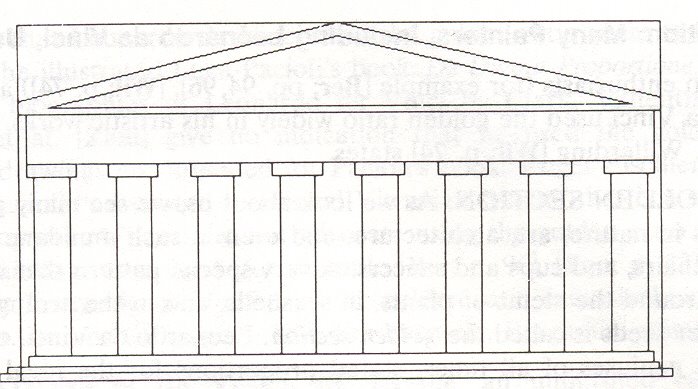
George Markowsky, professor of computer science at the University of Maine, took at hard look at claims about φ in Misconceptions about the Golden Ratio, published in the January 1992 issue of The College Math Journal. He cites several authors who were unskeptically enthusiastic about the supposed presence of the Divine Proportion in the façade of the Parthenon.
To support this claim authors often include a figure like Figure 6 where the large rectangle enclosing the end view of the Parthenon-like temple is a golden rectangle. None of these authors is bothered by the fact that parts of the Parthenon are outside the golden rectangle.... The dimensions of the Parthenon vary from source to source probably because different authors are measuring between different points. With so many numbers available a golden ratio enthusiast could choose whatever numbers gave the best result.
Markowsky isn't kidding. If you think he has deliberately done a bad job of boxing in the Parthenon in a golden rectangle, as in the accompanying figure (which I scanned directly from his article), then check out the examples that Golden Ratio fans have themselves posted: Example 1, Example 2, Example 3. No one seems concerned when the edges of the Parthenon's pedestal are clipped off to make the ratio work out.

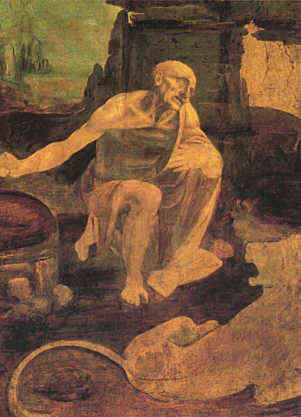
There's a similar problems with the alleged presence of the Golden Ratio in Da Vinci's famous unfinished portrait of St. Jerome: you have to cut off his arm to make it fit.

A little geometry

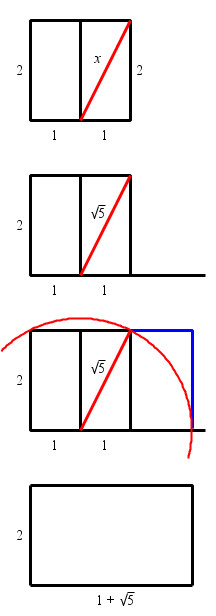
There are many different ways to construct the Golden Ratio, one of the simplest involving nothing more complicated than a square and a nicely chosen circle. One begins with a square that is 2 units on each side. Bisect the square vertically and consider the diagonal (in red) of the resulting rectangle on the right. By means of the Pythagorean theorem, we know that x2 = 12 + 22 = 1 + 4 = 5, so x = √5. If we construct a circle of radius √5, as shown, it will intersect the horizontal line extended from the base of the original square. Use that intersection point as the vertex of a rectangle that incorporates the original square. We see that the rectangle has a base of length of 1 + √5 and a height of length 2. With a handy calculator, one can ascertain that the ratio of the height to the base of our rectangle is (1 + √5)/2 ≈ 1.618.

Now that we know the exact value of φ, the expression involving √5, we could easily write out more decimal places. However, one of the lessons of this piece is that three decimal places is way too much for the fanciful applications of the Golden Ratio, where such precision makes no sense at all, and it's way too little for the true applications, where φ is the companion of infinity. Remember that the Fibonacci sequence goes on forever, as does the geometrical construction of nested stars and pentagons.

And that's only the beginning.

For further reading

For a rational treatment of one of history's most famous irrational numbers, check out Mario Livio's The Golden Ratio. Livio has worked through the fact and fiction in Golden Ratio lore and produced a readable account of the number's importance. The truth about φ is impressive in its own right, even without the embellishments of the credulous. A good on-line summary of the confusion over φ is available at The Cult of the Golden Ratio at Laputan Logic, where the writer checks out both the Parthenon and Da Vinci's Mona Lisa.

Rehabilitating a lie

Now it's truthiness!

The right-wing extremists think we're idiots. Well, Bush is still president, so I suppose they have a point. Nevertheless, KSFO's Melanie Morgan isn't just pushing the envelope on this one. She's torn it all to bits. Today she sent out a breathless message to her Move America Forward mailing list:
I'm sure you've heard the big news coming out of Iraq this morning—the head of Al Qaeda in Iraq, Abu Musab Al Zarqawi, has been killed in an air strike launched by the incomparable and unstoppable men and women of the United States military.

The anti-war contingent of our “mainstream” news media are devastated this morning, as this successful mission flies in the face of everything they've been telling you. They've falsely reported that there is NO connection between Iraq and Al Qaeda, so how can they tell you that the head of Al Qaeda in Iraq has been killed? They tell you that U.S. Troops are failing, that they are in a quagmire, that they are reduced to animalistic acts of torture and mayhem. But today's mission was the result of months of hard work and planning by our brave troops.

When it comes to the war on terrorism, the media is WRONG, and our troops and Commander in Chief have been RIGHT. It's time to watch that great video by the patriotic group, “The Right Brothers,” again. You know the song, it's “Bush Was Right.” Come on—go watch it right now.
As an anti-war, anti-Bush liberal, I guess I was supposed to be upset this morning. Oh, no! My hero al-Zarqawi is dead! Boo hoo! Alas and alack!

Let's keep this short and sweet: al-Zarqawi was a terrorist and his death is a good thing. Congratulations to the U.S. forces who finally nailed him. However, his main reason for being in Iraq was to exploit the opportunity provided to him by George W. Bush and the incompetent administration officials who put together our foolish incursion into Iraq. (These are the same people now working up plans to attack Iran just before the November elections.) Before we invaded, there was essentially no al-Qaeda presence in Iraq. Why? Because Saddam's regime was secular and Osama bin Laden is a religious extremist. To put it mildly, Saddam and Osama were not fond of each other. If any al-Qaeda operatives were in Iraq (al-Zarqawi hung out in the “no fly” zone, which was outside of Baghdad's control), it would have been to undermine Saddam Hussein and advance the cause of Muslim extremism. That doesn't make Saddam a good guy, but it did mean he regarded al-Qaeda as a problem rather than an ally.

As the 9-11 commission reported, there were no significant connections between Iraq and al-Qaeda before the terrorist attack on the World Trade Center and the Pentagon in September 2001. Despite that, the administration worked tirelessly to link Iraq and 9-11 in the minds of the American people, counting on our gullibility. Bush and company (thanks, Fox News!) did their work well and today shills like Melanie Morgan condemn the news media for having reported to the contrary. Of course, she spins it like a gyroscope: “They've falsely reported that there is NO connection between Iraq and Al Qaeda.” Oh, but al-Zarqawi was killed in Iraq! Oh, what a vindication for Bush! His lie has become the truth! Ex post facto, you know.

The right-wing noise machine is breath-taking in its brazenness.

Tuesday, June 06, 2006

The Law of Small Numbers

More fun with sparse data

Political pundit William Safire defined “thumbsucker” in Safire's Political Dictionary as a “political reporter's term for an analytical story; a think piece.” He adds that “Reporters and editors use the term with derision, to mean the opposite of ‘well researched.’”

A thumbsucker on political second chances by Margaret Talev of the Washington Bureau of McClatchy News has been popping up in various newspapers the last couple of months. It is clearly a thumbsucker in the first sense of Safire's definition, a discourse on the mixed record of politicians' second tries for the White House. While I would not go so far as to call it a thumbsucker in Safire's second sense—the information it contains is accurate—the article nevertheless fails to make a good case for its main argument. Talev describes the current positions of Kerry, Edwards, and Gore as active or potential future candidates for president.
But if any of these men goes ahead with a comeback campaign, history is stacked against him.

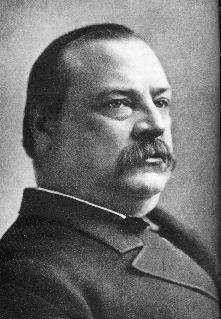
In three cases since the Civil War era, a presidential or vice-presidential nominee on a losing Democratic or Republican ticket was able to win the presidency in a subsequent election: Grover Cleveland, Franklin D. Roosevelt and Richard Nixon.

The list of those who tried but failed is considerably longer.
I think we get the point. As the Raleigh News & Observer said in its headline when it published Talev's piece on April 24, 2006, “2nd time's no charm for failed nominees.” When the Sacramento Bee picked up the article on June 4, 2006, it ran a blunt subhead: “History doesn't favor a comeback by Democrats Kerry, Edwards or Gore.” Take that, you guys!

Let us turn our attention now to the “considerably longer” list of second-time losers:
William Jennings Bryan, Thomas Dewey, Adlai Stevenson, Walter Mondale and Bob Dole each won another nomination after a loss, but none succeeded in the general election. Bryan was a three-time loser. Others who made the ticket and lost were unable to secure their party's nomination when they ran again: Ed Muskie, Dan Quayle and Joe Lieberman.
Well, that's definitely a longer list. I guess that clinches the argument.

Or does it?

Let's take a second look at the list of rerun losers. The original list of losers included Bryan, Dewey, Stevenson, Mondale, and Dole. That's five people who were on national tickets at least twice and lost both times. But then Talev padded out the list of losers with one-timers Muskie, Quayle, and Lieberman. That sure makes the list of losers longer, but only at the cost of changing the criterion. This second group of losers never got a second nomination.

In summary, there were three candidates who lost national elections as nominees for president or vice president and came back to win the White House. There were five candidates who lost national elections as nominees for president or vice president who came back to lose a second race (and in Bryan's case a third) as a presidential nominee. Three versus five. You know, I don't see that the historical deck is that heavily stacked against repeats. Three chances out of eight is 37.5%, which is by no means a trivial probability.

Whenever you try to spin out a theory based on such a small data set, you can be certain to find all sorts of interesting things. They just won't be significant. There have been too few presidential campaigns to offer us more than a tiny subset of the combinations and outcomes that might establish trends in the longer term. Why didn't Talev use the cases of Kennedy and Kerry to argue that a Catholic from Massachusetts can be elected president only if he is young and devilishly handsome? That might have been too transparent.

I imagine in the future, after we've had a couple of female presidents, there'll be articles trying to deduce general principles from a sample of size two. The two-time loser theory is not quite as trivially speculative, but it's close. As a historical piece, the Talev article is informative and interesting. As an analytic piece, its value is negligible. In that sense, a thumbsucker.

Note: The title of this post is a parody of the law of large numbers, a probability theorem that says the mean of a large sample taken from a population will generally be close to the mean of the whole population. Click on the link for more, if you're curious. Different meanings have also been assigned to the law of small numbers, some of them jocular.

Monday, June 05, 2006

Darwin in Davis

Inquiry-based instruction in evolution

The Davis campus of the University of California is one of the largest of the nine general campuses of the state's premier public university, both in area (5,300 acres) and enrollment (30,000 students). Founded in 1905 as the University Farm, an agricultural satellite of UC's flagship campus in Berkeley, UC Davis became a full-fledged educational institution in the 1950s and today awards more degrees in the biological sciences than any other institution in the United States.

One of my younger colleagues is a recent UC Davis graduate in mathematics and math education. He advised me that some of his erstwhile classmates and mentor teachers were participating in a spring symposium to present a progress report on a National Science Foundation research project. The topic was collaborative classroom-based inquiry in K-12 schools. My curiosity piqued, I traveled along Interstate-80 to the university to see what our fellow educators had in store for us. It was worth it.

Naturally I paid a lot of attention to the results of the math participants, who are trying to raise algebra success levels above the traditional (but extremely disappointing) 50% level. One of their more interesting results was that students love to have teachers give them “practice exams” before a test, but that such rehearsal tests have no significant impact on student performance on the real thing. Although topic-specific worksheets were more effective in raising student scores, the students themselves continued to be much enamored of the practice exam. I'll be curious to see what other details the teacher-researchers come up with next year after the third and final year of the NSF-sponsored investigation.

It stood to reason that there would be a major biological component to an education research project based at the old University Farm, and we were not disappointed. I pricked up my ears when I heard the title of the biology teachers' presentation: Facilitating student understanding of evolution through the synthesis of Darwinian arguments. It must be nice to be in California! Although there is a localized creationist infestation in Roseville, only about 35 miles away, at least UC Davis doesn't have to worry about an ID-obsessed state board of education or creationist pressures from its Board of Regents.

The biology component of the NSF project was conducted by teachers at Dixon High School, a rural secondary institution just a few miles from Davis. The two instructors had a heterogeneous student population in grades 9 through 12. They were particularly concerned by the low level of scientific literacy manifested by their students and hoped to inculcate principles of “scientific argumentation,” which they described as “supporting conclusions with evidence,” as opposed to bald assertion or appeals to authority. The teachers knew that evolution is often poorly understood by their students and they had designed lessons for a four-week unit devoted to scientific argumentation about biological change.

The teachers explained to us that at each stage during the evolution unit they gradually withdrew more of the supporting components of the lessons, giving them an opportunity to judge the degree to which the students were generating the arguments themselves or just following a template. The first two lessons (lizards and Galapagos tortoises) were complete with a model of the components of Darwinian natural selection, reiterated instruction on modes of argumentation, and repeated opportunities to synthesize Darwinian arguments based on authentic observations of biological change. The Darwinian model was reviewed during the third lesson (polar bears), but no example model was given. During the lesson on pigeons, which was given during the fourth and final week, the students were on their own, relying on their earlier work.

The students produced and submitted written arguments to their instructors for each lesson. The teachers subjected the arguments to an evaluation rubric that judged the arguments on their quality (sketchy vs. elaborate) and logic (consistent vs. inconsistent), as well as compatibility with recognized biological principles. To no one's surprise, the teachers discovered that most students have trouble providing evidence for their conclusions. However, the lessons were successful in fostering improvement in the students' argumentation skills. At the end of the four-week curriculum, 57% of the students were writing arguments compatible with principles of natural selection (versus only 30% at the mid-point) and their arguments became both more elaborate (detailed) and higher in quality.

The teachers gave a PowerPoint presentation from which I drew most of the items in this post, as well as a printed abstract containing the following lines:
Students were able to synthesize arguments compatible with accepted scientific thought immediately after receiving direction instruction, but required three additional opportunities to synthesize Darwinian arguments before generating compatible arguments independently. These findings demonstrate that reiterative instruction, models of scientific arguments, and opportunities to synthesize arguments based on authentic observations of natural phenomena can facilitate student understanding of biological concepts.
At the end, though, many students still did not grasp the essential notion of evolution. As one teacher-researcher told symposium attendees, several high-schoolers continued to confuse Darwin's idea of natural selection with Lamarck's idea of acquired characteristics. Given the trouble that most adults have with evolution, it's actually encouraging that the high school students did as well as they did. The teachers already have some ideas on refinements to their curriculum, which they'll be testing during the next academic year. I have but little doubt that at some point there will be publications in education journals on the Dixon High School investigations. I'll keep my eyes open for the announcement of the symposium that I expect to mark the end of the NSF research project next spring, probably near the end of May. It should be worth attending.

Note: Educators who are interested in finding out more concerning the Collaborative Classroom-Based Inquiry Project should contact the UC Davis School of Education. The principal investigator is science education professor Cynthia Passmore.

Sir Isaac Newton, feminist?

Newton won't bite that apple!

This weekend I read a book just because everyone else is doing it. To me, this is one of the least persuasive reasons for reading a book. My friends can tell you that keeping up with current fads is at the bottom of my priority list (though why should you accept the testimony of such a small group of people?).

In this case, however, I have many excuses, the main one being that Dan Brown's The Da Vinci Code relates to topics (religion, Catholicism, codes) that are actually interesting to me. When a friend lent me a copy of the book at last Friday's lunch group, I buckled down and dashed through it. The experience was relatively painless. I found The Da Vinci Code entertaining, cleverly plotted, and often amusing (although not always in the places that Dan Brown probably intended).

My opinion on Brown's sincerity in his promotion of a suppressed feminist past for Christianity is unimportant. There are certainly many misrepresentations of historical fact (e.g., Constantine created the Bible, the Council of Nicea first promulgated Christ's divinity), but fiction writers are specialists in pretense. Edgar Rice Burroughs took pains at the beginning of Tarzan of the Apes to depict himself as merely the editor of a mysterious manuscript that had come into his possession:
I had this story from one who had no business to tell it to me, or to any other. I may credit the seductive influence of an old vintage upon the narrator for the beginning of it, and my own skeptical incredulity during the days that followed for the balance of the strange tale....

I do not say the story is true, for I did not witness the happenings which it portrays, but the fact that in the telling of it to you I have taken fictitious names for the principal characters quite sufficiently evidences the sincerity of my own belief that it may be true.
Sir Arthur Conan Doyle did the same thing with his tales of Sherlock Holmes, just as Laurie King continues the tradition today with her own contributions to the Holmes legend. Dan Brown is in good company.

Good fiction requires plausibility, of course. If the reader can't suspend disbelief, the novel fails. If the reader explodes in incredulous laughter, we may reasonably infer that a faux pas has been committed. I can cite two such instances. One is Professor Langdon's lecture on phi, the Golden Ratio, a risible episode which I will save for a later commentary. The other is not entirely Brown's fault, although he falls into the trap of making it a significant plot point.

I refer to the inclusion of Sir Isaac Newton in the list of grand masters of the Priory of Sion. Given the Priory's supposed role in preserving the shocking secret of Jesus Christ's marriage to Mary Magdalene and her intended role as leader of the Church, Sir Isaac is one of the unlikeliest candidates imaginable for the job of grand master. A lifelong bachelor and overt misogynist, Newton would have been horrified at the notion that Christianity's true history included equality between the sexes. At least once, during what may have been a spate of mental aberration or melancholy, he directed paranoid rages at friends, apologizing at one point to John Locke for declaring “that you endeavoured to embroil me with women.” Imaginary or not, it seems that Newton numbered matchmaking among the cardinal sins.

Historians tend to agree that Newton died a virgin and that he may have been the kind of repressed homosexual who remains compulsively unattached throughout life. In any case, the “repressed” seems apt. One might expect that a requirement for the position of grand master of the Priory of Sion would be a robust heterosexuality, especially in light of the essential role of hieros gamos in the sect:
Langdon had read descriptions of this ceremony and understood its mystic roots. “It's called Hieros Gamos,” he said softly. “It dates back more than two thousand years. Egyptian priests and priestesses performed it regularly to celebrate the reproductive power of the female.” He paused, leaning toward her. “ And if you witnessed Hieros Gamos without being properly prepared to understand its meaning, I imagine it would be pretty shocking.”
No doubt Newton would find it so! One might also, therefore, question the role of Leonardo Da Vinci, who filled his art and his sketchbook with portraits of his favorite male model, the “little devil” Salai. There are definite problems with the roster of grand masters of the Priory of Sion.

One final thing, this one more of a head-shaker than a belly laugh. Langdon and Neveu roam London in search of “a knight a Pope interred,” at first not realizing the reference is to Newton, over whose funeral Alexander Pope presided. The second line of the poetic clue is “His labor's fruit a Holy wrath incurred.” Although I'm not especially good at mystery novels, I had already twigged to the fact that it was a reference to Alexander Pope, Sir Isaac Newton, and his famous apple, although I was put off the scent a bit by that “Holy wrath” business.
“Newton is buried in London,” said Langdon. “His labors produced new sciences that incurred the wrath of the Church.”
Excuse me, Mr. Brown, but are you confusing Sir Isaac with Signore Galileo? Newton incurred no Church wrath. His works in mathematics, optics, and physics were epochal, but they provided a new foundation for the system of the world rather than upsetting the existing order. The Church of England had no complaint with him (provided he kept prudently quiet about his unitarian tendencies) and he was beyond the reach of the Roman Catholic Church (to which “Church” usually refers in Brown's novel).

No, Isaac Newton doesn't fit Dan Brown's scenario very well at all.

Saturday, June 03, 2006

Cashing in on Jimmy Carter

Shake the right-wing money tree

Clio is notoriously fickle. The muse of history frequently changes her mind about the men and women she records in her diary. In the longer run, however, her opinion tends to settle down a bit. In recent times, Clio has been warming up to Jimmy Carter, who once seemed a strong contender for worst president ever.

Carter has been helped by two major factors. His much-maligned energy policy, with its emphasis on conservation and alternative fuels, is now seen as visionary. When an oil-stained wretch like George W. Bush feels forced in the light of current circumstances to give lip service (though little else) to alternative fuels, you know a seismic upheaval has occurred. Bush himself, of course, is the second factor: a president of such breathtaking incompetence and mendacity that people are now nostalgic for the virtues they once mocked in the peanut farmer from Georgia.

No doubt today's circumstances are a nightmare to the right-wing parasites who cling like unsated leeches to George Bush's body politic. Where will they suck up their sustenance if their host is running dry? In the great tradition of the classic Republican ploy “Look over there!”, some of the conservative extremists who wagered on Bush's continued success are now hedging their bets by seeking to milk the paranoia of the ignorant masses who propelled Reagan and Bush into office. To this end, they are trying to resurrect the old animus toward Jimmy Carter and exploit his status as a long-time bête noire of the right.

Melanie Morgan of KSFO radio in San Francisco, a hectoring voice of right-wing extremism throughout the Bay Area, is one of the leaders of a campaign to censure Carter. She and her allies accuse the former president of what amounts to treason:
Since leaving office, President Jimmy Carter has repeatedly undermined U.S. foreign policy, criticized the missions of the men and women of the United States Armed Forces, as well as embracing known terrorists and terrorist organizations.
Given that Bush's foreign policy has consisted of unilateral and irresponsible adventurism at the expense of our armed forces and the national treasury, we should be grateful there are still some adults around to criticize it. Morgan, however, prefers to use Carter's opposition to the Bush administration to do a little fundraising. She and former California assemblyman Howard Kaloogian created Move America Forward as a lobbying group whose ostensible purpose is to rally public support for the troops (as if anyone is actually against our men and women in uniform, in a clear distinction to being opposed to our commander-in-chief). While Move America Forward tried to garner media attention with publicity stunts such as a national tour in opposite to Cindy Sheehan (the “You Don't Speak for Me, Cindy” road show), the participation of Howard Kaloogian was certainly a negative component of its effort. He tried to use his position in Move America Forward to promote his candidacy for a congressional in the special election to succeed convicted felon Duke Cunningham. He drew unwanted attention, however, after posting a picture taken in Turkey on his campaign website and claiming it was evidence he had toured a pacified downtown Baghdad. Having been exposed as either an incompetent or a liar (or at least someone who employs same), Kaloogian garnered a mere 7.4% of the vote in April's special primary election.

In a flurry of May e-mails to the Move America Forward mailing list, Morgan hyped the supposed progress of the Censure Carter effort: “The Censure Carter campaign is about to make a lot of noise.” While the Move America Forward junk mail campaign continues, it may be having trouble gaining traction with such items as the “Bush Was Right” music video. (Although pretty funny, it's not an intentional comedy skit. The music is performed by the Right Brothers, who sing of our glorious leader's “successes” in foreign and domestic policy.) Just as with Move America Forward, each Censure Carter message concludes with a solicitation for funds. Some of them even begin with money-begging. Here's the subject line of the May 18 e-mail: $3,127 to Stop “Blame America First” Liberal.

Is it all about the money? Frankly, I think that Melanie Morgan is probably a completely sincere right-winger who abhors Carter and wishes she could have George Bush's bastard children. But, yes, it's also all about the money. Look at what she's doing with it:
On Sunday, May 21st we will have a Censure Carter message delivered in an email message sent to over 350,000 subscribers to the online news journal, Newsmax.

On Monday, May 22nd we will launch our TV ad blitz on the CNN and CNN Headline News television networks reaching several hundred thousand households.

Also on Monday we will launch online "Censure Jimmy Carter" banner ads on the Drudge Report and Human Events Online websites.
Excuse me, NewsMax? Who reads this purveyor of faux news except for committed rightists and the occasional slumming liberal? (I confess!) Talk about preaching to the choir! The exact same thing is true for Drudge and Human Events. These sites would have promoted Melanie Morgan's campaign for free, treating it as if it were a legitimate news story. (In fact, they have.) If it weren't for the spots on CNN, the Censure Carter campaign would be doing nothing more than shaking down the paranoid brethren for more contributions.

When the steam runs out of the Censure Carter effort and the contributions slow to a trickle, what will the stalwart right-wingers do next? No doubt Melanie Morgan and friends will have something to say about the California governor's race, although they're not big fans of Arnold (but his opponent will be a liberal! maybe even a devil worshipper!). Since Arnold is not a pro-lifer, perhaps Morgan will focus on the parental notification initiative that California voters rejected last year but is being recycled by its proponents. I do hope that Morgan stays active in politics, because her support is always a reliable indicator that something is worthy of opposition.

Friday, June 02, 2006

Alastair cracks a joke

In space, no one can hear you giggle

I am working my way through Alastair Reynolds' Redemption Space series of science fiction novels. As I mentioned in an earlier post, I like Alastair's hard-science bent and his ability to build it into his plots, instead of using it as mere gee-whiz embellishment. In that same post, I sadly reported on the egregiously abused science in a young-adult sf novel that I had read in grammar school, namely, comets of flaming gas and sound waves propagating through vacuum. It's like spacecraft roaring across the screen in cinematic space operas, complete with ear-shattering explosions in full Dolby Digital sound. Fun, perhaps, but bogus.

Near the end of Redemption Ark, I found Reynolds slipping a sly barb into his prose. Let's join Antoinette Bax on the bridge of Storm Bird as her spacecraft approaches a battle scene where dozens of smaller craft are swarming about a huge interstellar vehicle:
Pinpricks of light within the swarm signified smaller armaments detonating, and very occasionally Antoinette saw the hard red or green line of a laser precursor beam, caught in outgassing air or propellant from one or other of the ships. Absently, cursing her mind's ability to focus on the most trivial of things at the wrong time, she realised that this was a detail that they always got wrong in the space opera holo-dramas, where laser beams were invisible, the sinister element of invisibility adding to the drama. But a real close-range space battle was a far messier affair, with gas clouds and chaff shards erupting all over the place, ready to reflect and disperse any beam weapon.
What do you think? Could it happen this way? We always have among us the hypercorrect, the type who insist on saying “between you and I” because it sounds formal, never realizing how wrong it is. Perhaps one day they'll be making sf movies in just the way Ms. Bax anticipates. But stuffy enough to forgo dazzling light effects just because they once heard that vacuum doesn't scatter photons? Probably not.

Thursday, June 01, 2006

Contextual Comics: Lío

Shared experience is funny!

Don't snort Cheerios. It's bad for you. Of course, that's one of the risks naturally attendant on the practice of reading the comics while spooning up breakfast. Beware.

My loudest laughs this morning were provoked by Lío, a new comic strip by Mark Tatulli. Lío debuted in May with more than 100 newspapers participating in its launch. The June 1 installment showed Lío, the little boy who provides the strip's title character, placing a crank call to Charlie Brown of Peanuts fame. First I laughed. Then I started thinking.

Humor is highly situational. Not just the situation described in a joke or depicted in a skit or drawn in a comic strip, but also the situation of the participants in the humor, the joke-teller, skit-actor, comic-strip artist, and the person who hears the joke, watches the skit, or reads the comic strip. We're all in it together and the impact of the humor depends crucially on our shared experience. You don't “get it” unless in some respect you already have it.

The Lío strip was composed of several layers. Let's peel them apart and consider for a moment what you needed if you were going to laugh at the punch line.

A kid playing a trombone into a telephone is pretty funny all on its own, so there's a visual gag almost anyone can appreciate. Hmm. Why the mute? What's going on with that? It's funny to see Lucy Van Pelt and Charlie Brown in the last panel, the cartoonist's homage to Charles Schulz, but what does it take to catch the real gimmick of the comic strip? The reader must not only recognize the Peanuts characters, he or she must also have seen and remembered at least one of the many animated Peanuts programs that appeared on television. It was only in the TV programs and not in the comic strip that the wah-wah sound of a muted trombone was used to represent the voices of the off-stage adult characters (especially the teacher in the frequent classroom scenes).

Lío is asking a lot of its readers, but it's talking to my generation. After decades of reading Peanuts comic strips and no doubt dozens of viewings of animated Peanuts specials (A Charlie Brown Christmas, etc., etc.), I was perfectly prepared for cartoonist Tatulli to push my buttons, as indeed he did. Humor is conditioned by our shared experiences, which is something to keep in mind the next time you try to tell a joke and someone just doesn't get it. It might not be your fault.

There were two other things I noticed about this installment of Lío. Although the strip is less than a month old, it's already departed from its announced format:
First LIO has no dialog. It tells stories only with images—a “pantomime strip” says Mark Tatulli, the creator.
As you can see, today's strip definitely contains dialogue. If the aim was to make Lío a universally entertaining comic strip, independent of language, it seems that Tatulli has given up on that goal rather quickly. I noticed, however, that the “only with images” claim had already been breached in other ways. In the Sunday strip where Lío is enjoying a stimulating round of The Game of Life with a morose Death, we're expected to read the name of the game from the label on the box. In the daily strip where a spider helps Lío ace an exam, we're supposed to understand the meaning of “A+” on his paper. Trying to do it all with sight gags is apparently too much of a straitjacket for Tatulli. I can hardly blame him, but his publisher, Universal Press Syndicate, may have put the cartoonist in a tight spot:
“The fact that there is no dialogue and that everything is art-driven is exceptional,” added John Vivona, vice president of sales at Universal. “If there were ever a strip that knew no demographic boundaries, this is it.”

Universal also thinks “Lio” has strong international potential because there are no language barriers. So far, the Brussels, Belgium-based Bel De Morgen newspaper has picked up the comic.
Do they give letter grades in Brussels?

I said I noticed two things, the first being the prompt lapse in the original premise of the comic strip. The second was the appearance of Charlie Brown and Lucy in that last panel. In particular, Lucy's depiction conforms to the earlier Lucy model of the 1950s rather than her later look. Check it out. I think Tatulli made a deliberately retro choice and it adds charm to his strip. If you share my experience of having seen the Peanuts characters in the newspaper when they were brand new and before they had become a cultural phenomenon, perhaps you'll agree.

I look forward to future appearances of Lío in the funny papers, pantomime or not. This is clever stuff.