Tuesday, August 08, 2006

Jesus H. Christ, Ed.D.

We got your Christian calculus right here!

The indefatigable D. James Kennedy never ceases to provide a platform at this annual Reclaiming America for Christ conference to exponents of the Bible-blinkered worldview. On Monday, August 7, 2006, Kennedy's Truths that Transform radio program featured the first part of Dr. Paul Jehle's talk titled “Evaluating your Philosophy of Education.” Jehle is the senior pastor of a church in Plymouth, Massachusetts, as well as the principal of a Christian school and education director of the Plymouth Rock Foundation.

Jehle is also a master of the mock debate and a skilled user of false dichotomy: “There are only two philosophies of life.” Can you guess what they might be? Yes, it's Christianity versus non-Christianity, the latter of which is also known as humanism. (This is going to be a very big surprise to lots of Jews, Muslims, Hindus, etc., etc.) That quote, however, just makes Jehle look like a doofus and one might be concerned that it was taken out of context. Let's allow him to pay out a little more rope, in some extended excerpts in his own words:
You cannot candy-coat paganism and swallow it as godly. And because of that we need to clearly distinguish that which is Christian from that which is not Christian. If we do not, and if we fail to do that, we will often swallow something we think is Christian that will be bitter later on.

That's why there is such a thing as theistic evolution, for instance. For it's the buying of a lie. It's trying to Christianize a pagan religion. In the late 1800s almost every scientist who was a Christian attempted to do that. After Darwin's book came out in 1859, everyone was trying to Christianize paganism.

We have that today in almost every field. You think that's only limited to science? No way! We have christianized pagan jungle music that goes by the terminology of Christian. It's determined to be Christian because the words were Christian or the person singing it is Christian. But the issue is you cannot combine something by its nature which is pagan and built on humanistic principles and make it Christian by a magic wand.
So Jehle is putting on notice all of us paganistic, humanistic, jungle-music-loving, evolutionists—even the theistic ones.

I'm not strongly motivated to spring to the defense of theistic evolutionists, who tend to waste a lot of time wringing their hands over how their religious beliefs do not contradict their dedication to the scientific method. (Get over it, guys! Your religious practice and your scientific research are independent of each other. So stipulated!) To me, theistic evolutionists are not much of an issue. Jehle, however, feels obligated to beat up on them because they smear too much gray on his black-and-white world. Perhaps they even listen to jungle music, too. Shocking.

We can, I supposed, give Jehle some points for consistency: He insists on shoving everything through his Christian worldview meat-grinder:
I was taking calculus. I was a mathematics major and I was at a Christian college that was called Christian, but was not Christian....

I asked a question to my calculus professor: “What makes this course distinctly Christian?” He stopped. He said no one has ever asked that question before...

He said, “Okay, I'm a Christian; you're a Christian.”

I said, “That's not what I asked! What makes this calculus course distinctly Christian? What makes this different from the local secular university? Are we using the same text? Yes. Are you teaching it the same way? Yes. Well, then why is this called a Christian college and that one a non-Christian college?”
You can imagine my disappointment when Jehle abandoned this topic and never returned to it. Perhaps it was my fault for not listening to the second part of his talk, but my endurance can be tested only so far. If he indeed deigned to reveal the nature of Christian calculus, I didn't get to hear about it. I would imagine that something needs to be done about the godless limit process, wherein x is routinely permitted to go to infinity without asking God's permission. Too bad that Newton and Leibniz were never referred to the Inquisition.

Jehle did wrap up the first part of his talk with a wonderfully stage-managed mock debate, in which he helpfully portrayed both sides—the holy, God-fearing side with truth, right, justice, and Christ on its side, and the evil, godless, humanistic side with its fetters of evolution and that never-to-be-forgotten jungle music. Fortunately for Jehle, the side he favors managed to win when he was in charge of all aspects of the debate:
The answer is not whether religion influences law but which religion should influence law that produces the best liberty.

If I was on a debate show, and a man said to me, “You people would shove Christianity down the throats of every person in the United States of America because you're a fundamentalist right-wing—you know, I mean—out there in the ozone layer Christian.”

And I said, “Thank you for the introduction. I'm really glad that you understand how powerful Christianity is since you shake so much in its power.” I said, “Listen, the answer is not whether Christianity or any religion does that, but then which religion, sir, would you like to introduce as the base of law that would give the greatest of liberty and I'd like you to give me at least five civilizations in history that have proved to be liberty and protecting rights as the result of that religion.”

He's silent as it is now.

“Do you like the New Age movement?”

“Yes.”

“Okay, It's built on Hinduism. Let's look at all the Islamic countries over in Europe. Tell me which one would you like to live in?

I said, “I'm glad you're not answering because you're living in the United States, and the very Christianity you criticize gives you the liberty to debate me on radio. And that's why! I said, do you understand that we wouldn't have this freedom if we lived in the country where your religion reigns?”
The audience went wild with applause as Jehle expertly eviscerated his imaginary debate foe. I love the way his hypothetical narrative quickly became indistinguishable from an account of an actual event (“I said” instead of “I would have said”). A real opponent might have had just a little more success. Perhaps along these lines:
It seems unfair that you ask for five examples. Would you be happy with one really good one? The United States of America was founded by men who were at pains to avoid the European example of religion-influenced government, which is why the U.S. Constitution never mentions God and cites religion only in the Bill of Rights, where it declares that the people have religious freedom. That is the reason that our country is free—because it is not officially Christian, although an aggregate of Christian sects comprise a majority of the population.

While the New Age movement is full of nonsensical ideas, some of them borrowed from Eastern religions, it is foolish to identify it with Hinduism. It is even more foolish—or perhaps simply careless or ignorant—to identify Hinduism with Islam. If you bother to check, you will find many Muslims living in Europe, but precious few Islamic states. It would therefore be difficult for me to pick one.

Finally, the freedom to speak comes not from Christianity, as history clearly attests through the examples of Queen Mary's England, the Inquisition's Spain, and Calvin's Geneva, but from the neutralization of religion through universal religious freedom. Be glad of that, for otherwise you would be a prime candidate to be silenced for your sedition against the liberty of the citizenry.
Amen.

Monday, August 07, 2006

World War Whatever

C'mon, please get scared!

The Republican noise machine is desperately trying to revive the state of fear that has served BushCo so well in the past. Perhaps the electorate can be frightened one more time to cast its ballots in favor of the minions of our “war president.” It's worked before in the Global War on Terror. Could it work again for ... World War III?
Newt Gingrich: We're in the early stages of what I would describe as the third World War.... [Y]ou have to say to yourself: this is, in fact, World War III.
Gingrich's comment to Tim Russert set off a flurry of responses, complete with gladsome cries from the radical right as they clasped to their bosom a brand-new war meme. Sean Hannity solemnly declared, “I have absolutely zero disagreement.” (Hannity has a lot more “absolutely zero” than he realizes, poor thing.) And Jay Bryant no doubt thought he was cleverly stealing some of Al Gore's thunder when he intoned, “Gingrich's warning is, for many, a very inconvenient truth.” How droll these rightists are!

Of course, some people think the former House speaker is an optimist. One of these folks is a former CIA director, who anticipated the war- and fearmongering back in 2003:
James Woolsey: This fourth world war, I think, will last considerably longer than either World Wars I or II did for us. Hopefully not the full four-plus decades of the Cold War.
The prescient Woolsey is joined in his number choice by a resident scholar at the rightwing American Enterprise Institute; Michael Ledeen says, “It's more like World War IV because there was a Cold War, which was certainly a world war.”

V, anyone?

Although he initially thought he had “absolutely zero disagreement” with Gingrich's characterization of the situation, Hannity apparently changed his mind a few days later when he declared, “We are loaded up today, as the Middle East on the brink of World War V, here.” As noted by Media Matters, Hannity did not explain his numbering scheme. Of course, Hannity speaks in such lucid phrases that it would seem petty to demand that he justify his statements or—even more challenging—be required to parse them.

Hey, when it comes to this war-numbering stuff, I've heard it all before! More than twenty years ago, I read these words:
By Day Sixteen the news anchors were trotting out historians who spent their time debating whether the current unpleasantness should be called World War III, IV, V, the Fourth Nuclear War, or the First Interplanetary War....

In the end, the decision was made in an office on Sixth Avenue, New York City, Eastern Capitalist Confederation, by a network logo design analyst. The overnight Arbitrons on the numeral V were strongly positive. The V looked sexy and might stand for Victory, so World War V it was.

The next day, Sixth Avenue was vaporized.
This excerpt is from John Varley's Demon, published in 1984 and still available in paperback.

There is, indeed, nothing new under the sun. For our next recapitulation of the past, how about a faithful recreation of the Republican electoral wipeout of 1974? That fortunate debacle came in the wake of Nixon's Watergate scandals and resignation. Bush, who is even worse than Nixon, deserves no less a chastisement in 2006.

Saturday, August 05, 2006

Avast, ye Techers!

A piratical Ditch Day

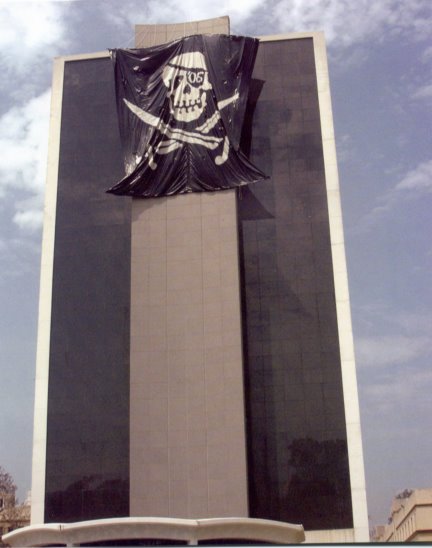
Caltech's Millikan Library continues to serve as the campus's tallest billboard (in addition to being its tallest building). This year the east side of the nine-story edifice was adorned with a Jolly Roger, the skull decorated with an “06” eyepatch.

The accompanying illustration was published in the new issue (Volume LXIX, No. 2) of Engineering & Science, Caltech's quarterly magazine for alumni and friends of the institute. As reported in the photographs' caption, “Besides flying their colors from Millikan Library, the pirate crew made the Gene Pool next to the Beckman Institute run red with blood in the form of FD&C Red Number 5.”

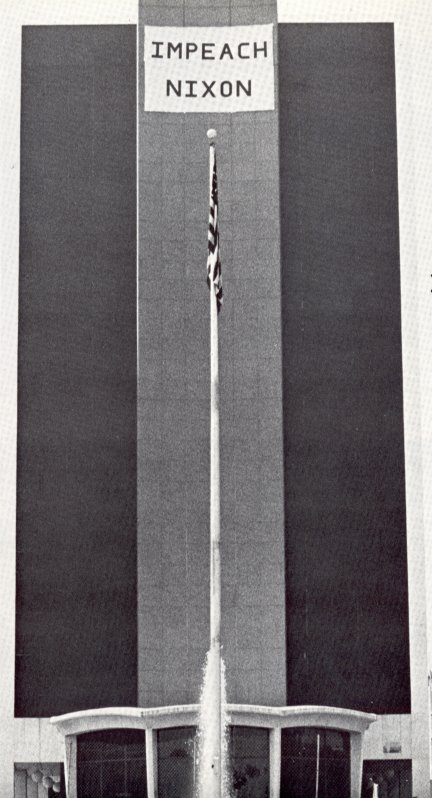
Back in 1973, Millikan was used to acknowledge a more specific pirate, who was then (but not for much longer) occupying the White House. Students from Dabney House used their mountaineering skills to dangle from ropes while affixing the wooden frame of their canvas sign to the side of the building. Quite a feat. The “Impeach Nixon” banner attracted wide attention, including an angry letter from the president of the National Oil Company, who said the prank was going to cost Caltech a million dollar contribution he had been planning to make. Campus opinion was mixed, but most of us thought the oil man was blowing smog. He could just as easily have written a letter saying he had decided against a two million dollar contribution. Words are cheap when they're not on a cashier's check.

The local coterie of college Republicans, in a tradition which survives to the current day, were gormless pudges unable to rappel down the side of Millikan to remove the offending sign. They dangled hooks over the parapet at the top of the building in an attempt to snag the sign and break it loose. When that failed, a genius who is probably now working in the Bush/Rumsfeld Pentagon came up with the idea of torching the sign. Fortunately, the polished rock face of Millikan Library was not seriously damaged, but it was defaced by soot and ash that remained visible for months.

The bastards are still at it, aren't they?

Thursday, August 03, 2006

Math majors are cool

We're, like, commercially viable?

It's time for the back-to-school sales and the airwaves are full of commercials on that theme. Ross Dress for Less is running a typical offering. While a perky and pretty teenage model equips her room and her wardrobe with new items, the voice-over explains that you can avoid “department store prices” by shopping at Ross. The model plops onto her bed, smiles at the camera while she tucks back her long hair with one hand, and says, “I love saving money. After all, I am a math major!”

Well, hot damn and knock me over. Major majors can now be pretty and perky on TV? This is a long way from Barbie's “Math class is hard” whine. What a nice development! I'm not, however, going to get my hopes up too high. Perhaps we're on our way to being rehabilitated in the public eye, but I suspect the Ross spot is more a fluke than a harbinger of a new trend. Really, the odds are against it.

You could do the math.

Tuesday, August 01, 2006

Are you being served?

Situational friendliness

Life can be difficult for creatures of habit. We like our routines and feel distress when they're disrupted. Disruption, however, is the natural state of affairs. Everything changes with time. Our habits must perforce change with them, and adapt to the new circumstances.

Before my favorite pizza place shut down and left town, it was my regular Saturday afternoon haunt. The ritual called for me to stop by the post office, pick up the week's mail, and read through it while munching on a personal-size Hawaiian pizza (Canadian bacon and pineapple, sometimes with mushrooms added if I were feeling giddy). As a known regular, I could count on the instant arrival of my preferred beverage and a quick pro forma confirmation of “Your usual?” It was comfortable. That habit lasted for many years and I was at quite a loss when it came to an end. (There's a large supermarket on the site now. I always experience a small pang when I shop there.)

It took awhile to get adjusted to a new regimen. My current Saturday habit is already of several years' duration and involves breakfast instead of lunch. I read the morning newspapers instead of the weekly mail and I like to show up early, before the rush. As a regular, I can expect to be shown promptly to a booth by a window (so that I'll have enough light to read by). Coffee will be served and there'll be a quick question about my “usual” (of which there are two or three to pick from; am I developing a taste for variety in my old age?). It is comfortable, and gets me started on the weekend in a predictable (and slightly caffeinated) manner. But it is about to change.

My breakfast venue is not threatened by radical new ownership or absorption into a growing commercial mall. No, this time it's a personnel change. I've grown accustomed to the usual cast of characters, which in a university town tends to run toward the young and fresh-faced. Some are students and some are not. Some graduate and go away and others simply get restless for new opportunities. Last week Taylor served breakfast with his usual panache, then announced he was leaving soon for the cooler climes and more urban environs of the Bay Area. I was startled to realize how much I regretted hearing that.

He's right, of course. He'll have more opportunities in a metropolitan region, to say nothing of the fact that he fancies himself a city boy anyway. Life in a modest college town must be dull by comparison for him. I don't know him well, of course, since our acquaintanceship is based on the simple fact that he frequently waits on me. That's not exactly a friendship, you know. Still, he knows his clients and, in particular, knows I'm a math teacher, knew when I was in grad school, and always seemed to keep tabs on things. On the one hand, this is merely the sound practice of one who serves a clientele and hopes for good tips. On the other, though, it's a thoughtfulness and consideration that becomes an episodic friendship—confined in a special compartment, but friendly just the same. I'm going to miss him. And I wish him well.

Darn him. I'll have to break in someone new now.

Sunday, July 30, 2006

Religion is good

For something, at least

My godson/nephew has a GF. At least, that's how my GS/N expressed it in his e-mail to me. Rather subtle. How did he expect me to parse that? God Father? (Like I didn't already know, right?) Grosse Fugue? (No, he's not that big on Beethoven.) Great Fall? (No, that was Humpty Dumpty.)

Fortunately, my GS/N has a clever GF/U, so I eventually puzzled out that he had finally gotten a girlfriend. The boy is rather a late bloomer in that respect, but grad school can do that to a science student. (And far be it from me, the boy's bachelor uncle, to give him a bad time.)

The GF appears to be the real thing, so she's undergoing the charming initiation rituals favored by our family. My GS/N has taken her to visit his parents a couple of times and she's even met his fearsome grandparents (my folks). She been cross-examined on family background, religion, politics, dietary practices, and number of tattoos. The family is thorough in its intelligence gathering and could put the CIA to shame. (But, hey, who couldn't in these days of Bushworld?)

Eventually my GS/N worked his way down through the family ranks till it was time for his GF to meet the GF/U. He called in a debt—a dinner I've promised him for ages—and the meeting duly came to pass.

I can say that I like the GF, although I did not feel any need to subject her to a special examination. She was, however, curious about me and wanted to know how it was that I had dual status in the life of her boyfriend. How was I both godfather and uncle? In some families that's achieved by intermarriage and inbreeding. In our family we do it with religion. I explained that I was the boy's maternal uncle, since his mother is my sister, and I'm his baptismal godfather because his parents bestowed that honor on me when he was born. It's a Catholic thing.

The GF is not a Catholic. Well, well. I'm sure that was the occasion of at least a bit of consternation in the maternal wing of his family. Still, she was pleasant and curious and wanted to know more about my baptismal duties. Her boyfriend and I explained that infants born in Catholic families are promptly baptized under the sponsorship of adults chosen by their parents to act as godparents. In theory, and sometimes in practice, the godparents see to the religious upbringing of the children if the parents are not able to. They also try not to drop the baby during the actual baptism ceremony. The main job of a godparent, however, is to provide gifts to the godchild at birthdays and holidays.

There is a certain awkwardness that arises, of course, whenever a godparent's religious convictions are at variance with the parents'. I was still nominally Catholic at the time my nephew was born, so that wasn't an issue. (For all I know, the diocese still carries me on the books in their Catholic population headcount. Those inflated numbers have to come from somewhere.) It became more of an issue when my godson came of age for the Catholic sacrament of confirmation, another Church ritual in which godparents figure.

“I'm just his baptismal godfather,” I told the GF. “My brother is his confirmational godfather. By that time, I thought it would be better if he had someone else as his Church sponsor. And the main thing is that he now has two godfathers, which doubles the number of gifts he can expect per year.”

“He made a good deal, then,” said the GF.

“That's right,” I continued. ”Just when you think religion is good for absolutely nothing in this world, it turns out that you can benefit from it after all!”

The GF paused for a moment, wide-eyed, and said to her BF, “Did I just hear what I thought I heard?”

My GS/N chuckled and replied, “Oh, you definitely heard what you thought you heard. That's my uncle.”

Hey! He forgot to mention “godfather,” as well. But I shouldn't take too much credit for his religious upbringing. He is, in fact, lapsing quite well all on his own.

I still expect a big church wedding, though.

Sunday, July 23, 2006

Sometimes a heel is just a heel

The seduction of the innocent redux
Barry is worried about dangerous squid in the pool, but what Curtis encounters is even scarier!
I'm just a bit too young to remember the fuss created by Fredric Wertham's attack on the hidden messages in comic books. He documented his thesis in a book titled Seduction of the Innocent, which was published in 1954. Wertham, a medical doctor, was sure that the writers and artists of comic books were striving to send subliminal messages about homosexuality (“Excuse me, Mr. Wayne, about your boy Dick Grayson: What exactly is a ‘ward’?”) and sadomasochism (e.g., Wonder Woman).

An echo of the Wertham diatribe arose in the late 1970 when Wilson Bryan Key began publishing a series of books on “subliminal seduction.” He started off in 1973 with Subliminal Seduction: Ad Media's Manipulation of a Not So Innocent America and continued to work that vein with a new book every couple of years. I was working a summer job as a science journalist when Key breezed through town on his publicity tour to promote Media Sexploitation. I remember our senior science writer poring over Key's examples of subliminal advertising with the health writer, laughing as they tried to see the sexy images Key claimed were hidden in a photograph of ice cubes. (“Ice cubes just don't turn me on that much.”) Key published his last book in 1992 and we don't hear much about him these days. Soon after the incident in the newsroom, however, I got a job with the California legislature, just in time for the flap about hidden messages on the vinyl records of rock groups like Led Zeppelin. One Republican legislator tried to get a law passed to make it illegal, but he couldn't get enough people to take him seriously.

More recently, of course, we've witnessed the stunningly successful campaign—although for only a brief time—by Marge Simpson to censor cartoons like the lovable Itchy & Scratchy. Fortunately, she came to her senses and soon realized that censorship is a cure worse than the original illness. Marge's epiphany came in the form of Michelangelo's “David,” whose scheduled visit to Springfield created an outcry over the supposed obscenity of David's dangling doodle. Saner heads prevailed and, astonishingly enough, the episode ended with everything restored to the exact status quo that had prevailed at its beginning.

As you can see, the panic over subliminal images never really ends. As I was paging through the Sunday newspaper this morning, I was reminded of this when some of the colorful artwork caught my eye. The new installment of Ray Billingsley's Curtis brings us yet another ripe opportunity for the dirty-minded to exploit. While the timid Barry worries about creepy invertebrate sea life, the bold Curtis plunges fearlessly into the swimming pool (how does he keep his hat on?) and encounters the horrors of the deep. Say, what is that scary thing that caught Curtis's terrified gaze? My own opinion is that Curtis is offended by the shockingly bad taste exhibited by the red swimsuit.

Why, what did you think I was going to say?

Wednesday, July 19, 2006

A creationist tells the truth

As he sees it, naturally

Creationists are notorious liars. It's as though they can't help themselves when they consciously distort the words of evolutionists as they assiduously go quote-mining for phrases they can cite out of context. I suppose it's okay to break the commandment against bearing false witness as long as you do it in a good cause. Ad majoram Dei gloriam and all that (although I imagine most rock-ribbed creationists would blanch at my quoting the Jesuit motto).

Therefore it is a rare treat to find a creationist who is almost painfully honest by comparison with most of his fellow believers. (I did say “almost”; even this sterling figure is not quite perfect.) The creationist in question has genuine scientific credentials—another rarity in the ranks of the Genesis crowd. Jason Lisle holds a doctorate in astrophysics from the University of Colorado at Boulder. He's published research in solar astrophysics. Clearly he's not just another one of the disgruntled engineers who get to call themselves “scientists” once they sign on as anti-evolutionists.

Dr. Lisle came to my attention when I picked up a copy of his book Taking Back Astronomy: The Heavens Declare Creation. While TBA is not the first attempt to explain away the mismatch between the billions of years of history recorded in the sky and the paltry 6,000 years posited in the Bible, no other book appears to have an author of such reputable scientific pedigree. Young-earth creationists with Ph.D.'s in astrophysics are as rare as hen's teeth (if you'll forgive the evolutionary phrase).

Taking Back Astronomy won't help Lisle's reputation among his fellow scientists, but that may be moot anyway. He decamped from the field of real astronomy years ago to become, as TBA's author blurb has it, “a research scientist, author, and speaker at Answers in Genesis in Kentucky, and is the planetarium director at the Creation Museum.” A planetarium in a young-earth creation museum? Well, if it were easy to explain then any fool could do it. Dr. Lisle exercises his book-learning and his smarts to do the impossible, reconciling Genesis and reality.

So how well does he do it? And why do I remark on his truthfulness? Well, in the beginning—as they say—Lisle offers a cogent observation with which I entirely agree:
Glasses of the wrong prescription can make the world appear even blurrier than it otherwise would. Glasses can either distort or make clear, and so can a worldview.
However, Lisle's comment on the importance of a worldview shares the page with an illustration of a nice fat Bible, an illustration whose caption reads, “The Bible is the history book of the universe.” Well, so much for worldview. Lisle's view is that everything must be contemplated through the lenses provided by a strict literal interpretation of Genesis. As they teach us in logic, you can conclude anything from a false premise, so Lisle is off and running.

As a diligent scholar, however, Lisle doesn't restrict himself to Genesis. No, he ponders other sources of knowledge, too. Like the book of Isaiah, for example:
The Bible indicates in several places that the universe has been “stretched out” or expanded. For example, Isaiah 40:22 teaches that God “stretches out the heavens like a curtain, and spreads them out like a tent to dwell in.” This would suggest that the universe has actually increased in size since its creation. God has stretched it out.
Yes, Lisle is arguing that the Bible anticipates the discovery that the universe is expanding. While he said the Bible refers to this in “several places,” the Isaiah quote is the only citation I found in TBA. I presume therefore that it must be the best. Does the “like a curtain” simile put you in mind of something that grows and grows and grows? That's some curtain. How about the tent instead? God spreads it out and keeps stretching it, rather like a situation comedy camping trip, where you know the tent will come to no good end. If the God in Isaiah is pulling tents out of shape as dramatically as all that, we can assume he never got the merit badge for camping.

Naturally I perked up when Lisle moved on to some numerical arguments:
The Bible often uses the “stars of heaven” to represent an extremely large quantity. Genesis 22:17 teaches that God would multiply Abraham's descendants “as the stars of the heaven, and as the sand which is on the sea shore.” Genesis 32:12 makes it clear that this represents a number which is uncountable by humans: “the sand of the sea, which cannot be numbered for multitude.”
Lisle follows this up by pointing out that the stars in the universe and the sand of the sea are approximately equal in number—somewhere around 1022, thereabouts. But didn't the Bible say humans cannot count these? Oh, that's okay! Lisle hastens to assure us that they can be “roughly estimated” but never “counted exactly.” See? The Bible was using figurative language! (Oh, wait a minute. Scratch that!) In any case, I have to say that Lisle's worldview goggles are working really well.

By the way, would Dr. Lisle care to enlighten us as to where we're going to put Abraham's ten billion trillion descendants? It sounds like planet Earth is going to get a little crowded. As for those preachers who like to piously express the hope that Jesus not tarry long in his return, need I point out that a lot of baby-making has to occur before Abraham's children number 1022. For Christ's sake, I hope the waiting room has a comfy chair.

My copy of TBA is from its first printing. Some errors survived the proofing process, but only one was deemed of sufficient significance to prompt the publisher to affix correction stickers on one of the pages. Lisle whips out some calculus to demonstrate that the recession of the moon argues against an old universe. No doubt the proofers were entirely unable to make heads nor tails of the mathematical notation, so the original printing is a mess. One of the errors even survives on the correction sticker, where 1029 is rendered as simply 1029. Quibbling aside, however, I can confirm that Lisle's computations are quite correct. However, a computation is only as good as the assumptions that go into it. Lisle adopts a caricature of scientific uniformitarianism when he says that secular scientists assume that physical processes don't vary over time. (No doubt he's thinking about the assumption by mainstream science that radioactive decay rates and the speed of light really are constant, an assumption Lisle doesn't accept.) Thus he says we should assume, for the sake of argument, that the moon's recession rate constant is k = 1.2 × 1029 km7/yr, as it was in the beginning, is now, and ever shall be. Amen.

The recession rate constant appears in a differential equation for the rate of change of r, the earth-moon distance, with respect to time. Lisle says the equation is approximately given by dr/dt = k/r6. Do you feel a pricking in your thumbs yet, because a wicked-awful argument is in the offing? Using the current lunar recession rate of 2.3 cm/yr as an initial condition, Lisle “proves” that the upper bound on the age of the earth-moon system is 1.5 billion years, “much less than the 4.5 billion years that evolutionists require.” First of all, getting this back-of-the-envelope calculation to come out within a factor of 3 of the accepted age of the earth is not exactly a miss. It's remarkably close, in fact, considering that the differential equation is only an approximation anyway. Besides, the earth-moon system was quite different in the past, at least under the principal hypothesis of its formation, so it takes no stretch of the imagination to suppose that k was different eons ago. Nevertheless, Lisle brags
The recession of the moon is a problem for a belief in billions of years, but is perfectly consistent with a young age.
I guess he has a point. If the universe is only 6,000 years old, you sure don't have to worry about the moon going anywhere.

Lisle continues in this vein throughout Taking Back Astronomy: When scientists offer hypotheses or explanations, he waves them away as if they were no more than Ptolemaic astronomers struggling to “save the phenomena” of the geocentric theory of the universe. When Lisle espies any feature of modern astronomy that is not explained to his complete satisfaction, it's a telling blow against mainstream science and the purported age of the universe. He appears completely sincere and open in his arguments, carefully building everything on a biblical foundation. Eventually, even though he might not think so, Lisle comes to ignominious grief when he cites the work of another credentialed creationist, physicist Russell Humphreys. Mainstream astrophysicists have a big problem, Lisle explains, in understanding the strengths of magnetic fields detected during space exploration. In a solar system billions of years old, magnetic fields should be weak and attenuated. Creation science, however, offers a compelling explanation:
Dr. Russ Humphreys has produced a creation-based model of planetary magnetic fields. This model proposes that when God created the planets of the solar system, He made them first as water which God then supernaturally changed into the substances of which the planets are comprised today.
You see, water molecules are dipoles that generate a small magnetic field which just might hang around after the water transmogrifies into other elements. Wow! This is working way too hard. The moment Humphreys came up with a “theory” that required God's direct intervention, William of Ockham would have nudged him in the ribs and said, “Hey, buddy, why not just let God set the magnetic field strengths directly? I mean, as long as he's puttering around in the universe doing magic.”
After God transforms the water into other materials, the electric current maintaining the magnetic field will begin to decay as it encounters electrical resistance within the material.
Not if God doesn't want it to!

I'm sorry, Dr. Lisle. “God did it” is not a scientific hypothesis. You pass your own worldview test with flying colors. Your blinders are in excellent working condition.

Friday, July 14, 2006

Recycling old words

Vocabulary for mis-Ann-thropes

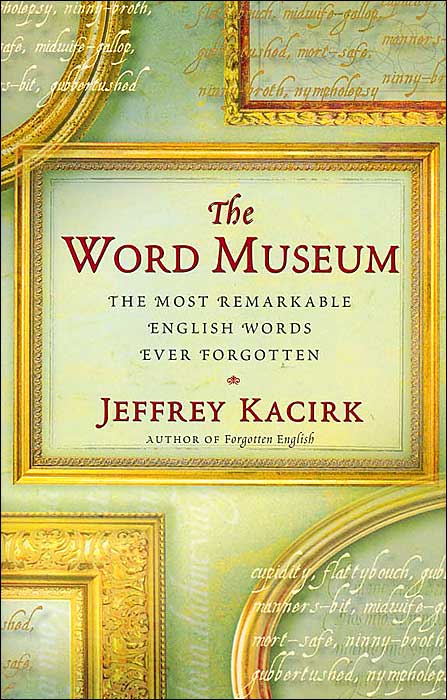
The senior member of my Friday lunch group is fascinated by words and homes in with his highlighting pen on unfamiliar expressions in his reading material. Browsing through one of his books is like examining a manuscript illuminated in pinks and yellows and blues. Today, though, he brought along a book that he had left completely unmarked. No wonder, either. He would have needed the paint-roller version of highlighter to flag virtually every word on every page of Jeffrey Kacirk's The Word Museum: The Most Remarkable English Words Ever Forgotten. The subtitle is not completely accurate (we found a few entries we have never forgotten), but Kacirk's book is certainly replete with obscure words.

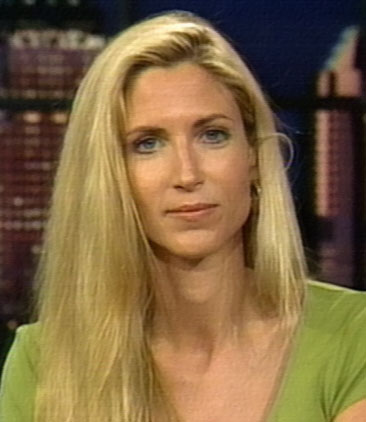
During a lunch discussion that wandered through the topics of opera, sports, politics, and health, I borrowed the book and paged through it. Some of the words stood out as instant favorites. With the encouragement of my lunch companions, I began to string them together into a little story. Not only was it amazingly easy, as if the story wanted to tell itself, it was almost immediately apparent that the story had to be about Ann Coulter, although I doubt that this could have been Kacirk's selection criterion for the words in his book. Observe. Story first; glossary second:
As she plies her trade as a self-proclaimed snoutfair and prunk dispenser of scaum, we can imagine she cut her teeth as a flarting nazzle. Time, however, is not the ally of this cock-throppled fishfag, now well on her ostentiferous way to becoming a dwizzen-faced hurrion. She may not anticipate her condign fate while still basking in the puzzomous regard of the national media and girding her loins in defense of the rhonchisonant quockerwodger in the White House, but she will end up well and truly scunt.
My favorite word in this brief cautionary tale is cock-throppled, which deserves to be brought out of retirement specifically for Ann Coulter. Here are the definitions of the obscurities, excerpted directly from The Word Museum:
cock-throppled: Having the “Adam's apple” largely developed. From thropple, the wind-pipe.

dwizzen: To shrink and dry up; to have a parched appearance, as withered fruit, or the skin of old people. A skinny-looking person is dwizzen-faced.

fishfag: Originally a Billingsgate fishwife; now any scolding, vixenish, foul-mouthed woman. SEE tongue-whaled, xantippe.

flarting: Mocking, jeering.

hurrion: A slut. So called from hurrying on things, or doing them so hastily and carelessly that they are not well done. SEE ferry-whisk, fluckadrift.

nazzle: A child who has been guilty of deceptive practices is termed a “little nazzle.” Never applied to the male sex.

ostentiferous: That which brings monsters or strange sights.

prunk: Proud, vain, saucy.

puzzomous: Disgustingly obsequious.

quockerwodger: A wooden toy figure which, when pulled by a string, jerks its limbs about. The term is used in a slang sense to signify a pseudo-politician, one whose strings are pulled by somebody else.

rhonchisonant: Imitating the noise of snorting.

scaum: Insincere talk; banter. One listening to a letter being read will, at a characteristic passage, say of the writer, “That's like his scaum,” like his trick of talk, being more humorous than sincere. The term is also applied to scornfully abusive language.

scunt: Bankrupt; used in marble games. When a boy has lost all his marbles, he is said to be scunt. The word appears to be a variant of skinned, which is used in the same sense.

snoutfair: A person with a handsome countenance. SEE bellibone, cowfyne, pigsnye.
This is a game the whole family can play. Get yourself a copy of Kacirk's The Word Museum and create your own orotund morality plays. And don't worry too much about Ann. As long as you're talking about her, that stultiloquent spoops will be happy.

Tuesday, July 11, 2006

A is for Artificial

The extra credit hoax

I hate messages like this:
Dear Dr. Z,

I am wondering if there are any extra credit or make up exam I can do to improve my grade to an A? This is very important to me to get an A at this class, please let me know.

Thank you.
Would you consider coming to class on time? Or coming to my office hour for assistance? You were half an hour late to the last two class sessions and you have never sought help during the hour I'm in my office right after class.

Actually, I didn't say that to her. I tried to be more subtle:
Thanks for your message. There is very little extra credit in a calculus class like ours. (I give a few extra points to students who put solutions up on the board.) A good grade depends mostly on doing well on exams. You should focus on being prepared for those. It would also be a good idea to earn all the points possible on quizzes, even though they're not worth as much as exams, so attending class regularly and on time (so you don't miss the ones at the beginning of the period) is also a priority.

The main reason I don't give much extra credit or make-up work is because an A should reflect mastery of the subject, not the amount of extra work one does.

Be ready for tomorrow's exam and do the best you can. You are doing rather well in the class and can be confident of at least a B for the course. An A is more difficult, but within reach if you earn excellent scores on the remaining two chapter tests and the final.

-Z-
As you may have noted from my response, the “I need an A” message arrived the day before an exam. That's never a good sign. It smacks of grasping for straws after a frustrating study session.

I tried to be reasonably encouraging. The student has been earning a middling B in the course, but after looking over the most recent exam I can see why her concerns are mounting. She may be one of those “one-shot” students—those who cram facts and examples into their heads just before a test and lose it all the moment they walk out the door afterward. That is, of course, the kiss of death in a math course, or any other course where cumulative knowledge is at a premium. Today's exam was about optimization techniques, but it requires everything the students learned in preparation for the exam on differentiation methods. While she passed the differentiation exam (squeaking out a B with a score of 80%), since then she's gotten a little unclear on the power and product rules. This is not good. Her B is weakening and can't withstand a continued slide in her performance.

You'll note that I also gently prodded my student about coming to school on time, since she has missed quizzes that were held at the start of class. The day after I sent her the gentle reminder, she strolled in thirty minutes late. Apparently she did not feel any need to attend the in-class review session that I conducted just before administering the exam. The preliminary indications suggest her need was greater than she realized.

Learned behavior

A colleague and I discussed the situation in which my student finds herself. My colleague suggested that the “extra credit” approach might have worked for her in the past, especially in classes other than math. If it's worked before, one can hardly blame her for trying again. I just regret that she's seized on it as a panacea for her predicament.

But what does “extra credit” signify? Bonus points might increase a student's grade, but they say nothing about whether a student actually learned anything. I suppose I could devise extra-credit projects that would entail solving actual mathematical problems, but that's what homework is for. If you're still unclear on the concept after doing the homework, then it's time to see the teacher (I should think). Or raise questions during the homework review session in class (which the student in question never does).

The clear impression I received from my student (and others like her in past years) is that “extra credit” is the magical solution that permits any diligent student to rack up the points necessary for a target grade—entirely independent of mastery or comprehension. Understanding stuff is challenging, but earning a grade via the extra-credit route merely requires a willingness to grind away at point-earning projects. Frankly, I think grades earned that way are bogus grades. They may look great on a transcript, but they mislead you about the student's accomplishments. They mislead the student, too. Witness the example of my student, who struggles with the product rule for derivatives yet thinks she could reasonably hope for an A in calculus.

I'm afraid one of her biggest lessons this summer session will not be mathematical.

Update: The exam results are in. My “needs an A” student managed a score of only 64%. Her course average drops from a lower-middle B to a high C. The trend line is not encouraging. The evidence now suggests she would have to work diligently to demonstrate that she is a good calculus student—let alone excellent.

Saturday, July 08, 2006

The Lois Lane Protective Society

He's too super for you, girl

Now that Superman Returns has been in release for a while, I suppose that most interested parties are aware that this new movie is a surprisingly explicit rival to The Da Vinci Code. (Spoiler alert: If you haven't seen it yet, you might want to stop reading right now, because I'm going to mention the movie's surprise twist.) Both movies offer saviors with supernatural powers, fallen women, and divine offspring. While Da Vinci merely mangles the historical record and Christian tradition in pursuit of titillating diversion, Superman Returns trifles scandalously with the health and well-being—life, even—of its lead female character.

The great unanswered question in Superman Returns is how Lois Lane managed to survive her intimate encounter with the Man of Steel without incurring extreme physical trauma. This question is thrown into sharp relief when the incident of the Steinway piano reveals the paternity of Lois's out-of-wedlock child. Although I was momentarily stunned by the shocking spectacle of the reduction of a concert grand into a splintered wreckage (some movie violence really is beyond the pale), I soon realized that circumstances now demanded a serious explanation. None was forthcoming.

While biologists might tend to fret over the extreme unlikelihood—impossibility, even—of convergent evolution on a distance planet producing a species interfertile with homo sapiens, scientists in other disciplines long ago identified problems that are even more fundamental. Larry Niven is one significant early researcher into the issues of Superman's potential to produce Earth-based progeny. In 1971 he published the treatise Man of Steel, Woman of Kleenex, which appears to be the first scholarly examination of the pertinent issues. Niven minced no words.
Electroencephalograms taken of men and women during sexual intercourse show that orgasm resembles “a kind of pleasurable epileptic attack.” One loses control over one's muscles.

Superman has been known to leave his fingerprints in steel and in hardened concrete, accidentally. What would he do to the woman in his arms during what amounts to an epileptic fit?... Superman would literally crush LL's body in his arms, while simultaneously ripping her open from crotch to sternum, gutting her like a trout....

Lastly, he'd blow off the top of her head.
As Niven points out in an understated footnote, “One can imagine that the Kent home in Smallville was riddled with holes during Superboy's puberty. And why did Lana Lang never notice that?”

These difficulties appear to offer insuperable problems in any attempt by Superman to engage in traditional sexual intercourse with a human being. Niven then examines whether artificial insemination might offer a more feasible alternative if Superman wishes to have offspring:
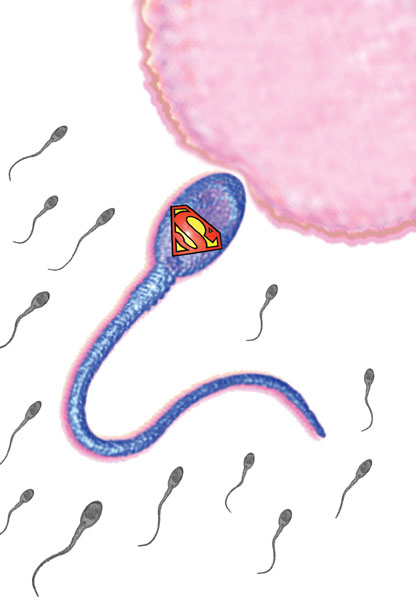
One sperm arrives before the others. It penetrates the egg, forms a lump on its surface. The cell wall now thickens to prevent other sperm from entering....

And ten million kryptonian sperm arrive slightly late.

Were they human sperm, they would be out of luck. But these tiny blind things are more powerful than a locomotive. A thickened cell wall won't stop them. They will all enter the egg, obliterating it entirely in an orgy of microscopic gang rape. So much for artificial insemination.
There are other problems, as well, such as the question of what happens if Superman's sperm cells share his physical invulnerability. Might they survive indefinitely, using their kryptonian powers to fly about the Earth, seeking fertile eggs wherever they can be found? Since this has apparently not occurred, there must be some as yet unknown inhibitory mechanism that preserves the women of the world from unexplained kryptonian pregnancies. That, at least, is very fortunate. Niven cites the dread possibility that fetuses fathered by Superman might begin to experiment in vivo with the heat vision inherited from their sire. And vivo would undoubtedly be short-lived the moment that superbabies began to kick within the womb.

For everyone's sake, it would be better if Superman never attempts to breed. The message of Superman Returns, however, is that there is a way that it can be successfully done. Since reality is entirely logically consistent, we residents of Superman's universe wait hopefully for the revelation that will explain the advent of our savior's son.

Tuesday, July 04, 2006

Blogito, ergo sum

Apologia pro blog suo

Today Halfway There is privileged to present an interview of that estimable blogger “Zeno.” This is not the first time we have profiled this remarkable individual, who provided a chatty first-person account in Who is Zeno? concerning the origin of his nom-de-blog. Zeno—sometimes also known as “Zeno Ferox”—is a brilliant writer and mathematics educator. We're sure you will enjoy his scintillating discourse and repartee as we subject him to a close examination with our penetrating questions. So, without further ado, we give you the transcript of Halfway There's interview:

Halfway There: Welcome to Halfway There, Dr. Z, it's an honor and a privilege to have you with us today.

Zeno: You're not fooling anybody, you know.

Halfway There: We're obviously fooling you, buddy, since you replied to our opening remarks. Please think of this as a form of self-examination in the manner of your heroes Cardinal Newman and David Berlinski.

Zeno: Self-abuse is more like it, but that's a nice use of obscure allusion with the “apologia” subtitle. You're going to have people thinking I know a smidgen of Latin. As for Berlinski, the word “manner” wasn't a bad choice, because I find his writing extremely mannered, as well as unenlightened and unenlightening. I decline to acknowledge either Newman or Berlinski as personal icons.

Halfway There: Point taken. As for Latin, I'm certain you know exactly as much Latin as we do. But enough of the gentle bantering and verbal fencing. Let's get down to the details people are clamoring to know.

Zeno: Good luck with that.

Halfway There: First things first: why blog?

Zeno: Well, I'm pretty sure it's cheaper than psychotherapy. In addition, sometimes I have things to say and blogging is a convenient way to say them publicly, just in case anyone else is interested.

Halfway There: And are they?

Zeno: Sometimes. I used Bloglines to track the blogs I like to read and I've noticed that I have 7 subscribers who are watching my blog for new posts—that's 6 if you don't count yourself. Uh, myself. Whatever.

Halfway There: Who are your readers and what are they interested in?

Zeno: Because the traffic on my blog is quite low—averaging between 50 to 100 hits per day—I can actually have some familiarity with the regular readers. Each time I put up a new post, I promptly see visitors listed on Site Meter whose home domains are harvard.edu, caltech.edu, and a few other college sites, including my own school. I have a frequent visitor in Reykjavik who's been absent recently (Hello, Iceland!); I suspect school is out for the summer. The Site Meter world map shows that most of my readers are concentrated in North America, but I get visitors from all over the globe. That's spooky in some ways. The notable exception is Africa. Except for the occasional reader in South Africa, I don't see any visitors from that continent. Perhaps if I posted more things in Portuguese I'd get some hits from Angola and Mozambique. It might raise my hit rate from South America, too, which is also rather sparse in readers of my blog. No big surprises. This is an English language site.


Halfway There: You get hits from your own college site? Do those readers know who you are?

Zeno: Oh, definitely. At least, I don't know of any readers from my college who don't know who I am. There might be a couple. I have three colleagues in my math department who know my blog pseudonym and are fairly regular readers. Sometimes I even drop them a note when I put up a post that's specifically about math or math teaching, since that's obviously our common interest. A few non-local friends read my stuff from their homes in Nevada, Washington State, and Canada.

Halfway There: So you're not totally anonymous as a blogger, are you? Why bother with the pseudonym?

Zeno: Why does anyone? Privacy. At least a degree of privacy. And not just mine. My students have a right to their personal privacy and I must respect that. At the same time, I want to share my opinions and experiences as a teacher. Just as I used codenames to disguise my students' identities when I did my dissertation research on them, my blog pseudonym conceals my school and my students' identities when I ruminate on the attitudes and behavior of people like Boycott Woman, the Naked Student, my Best Algebra Student, the Twelve O'Clock Scholar, and Cyborg Students. Even my colleagues do not necessarily recognize these students from my discussions. When they do, it's because we've had the same student in our classes and, in some cases, discussed among ourselves some ideas about dealing with the difficulties they might present. My students' identities are not for public consumption, even if the educational issues involving them might be of interest to a broader audience than just the faculty members in my department.

Halfway There: Do members of your family visit your blog?

Zeno: God, no! Mom and Dad and “Becky” and “Phyllis” get enough grief directly from me without also having to wade through my blog posts. My father, of course, is aggrieved that his son is “too liberal,” but his brain has been rotted out by too much exposure to Rush Limbaugh and printed propaganda by Ann Coulter, Zell Miller, Sean Hannity, and Michael Savage. My parents have severe cases of political Alzheimer's and would be appalled by my writing. They're already appalled by what I say in their presence when they're foolhardy enough to poke me with a rhetorical stick. Dad: “Can you believe those Senators were stupid enough to vote against oil drilling in the Arctic National Wildlife Reserve?” “Well, Dad, I would have voted with them. Even if I thought it was a good idea, I'd vote against letting a criminal enterprise like the Bush administration be in charge of it.” Yeah, no time soon am I going to be saying, “Look, Mommy! Look, Daddy! See what I did!” We've agreed to disagree—at swords' point.

Halfway There: You write about mathematics, politics, education, and science. What qualifies you to declaim on these topics?

Zeno: I've also written about music, language, religion, and culture. In most of these areas I have no professional qualifications at all. That is, of course, exactly the level of qualification that is required for the role of blog writer or political commentator at Fox News or NRO. My actual credentials are in teaching and math, of course. Unlike some people, I don't make the mistake of assuming that a Ph.D. entitles one to be regarded as a universal expert on all topics, although—to be fair—I know I've had a tendency to come across that way long before I returned to grad school for an advanced degree.

Halfway There: And how did that happen?

Zeno: I can string words together. I've even done it professionally, as a science writer for a newspaper and a columnist for a few computer magazines. Once you get the knack of it, you can be pretty persuasive. When I worked in California politics and its civil service, I sometimes got to write words that went out as statements from my boss, one of whom was a statewide elected official. It's a gift, you know.

Halfway There: And a responsibility, too.

Zeno: Yeah, yeah. I must use my power only for good.

Halfway There: Although you may have a modicum of talent for stringing words together, your academic record suggests you're not exactly a man of letters.

Zeno: Let us say, rather, that I am a man of letters and numbers. My undergraduate degrees and master's are in mathematics and my doctorate is in education with an emphasis in math education. I have done a lot of math.

Halfway There: How much is “a lot”?

Zeno: Five years of graduate work. One for the master's degree and four in a Ph.D. program I didn't complete. I passed all the written qualifying exams but never advanced to candidacy.

Halfway There: So you're a drop-out.

Zeno: More like a toss-out, actually. I made two major mistakes. You need a doctorate to teach at the four-year college or university level, but the math Ph.D. is a research degree. You have to do your research, you know. I was given a teaching assistantship for the four years I was in the university's math department, but I should have turned down the opportunity to actually teach a class instead of simply assist a professor. I tried to decline, but the department chair told me it was clearly what I wanted to do. He was right, of course. I loved it. I loved explaining things, trying different ways to get ideas across, seeing students' eyes light up with comprehension. I wish I had seen that lighting-up thing more often, naturally, but it was really rewarding and worthwhile. It just didn't benefit my graduate studies. In fact, it took time away from it, since you can always find more ways to work on your teaching techniques and presentations. It expands to fill the time you allow.

Halfway There: You said there were two big mistakes.

Zeno: Too true. While all grad students should strive to remain on the good side of their department chairs, there are situations where one should watch one's back. The first case was accepting a teaching slot sooner than I should have. The second was the composition of my graduate committee. The chair gave me the name of an engineering professor to approach about serving as my committee's “outside” member. The engineer politely turned me down. When I reported back to the math department chair, he told me he'd take care of talking the reluctant engineer into agreeing to be on my committee. Need I tell you that it's a bad idea to have a committee member who was browbeaten into serving? Real bad. Things went off track from there and I didn't have my act together sufficiently to fix it. Too bad I didn't. With more focus and less distraction, perhaps I could have, but that's not the way it worked out.

Halfway There: That started your detour into other things.

Zeno: Exactly. Beginning with journalism, which turned out to suit me rather well. My writing got a good workout in grad school, but nothing like what followed as a science journalist. Writing became a major component of everything I did thereafter, like my legislative staff position and my civil service job in a constitutional officer's department. Writing has served me well in my return to academia, too, both as a full-time math teacher and when I decided it was time to take another crack at grad school. Certainly I have done a lot of writing. If I didn't enjoy it (for the most part, anyway), I wouldn't look for outlets to do more of it. Witness this blog.

Halfway There: Perhaps. But you don't post very often.

Zeno: I started the blog at the end of August 2005, so it's been a little over ten months, during which time I've produced a little over one hundred posts. Yeah, I do only ten a month or so. I could do a lot more if that were the point, but I'm not interested in doing quick little posts that say, “Hey! Look at this!” with a link to show you what “this” is. I'd say Atrios has that approach covered pretty nicely. I prefer to say something rather than simply point and shout.

Halfway There: Okay. We noticed you don't post much about your education, except to point out that your fields are math and math ed. Isn't that a big deal to you?

Zeno: Well, sure, but I tend not to talk about specifics because this is, after all, a semi-anonymous blog. I attended some pretty good schools, but people don't need to know their names. I have not, however, been able to resist the impulse to mention where I earned my bachelor's degree.

Halfway There: Yes. Caltech. We know you've mentioned it exactly twice in your posts here.

Zeno: Only twice? That's way more modest than I usually give myself credit for. I am quite proud of being a Caltech alumnus. That is one amazing school and my two years there hammered me into the shape I am today. More than any other experience anyway. Or so it seems to me, even after all these years. Think what it's like to have your school paper publishing new photos from a space probe orbiting Mars before the regular news media get hold of them. Think about dodging Nobel laureates at every corner and coming within a hair's breadth of careening into Richard Feynman. And then during finals week you have a fellow alumnus tramping around on the moon. Pretty cool!

I probably mention Caltech a lot more in comments on other blogs than here. In fact, the last time I mentioned my alma mater in one of my own posts was when I quoted extensive excerpts from a troll infestation over at Pharyngula.

Halfway There: Ah, yes, Pharyngula. You sure do spend a lot of time there.

Zeno: What's not to love? PZ Myers is an outspoken, non-believing, unapologetic, liberal evolutionist. May his tribe prosper! I'm really weary of seeing the havoc wrought by our god-ridden federal administration and its minions. I wish we had Christians who were more given to practicing the tenets of their faith and less driven to seek political hegemony. Why do these people keep trying to pile up treasures on earth? Don't they read their own Bibles? The most fascinating thing about religious political activism is the same thing that permeates the creationist movement: lies. We see it constantly from these pious hypocrites: I'm so holy and righteous that I don't have to tell the truth, especially if it's about people who are scum anyway. Exactly those people who should reject “the ends justify the means” are falling over themselves to embrace expediency. If I thought it likely that God existed, I would pray that the Deity might protect us from our modern Pharisees. As it is, I would be greatly pleased if the overweeningly faithful would spend a lot more time on their knees in supplication to their God. At least prayer keeps them busy and out of actual mischief. In that sense, at least, I think prayer is efficacious. I heartily endorse prayer. For them.

Halfway There: So what blogs do you follow besides Pharyngula?

Zeno: Well, I'm a regular visitor of Pharyngula's stable mates at ScienceBlogs. I scan quite a few political blogs. I already mentioned Duncan “Atrios” Black's Eschaton. I peruse Daily Kos every day and even got to meet Markos at his book tour stop in Sacramento and get his autograph. There are some great math blogs, too. Moebius Stripper has a great site at Tall, Dark, & Mysterious, but her postings have grown regrettably sparse. MS was the first blogger to add Halfway There to her roster of blog links. That was kind of special. Other cool math sites are maintained by Rudbeckia Hirta at Learning Curves and by Mark Chu-Carroll at Good Math, Bad Math. One of the few fellow bloggers I've had the privilege of meeting is Nick Barrowman. Nick is a Canadian who writes about statistics (not math, mind you; there is a difference) at Log base 2. I had a great visit with Nick and his two neat children when they visited family members in California.

Halfway There: What can we expect from you in the future, Dr. Z?

Zeno: More of the same, of course. I think perhaps I should try to play a little more to my strengths and work up a few more posts about teaching. The problem there is trying to cut things down to a manageable size. Education problems do not tend to come in neat bite-sized chunks, I'm afraid. I'm also inclined to do some very specific debunking. That, at least, can be tightly focused. I was inspired when Al Gore quoted Mark Twain near the beginning of An Inconvenient Truth:
It ain't what you don't know that gets you into trouble. It's what you know for sure that just ain't so.
We get tons of crap and deception from the White House and the Republican Congress. There's a lot of falsehood drifting around unquestioned in people's minds. These distortions have become part of the conventional wisdom because of reporters who are all too willing to pass them along in a lazy fashion—it's too hard to set the record straight, you know. In particular, you'll recall the GOP drumbeat insisting that Gore is either a chronic liar or simply mentally unbalanced. What a slick smear that is! And it includes things like “he said he invented the Internet.” I am so sick of that one! And we all know that Bill Clinton once said he “loathed” the military. Except he never said that. It goes on and on.

I want to put my own two cents' worth in on some of those. I'm not, unfortunately, likely to run out of them. The GOP noise machine has been generating them for a long time now.

Halfway There: Thank you very much for your time, Dr. Z. It was an honor and a privilege to talk to you.

Zeno: Yeah, I bet.

Saturday, July 01, 2006

The Ann Coulter autopsy

Dissecting the public persona

The right-wing cultural phenomenon known as Ann Coulter has another book on the New York Times bestseller list. We can dismiss the inflated sales figures all we like (for example, NewsMax gave away hardcover copies at $4.99 in a promotion to acquire new magazine subscribers), but we must face the fact that a lot of people are actually buying the book. Even my mother, to my lasting shame, has purchased a Coulter book.

Facts and reality have never been Ann's friends (nor she theirs), although her usefulness to the extremist agenda in American politics has encouraged many people to overlook her mendacity. It's not an easy thing to overlook, either, especially as her diligent detractors have done a splendid job of demolishing her specious arguments and exposing her factual errors. I do not propose to carry further coals to Newcastle by piling on additional evidence of her fondness for falsehood, although I will certainly have occasion to cite specific instances. My purpose instead is to take a scalpel to Coulter's public persona, the wind-up avatar that haunts the precincts of Fox and CNN, and examine the cogs and gears of its entrails. While I doubt that the public Coulter is the same as the private Coulter, it matters not whether she is a true believer or merely a highly successful hypocrite.

Let's take her at face value and ask some questions. The answers will be documented in the most responsible manner possible—with her own words.

Question: Is Ann Coulter a Christian?

Answer: No. She is not. Yes, I know the risk of running afoul of Matthew 7:1. (Okay, for you heathens out there, Mt. 7:1 is “Judge not, that ye be not judged.” I'm quoting from the King James Version, of course, the big gay edition authorized by the big gay king.) I am not, however, Coulter's judge and I disavow any presumption that I can see into her “heart” (or whatever bionic device thumps in her chest). I merely cite the public record and refer to Mt. 7:16 (“Ye shall know them by their fruits”).

Coulter told Human Events Online that, “Christianity fuels everything I write.” Thus her claim to be Christian is explicit. However, she also told Geraldo Rivera, “Let's say I go out every night, I meet a guy and have sex with him. Good for me. I'm not married.” Unrepentant fornication is not an attribute of the genuine Christian.

Neither is bearing false witness, famously barred in one of the Ten Commandments. False witness, however, has never troubled Coulter. The title of her book Slander is as much a description of its contents as anything it purports to report. When the Columbia Journalism Review examined some of the challenged claims contained in Coulter's book, it found that she seemed quite comfortable in ignoring or twisting the truth. Here's one example:
Coulter Claim: She introduces a New York Times editorial on Supreme Court Justice Clarence Thomas headlined the youngest, cruelest justice, then writes: “Thomas is not engaged on the substance of his judicial philosophy. He is called ‘a colored lawn jockey for conservative white interests,’ ‘race traitor,’ ‘black snake,’ ‘chicken-and-biscuit-eating Uncle Tom’ ....” (p. 12)

Footnote: The passage is constructed to suggest that the Times authored these epithets, but the footnote refers readers to comments made in a Playboy article, which goes unmentioned in the book's text.
Is it at all credible that such a misrepresentation should have occurred by accident? No, it's clearly a lie by implication. She may have left herself a fig-leaf of deniability and claim to have been misconstrued if challenged on the veracity of her statement, but false witness is not diminished by the provision of an alibi. If Jimmy Carter can lust in his heart, Coulter can just as clearly lie in her books.

We can search all we like for evidence of Christian fruits in Coulter's work, but all we find are fleurs du mal.

Question: Is Ann Coulter pretty?

Answer: Yes and no. Normally this is a question that is properly considered out of bounds whenever the topic is something other than a beauty pageant. Coulter herself, however, has specifically made this part of her stock in trade. Her long blonde hair is a cherished trademark and her regular features are conventionally attractive. Skin deep, anyway. Coulter's website features a glamor-puss portfolio of pin-up pictures for her devotees. She even told TV Guide, “I am emboldened by my looks to say things Republican men wouldn't.” Sadly, though, Coulter is boxing herself in by relying on an evanescent asset. She bragged about her looks to TV Guide in 1997, and it's been downhill all the way since then. You can keep your brains in top condition for decades, but the blonde bombshell look is highly perishable. At 44 years of age, Ann is coming to the end of her shelf-life as a professional beauty.

Question: Is Ann Coulter smart?

Answer: She clearly is. A stupid person could not have built herself into such a success. Besides, she's a cum laude university graduate. That takes brains. While she may prostitute her intelligence in the cause of making a living as the flame-tongued goddess of the wacko right, the intelligence is clearly there. She might even be smart enough to have a hearty contempt for the wingnuts who have fallen under her spell, but that's speculation.

Question: Is Ann Coulter conservative?

Answer: No, not in any meaningful sense. Coulter is an extremist who uses the unbridled language of the anarchist. Her excuse, if she bothers to give one, is that she is “joking” when she makes outrageous statements. Her defenders think that people should be able to perceive the puckish humor when she declares that domestic terrorist Timothy McVeigh should have blown up the New York Times, “My only regret with Timothy McVeigh is he did not go to the New York Times Building.” However, when asked if she had been kidding, Coulter said, “No, I think the Timothy McVeigh line was merely prescient,” claiming that the newspaper was treasonous and deserved wanton destruction. Perhaps that was supposed to be a joke, too.

Coulter loves to employ the eliminationist rhetoric that characterizes the extremist fringe, the hate groups that nibble at the edges of American society. David Neiwert of Orcinus cited Coulter's witticism about the senior justice of the U.S. Supreme Court: “We need somebody to put rat poisoning in Justice Stevens' creme brulee. That's just a joke, for you in the media.” Yeah, pretty funny. Neiwert pondered her ostensibly funny remark:
Although, perhaps, Ann could explain just what was supposed to be humorous about it. Perhaps I'm just dense, but assassinations have never been very funny matters in my experience. Is this a new hip thing?

No, David, you're right. Ann is just a stone bitch. In addition to lacking the Christian virtue of charity, she displays no real talent for wit or humor. It's just nastiness, eaten up raw by her acolytes, who confuse pandering with cleverness.

Question: Does Ann Coulter support traditional family values?

Answer: She only claims to. In terms of political rhetoric, she does as much gay-bashing as the Christian right could pray for, but Coulter is a childless spinster. Traditional families are apparently for other people, not bachelorette Ann.

Question: Does Ann Coulter understand science?

Answer: Maybe. I'm not sure. It depends on whether she means what she says in her most recent book, Godless. If her chapters on evolution are not merely more of her pandering schtick, if she really believes what they contain, then Coulter does not understand science at all. She writes that evolution is simply an excuse for atheism, although it is entirely independent of atheism. It's an example of bad reasoning on her part, a chain of bastardized logic that runs like this: The theory of evolution does not require God as part of its explanation for the development of life on earth, therefore it is inimically opposed to the very idea of God. If Coulter thinks that's valid reasoning, then her brain doesn't work right. Her anti-evolution arguments are merely the reheated leftovers of such isolated and retrograde thinkers as Dembski and Berlinski, two mathematically trained men who are fond of spouting symbolic gibberish in defense of Intelligent Design.

Coulter writes like someone who hasn't the faintest notion what science is, possesses no pertinent ideas of her own, and regards the entire enterprise with contempt. This is probably the reason that scientists tend to return the favor.

Question: Is Ann Coulter honest?

Answer: No. God, no! Haven't you been paying any attention?