Tuesday, December 06, 2011

Dan Quayle speaks!

Stupid is as stupid does

My goodness, how we have missed Dan Quayle, the man elevated above his station in life as impeachment insurance by George Herbert Walker Bush. Quayle spoke up this week to endorse Mitt Romney for the Republican nomination for president of the United States. The man who spent four scary years one heartbeat away from the presidency stressed the conviction with which he was backing the former Massachusetts governor. Addressing Romney in front of television cameras and radio microphones, the illustrious former vice president said:
I am confident that you will be our nominee, and I am even more confident that you will be the next president of the United States of America.
Okay, you got that? Dan Quayle thinks Mitt Romney is all but certain to be the Republican standard-bearer ... and even more certain to become president. That's tricky, since the consequence cannot be more likely than its prerequisite.

Poor Dan is as good at probability as he is at spelling.

Saturday, December 03, 2011

I think that I shall never see

Sic transit gloria arboris
The house was nearly ready. The front yard was nothing but dirt, but it was already cleared of most of the construction debris. Paulinho had planted a small evergreen tree that he intended to use as a local landmark when it grew larger. “The house with the fig tree” was his father’s. His would be “the house with the evergreen.”
—From an unpublished novel
The sentence of death was announced on Thanksgiving. The decision had been made earlier, but it was revealed only when I was present to hear it in person. One more eternal verity is about to hit the dust—quite literally in this case.

The pine tree in my parents' front yard was planted the month before I arrived on the scene. The family photo album is full of pictures of the first-born standing next to it. The tree's growth quickly outpaced mine and soon it towered over everyone and everything. For many years my siblings and I referred to it as simply “the Christmas tree,” in honor of its once-a-year decoration with lights and in recognition of its uniqueness. No other house on the dairy farm was so adorned. Deciduous trees and spindly palms dominated the landscape, while our evergreen stood out in singular splendor.

For all I know, the execution has already been carried out. My parents and their friendly neighborhood tree surgeon were simply waiting for a mutually convenient date to do the deed. My Christmas visit will tell the tale, and I will know the outcome while still several miles from the family farm. The tree's absence on the horizon will be more than obvious. The loss of the lifelong landmark will be acutely felt.

My parents did not make a casual and unfeeling decision to raze the tree. The decades had inflicted significant damage on the evergreen. A dangerous crack in the upper reaches of the trunk had already forced a hasty topping of the tree before it dropped its crown on the house. No other remedy was possible. The truncated tree was still taller than anything other than the oldest palm trees (it's framed by the two tallest in the above photo), but its glory days were now clearly over. The loss of its upper third caused the tree's remaining branches to spread out in renewed vigor, extending them to the point that they began to sag and threaten to break. The old tree required either a serious and continuing pruning regimen or ... removal.

My parents made an economical and prudent decision, so the tree's fate was sealed. I passed the information along to my manuscript editor, who was aware of the tree's supporting role in my novel. He quickly replied to my message with a painfully apt poem by Seamus Heaney:
Clearances VIII

I thought of walking round and round a space
Utterly empty, utterly a source
Where the decked chestnut tree had lost its place
In our front hedge above the wallflowers.
The white chips jumped and jumped and skited high.
I heard the hatchet's differentiated
Accurate cut, the crack, the sigh
And collapse of what luxuriated
Through the shocked tips and wreckage of it all.
Deep-planted and long gone, my coeval
Chestnut from a jam jar in a hole,
Its heft and hush became a bright nowhere,
A soul ramifying and forever
Silent, beyond silence listened for.

Saturday, November 26, 2011

A tale of two churches

Catholicism in transition

This is the weekend when Catholics in the United States begin to use the third edition of the English-language Roman missal, which makes several changes to the text of the mass. It is, overall, a more traditional translation, reinstating such things as the thrice-spoken “mea culpa” (rendered in English as, “through my fault, through my fault, through my most grievous fault”) and reverting to “And with your spirit” as the rendering of “Et cum spiritu tuo” (instead of the more mundane “And also with you”). Except for the hardcore ultramontanes who still pine for the old Tridentine mass in Latin, most conservative Catholics are gleeful, correctly seeing the new translation as further evidence of reactionary retrenchment in the Church—and a further diminution of the influence of Vatican II. Can veils for women be far behind?

In the past few months I have had occasion to step into two Catholic churches. (Before anyone asks, I will note that in neither case did anything shatter or burst into flames.) Both churches are modern constructions and had some notable features in common. In particular, they represented a big step back toward a more traditionally Catholic presentation, a far cry from the nearly featureless dark-paneled rectangular box that is St. Aloysius in Tulare.

I visited Our Lady of the Assumption on the occasion of a Portuguese festa in Turlock. The pastor's brother gave me a tour of the facilities. As someone old enough to have been an altar boy in the days of the Latin Mass, I have seen enough Church history to recognize a regression toward the mean. I told my guide that his brother's church represents a successful fusion of modern construction with traditional decor. My guide beamed, acknowledging that the Portuguese community in Turlock had aimed at that exact result when planning their church.

More recently I joined some family members at Holy Spirit Church in Fresno for the baptism of a nephew. The christening would follow the conclusion of the mass service, so I thought I was safe when I made a late arrival and loitered in the lobby. However, my eagle-eyed sister was too alert for me, noted my presence, and came out to collect me and take me inside. (As previously noted, no supernatural phenomena attended my entry into the sacred circle of mystical incantations and wafer transubstantiation.) The first thing I noticed was that Holy Spirit departs from the traditional parallel rows of pews in the same way as Our Lady of the Assumption. Unlike the Turlock church, however, the Fresno church has placed its crucifix so that it is invisible to those sitting in the side pews. From that perspective, where I was sitting with my sister's family, you might as well have been sitting in an Episcopal church. Holy Spirit's altar was a Protestant-compatible table and I'm sure the motley collection of art screens behind it provided ample peek-a-boo opportunities for the servers (both altar boys and altar girls at the service I attended).

The churches in Turlock and Fresno had another thing in common, and I regret not having any photographs to show you. Both of them have the Stations of the Cross (the “Via Dolorosa”) represented in mural form as a kind of frieze on the interior wall above the main entrance. In traditional churches, the fourteen Stations are usually wall plaques depicting the crucifixion of Jesus, seven of them equally spaced on the north wall and the other seven on the south wall (many old Catholic churches were preferentially oriented so that the altar was at the east end). The mural in Our Lady of the Assumption is dark and stark, graphically conveying the pain and anguish of the Savior's execution. I commented to my guide that it seemed more intense than some parishioners might prefer. He admitted that a few people in the community had lobbied to have the mural painted over after it had been unveiled, but that it was now generally accepted. The artist had had plans for other artwork in the interior of the church, but those had been shelved after the mural of the Stations of the Cross had been judged to sate the community's appetite for the artist's work.

By contrast, the Stations mural in Fresno's Holy Spirit is an exercise in kitsch, a truly unfortunate and distracting collection of excessively bright images in different sizes, cartoonish in conception and execution. The color palette appeared to be inspired by sidewalk chalk. If any venue cries out for disciplined and respectful depictions, I should think a church interior does. While the Our Lady of the Assumption mural pushed hard against the bounds of tradition in its display of angst (Jesus is amazingly serene in most of the crucifixion scenes in Stations of the Cross), the composition had a unity of purpose and conception. The Holy Spirit mural was a collage of disparate scenes united by garish colors and amateurish execution.

The results were occasionally unintentionally amusing (unless the artist was being deliberately subversive). The fifth Station depicts Simon of Cyrene, an innocent bystander, being impressed into service to help Jesus carry the cross lest the condemned prisoner die of exhaustion before the authorities get to nail him to it. The Holy Spirit mural makes it look as though Jesus is copping a feel of Simon's butt. In the tenth Station, Jesus is stripped of his garments. This scene in the Holy Spirit mural is so badly composed that it could be subtitled “Jesus flashes his Roman guards.” Both of the guards have stunned expressions on their faces, so they appear to be quite impressed. I made it through the service without chuckling aloud, but I suspect it looked like I was having a better time than the mass warranted.

It will take a few Sundays for practicing Catholics to work the kinks out of the new Roman missal, but I expect the complaints to be few. Regular mass-goers will quickly pick up on the changes and infrequent attendees (Easter and Christmas, anyone?) won't care. For former Catholics who outgrew religion and “put away childish things,” it's mostly a matter of curiosity and perhaps just a bit of nostalgia. The third edition of the Roman missal is yet another signpost that conservatives are in the ascendant in the Church, but we already knew that, didn't we?

Addendum

In searching the web for photos of the Turlock and Fresno churches, I ran into the following dyspeptic reaction to Our Lady of the Assumption, posted by someone who thinks highly enough of himself to use “St. Christopher” as his handle:
What madness! A Catholic Church that has mostly Portuguese Mass. Oh yes — a TLM [traditional Latin mass] thrown in, at the Chapel at odd times on Sunday. Having cultural loyalty is a fine thing, and Portuguese is a wonderful language — but this focus on whatever is prevalent (Klingon Mass, anyone?) obliterates the meaning of what the Mass is supposed to represent. There is no question but that the Church must return to Latin, and a single, uniform Order of the Mass, as soon as is possible. Let those that wish to participate in something else, go to something else.
Is there any chance that “St. Christopher” might consider taking his own advice? No one is making him attend a Portuguese-language mass. For my own part, however, I think it might be fun to attend a Klingon mass. Once, anyway.

Post-Addendum

The diligent searching of my friend Gene O'Pedia has uncovered a pair of on-line images of the Holy Spirit mural. The colors are more muted in the photos than they appeared to me in real life, but I recognize the compositions and can confirm that these are the Stations of the Cross that I saw in Fresno. Their resolution is not high enough to zoom in too closely on the panels of particular interest, but they can still convey a sense of what I was talking about. The first image depicts, right to left, Stations 6 and 7 (“Veronica wipes the face of Jesus” and “Jesus falls for the second time”). The flat perspective of Station 7 (not Station 5, as I said above) makes it look like Jesus is patting Simon on the behind. The other photo shows Stations 10 and 11 (again, right to left: “Jesus is stripped of his garments” and “Jesus is nailed to the cross”). Again, the resolution is limited, but you can just tell that the two Roman soldiers are gaping at the undraped Jesus in Station 10. It's a fine example of religious kitsch.

Wednesday, November 23, 2011

A moment's reflection

Another conceptual understanding problem

I gave my algebra students a pretty little problem involving the graphs of functions and their inverses. The prompt was fairly simple:
The graph of y = f(x) is shown in the figure. Use the graph to find the following function values and then sketch the graph of the inverse function y = f −1(x) on the same coordinate grid.
The student was asked to find the values of f(−3), f(1), f −1(2), and f −1(10). As you can see from the graph, I conveniently provided my students with several points highlighted on the graph. If one examines the point on the function curve where x = −3, it is fairly easy to discern that y must be 2. Hence f(−3) = 2. Similarly, f(1) = 10. It's elementary graph reading.

After reading the initial two function values, I expected my students to discover the method in my madness, noting that I'm asking them to figure out the value of the inverse function for the input values 2 and 10, which were the initial output. Since the inverse function, by definition, maps in the direction opposite that of the original function, it immediately follows that f −1(2) = −3 and f −1(10) = 1. What could be simpler?

Apparently, lots of things. Some of my students were quite irked:

“You didn't give us the function.”

“On the contrary. I certainly did. Its graph is right there before you.”

“No, I mean, you didn't give us the formula. We can't figure out the inverse function without the formula.”

“Leave that for a moment. Can you do the first part of the problem? Can you find the value of the original function at x = −3 and x = 1?”

“No, I already told you: You didn't give us a formula to plug into.”

“I recommend you try looking at the graph a little longer.”

In a few variations on the above theme, the querulous student suddenly lit up and rushed back to his or her desk to fill in the answers. In other cases, the student instead sat down, head shaking, and appeared to be muttering sotto voce imprecations at the instructor's expense.

Later, of course, when the exams were returned, I demonstrated what I had expected them to do. Since most of them had memorized the procedure for computing an inverse function—switch x and y in the formula y = f(x) and solve for y—they should have realized that the presence of the point (1, 10) on the graph of the original function implies the presence of (10, 1) on the graph of the inverse. Previously perplexed students rolled their eyes: “Oh, is that all? Why didn't you say so?”

I thought I did.

Saturday, November 19, 2011

Hasta la vista, pendejo!

Telling more than they know

During the 6 o'clock hour on Friday morning, November 18, the KSFO talk-show hosts had some fun with the news item on the White House shooter. Babbler Brian Sussman and his trusty sidekick, “Officer” Vic, magnanimously agreed that it was important to protect the country's public officials (in stark contrast to their predecessors), but nevertheless found some cause for amusement.
Sussman:The media, though, has to really be bummed out. Because, okay, you look at the story, okay, think of this. He owns guns! All right?

Officer Vic:Yeah.

BS: He's from Idaho!

OV: Ah! That's two. We're getting close!

BS: He's a Christian!

OV: Oh! That's the big golden one right there.

BS: Oh, no, no, no. You really need a fourth one to really make this work.

OV: Yes.

BS: He needs to be white.

OV: Ah!

BS: Damn! His name is Ramiro Ortega Hernandez!

OV: Ah, darn it!

BS: He's Latin!

OV: Arrgh.

BS: We thought we had the perfect whitey. The bad Christian whitey from Idaho, who owned guns.

OV: They could even make him a tea-party guy!

BS: Oh, yes! Oh, we thought we had Idaho Whitey. The gun-owning man who's a Christian, who called Obama the Anti-Christ. But what's his name? What? His name's Ramiro Ortega Hernandez?

OV: Oh, no!

BS: Uh! Okay, wait—

OV: Can we anglicize it like we used to in baseball?

On the surface, of course, Sussman and his sidekick are simply mocking what they perceive as bias in the mainstream media (to which they apparently do not belong, despite being broadcast by a radio station that blankets the greater Bay Area). Without realizing it, though, they are making something else exceedingly clear: People with Hispanic surnames are automatically part of the constituency of the “mainstream” media. KSFO has no truck with such. Sussman and Vic draw the line of demarcation without a moment's hesitation.

And the right wing wonders why the damned Mexicans keep voting for the other guys.

Saturday, November 12, 2011

I threw them a curve

Rote versus reason

Most math teachers would agree that we want two things from our students: (1) correct solutions to math problems and (2) an understanding of those solutions. Of course, some students are perfectly happy with mere technical facility: Please teach us the algorithm so that we can turn the crank on it, generate correct answers, get our college credit, and get the hell out of here. They balk when we probe for conceptual understanding. Other students, naturally, claim a profound knowledge of the conceptual underpinnings of the subject matter but lament their difficulty with the merely technical and computational aspects. Will the twain ever meet?

Course grades in math classes tend to be based mostly on the demonstrated ability to compute accurate results. It's more difficult to probe for evidence of their conceptual grasp. Occasionally, however, I give it the good old college try. Here's a graph I presented to one of my calculus classes. I asked my students to look at each of the points indicated by the red dots and make some judgments about the function and its first two derivatives.


My students had a little table to fill in. The instructions said, “Fill in the table, using +, –, 0, or DNE (for positive, negative, zero, and “does not exist,” respectively) for f(x), f ʹ(x), and f ʺ(x) at the indicated values of x.”

A small panic ensued. “Where's the formula for the function, Dr. Z?” “How can I compute derivatives if I don't have the formula?” I counseled them to calm down and consider that I wasn't asking for numerical values—yes, quibblers, except for 0—and that actual computations were unnecessary.

Consider, for example, the point corresponding to x = −1. The value of f(−1) is pretty clearly 5, hence positive. The point is also a local maximum, so a tangent line at that point would be horizontal; the slope is therefore 0 and that's the value of f ʹ(−1). Finally, the curve is concave down in the vicinity of a maximum, so f ʺ(−1) is necessarily negative.

No need to panic.

The trickiest case (if “tricky” is even the right word) is probably x = 3.2 (or thereabouts). It's approximately midway between a local maximum and a local minimum, suggesting that it must be at or near a point of inflection, where the concavity changes and the second derivative must be zero (or nonexistent). That takes a little discernment. In most cases, however, the answers should be evident to any first-year calculus student with a genuine understanding of the significance of the first and second derivative.

At the class's post-exam discussion of the results, the reviews for this problem were decidedly mixed. When pressed slightly, there was a grudging consensus that, “Oh, yes, it's clear now,” but my more computation-driven students remained unmollified. They preferred to demonstrate their differentiation chops on actual formulas using the rules they'd memorized.

The experience triggered an odd recollection with me. I remembered my grandfather at the dinner table, finishing off a meal my grandmother had prepared with a recipe she had never used before. She was eager for his verdict:

“Was it good?” she asked. “Did you like it?”

My grandfather nodded his head.

“Yes, thank you. It was very good. But don't make it again.”

A few of my students may despair, but I'm keeping that calculus problem in my recipe box.

Friday, November 11, 2011

Get on your knees

Amen!

Jeanne Phillips fumbles another easy one with a flaccid answer in today's installment of Dear Abby:
Dear Abby: My husband and I are not religious. We believe that people are entitled to their own beliefs. My problem lies with my brother-in-law and his wife. They are two of the most judgmental, sanctimonious people I have ever known. They “hate” (their word) Mormons, Catholics, etc. How would you suggest I respond to their criticism of our “lack” of Christianity and their offers to pray for us? —Biting My Tongue in Great Falls, Mont.

Dear Biting Your Tongue: If your relatives are an example of people who practice Christianity, heaven help the rest of us. If you must interact with them, practice selective deafness, and when they spout hatred, excuse yourselves.
Oh, Jeanne, “selective deafness” isn't going to work with these god-botherers. Otherwise they would have gotten the hint long ago that their religious babble isn't appreciated by the tongue-biter and her husband. By offering to pray for them, the self-righteous duo is setting up a perfect rope-a-dope situation. Seize the opportunity! For example, thus:
Dear Biting Your Tongue: Subtlety would be lost on your brother-in-law and his wife and direct confrontation could cause family strife you might prefer to avoid (though do discuss with your husband the possible advantages of being estranged from his brother and sister-in-law). Your best option is grateful acceptance of their offer to pray for you: “Oh, thank you! That is so considerate of you! You know that my husband and I aren't particularly religious, but it's clear that your faith is strong and in your hearts you're prepared to move mountains. You are welcome to pray for us as much as you want, but let's not speak of it again. We can patiently wait for your prayers to demonstrate their power.” Try to avoid a sarcastic tone while you say this. Keep it neutral. If they try to bring it up later, quash it quickly: “Oh, don't worry about it. I'm sure you're doing your best.” Repeat as necessary.

Sunday, October 30, 2011

Garfield does math

And so do we

I always look at the comic sections of the newspapers I read, but I don't necessarily look at all of the comics. “Pearls Before Swine” always gets my attention, as does “Bizarro,” but others need to do something special to draw me in—like sprinkle their panels with numbers. “Garfield” did exactly that yesterday. (Is it true, as Stephan Pastis says, that cartoonists prefer to bury their weakest efforts in their Saturday strips?)

Everyone realizes, of course, that a giant mutant 98-year-old lady would be physically impossible, despite such earlier documentary evidence as Attack of the 50 Foot Woman. Galileo's square-cube law should have put that notion to rest (but Hollywood prefers to honor that law in the breach). But let's allow Garfield the same leeway that movie producers get. Let's accept that a giant 98-year-old lady is driving her 32-story 1965 Bonneville into town, threatening the entire community.


The 1965 Bonneville was a gigantic (in its own way) vehicle over 18 feet in length. Its height was about 4.5 feet (with allowances for tire pressure and passenger load). In the comic strip, the giant old lady's Bonneville is said to be scaled up to 32 stories in height. While architects are allowed quite a bit of variation in what constitutes a “story,” we can use 10 feet as a reasonable mid-range measure. In other words, the giant old lady's car is 320 feet tall, or (divide by 4.5) over 71 times as tall as a regular Bonneville. That's big.

And if your 98-year-old great-grandmother is five foot two, she'd be nearly 370 feet tall if she were scaled up to be the little old lady in the car.

Scary!

Now, about that turn-signal thing. Garfield says it's 16 feet tall (and blinking, of course). A look at the back end of a '65 Bonneville shows us that the rear lights were not quite half as tall as your basic license plate. If we call it 4 inches (being just a little generous—I don't have a Bonneville handy to actually measure), scaling it up by a factor of 71 results in 284 inches—or nearly 24 feet.

But Garfield said 16 feet. Oh, oh! But you know, that's probably good enough for the funny papers. Let's give him this one.

Friday, October 28, 2011

Catch 22 goes to school

Academic dual citizenship and its discontents

One of my friends is in postdoc limbo, having completed his degree and thus been thrust into academia's outer darkness. Since PiD is no longer a graduate student and faces a very discouraging job market, he is now at the tender mercies of the schools that hire part-time instructors on a term-by-term basis. To earn something approaching a living wage, he currently shuttles between his old school—a university that tosses him an occasional class or two—and a neighboring community college, which uses adjunct faculty for many of its classes. The two institutions don't cooperate in any formal way, so it's up to PiD to juggle the offers and cobble together a schedule that doesn't require him to break any laws of physics to meet his classes.

Fortunately, PiD has found enough similarities between the course offerings at the two colleges so that he can adapt materials he uses at one school for use at the other. In particular, boilerplate text concerning student conduct was borrowed from his university syllabus and incorporated into his community college syllabus. It had been battled-tested at the Big U, so it seemed suitable for Medium Community College. PiD had every reason to assume that all was well because MCC requires its instructors to submit their syllabi for review and approval before the start of each semester. The BU language passed muster with the MCC administrators, so clear sailing was to be expected.

As I'm sure you can well imagine, PiD's education was about to move into a new and more surrealistic phase.

He called me recently to share a conundrum. It seemed an unfortunate but typical college situation: He had clear and unmistakable evidence that a student had committed plagiarism. PiD had found the original source material and the student's surreptitious use of it was extensive and blatant. He reported it to the department chair:

“I have a clear case of plagiarism by one of my students and I need to initiate MCC's academic discipline process.”

The chair was characteristically helpful.

“What do you mean?” she asked.

“I mean the student will flunk the class, per the language in my syllabus regarding plagiarism, and I need to refer him to the college's disciplinary process.”

“Um, well, I don't think we have a formal process.”

“So what do I do then? My syllabus says plagiarism is a flunking offense and that the student can appeal by means of the college's disciplinary process. The evidence I have is unambiguous, but I presume we have a way for the student to state his side of things and get due process.”

“Okay. Well, you have to do what's in your syllabus.”

“Yes, of course. So how do I do that?”

“You should check with the academic dean.”

“Okay. Good. Does he enforce academic discipline?”

The chair seemed to think that might be the case. PiD contacted the dean.

“Yes, I agree with the chair. You have to follow your syllabus. We approved it and you need to follow it,” said the very helpful dean.

“Yeah. How exactly do I do that?”

“You know, I'm new here and just learning the ropes, so I don't want to depart from MCC's established practices. I need to refer you back to your department chair.”

As PiD well knew, Big U had a fully functioning review process in place to handle cases of academic misbehavior by its students. To his dismay, however, he had discovered that MCC was letting each department go its own way and there was no college-wide protocol for dealing with plagiarism. His current department had essentially nothing in place. The chair referred PiD to the college's statement of academic standards, which did mention that students were expected to be good citizens who behaved in a scholarly way, but neglected to stipulate any penalties or adjudication process for dealing with instances of not living up to those expectations. There was, of course, that helpful policy of reviewing instructor syllabi each semester, but apparently no one bothered to tell instructors when they cited nonexistent processes. (To add the cherry to the sundae, the department specifically required that syllabi contain a statement on the evils of plagiarism—but in reality was unprepared to deal with its occurrence.)

The last I heard, PiD was preparing a carefully constructed message to the cheater that his plagiarism had been discovered and that (a) his case had been brought to the attention of the department chair “in accordance with the provisions of the course syllabus” and (b) he would receive a failing grade in the class “in accordance with the provisions of the course syllabus.” If the student is bold enough to object, he can try his own luck with the chair. (That sounds like a “process,” doesn't it? Close enough!) Maybe she'll send him to the dean!

Oh, oh. Good luck, PiD! The dean ain't got your back!

Sunday, October 23, 2011

You are right, I guess

And I'm right: you guess

The aftermath of the semester's first exam is often a teachable moment. I frequently assign my students to analyze their results. This usually comes in the form of a two-part prompt, to which I want a written response: (1) What kinds of mistakes did you make? (2) What steps will you take to minimize these mistakes on the next exam?

Most of the responses are dominated by the usual litany of math's most persistent errors and shortcomings:
  • I misread the problem.
  • I made a stupid mistake.
  • I used the wrong formula.
  • I made a calculation error.
  • I didn't study.
  • I didn't do the homework.
  • I need to catch up.
The proposed remedies are as predictable: More study. More answer-checking. More diligent attention to homework. More visits to office hours or tutors. All good ideas and apt to be helpful if actually applied.

Occasionally, however, I get the whiny response from someone who is looking to place the blame elsewhere. Why not engage the instructor's sympathies by explaining to him that he is to blame? Most students avoid this approach, but sometimes you get a brave one:
After looking to see if I had done the problem right in which case it was correct but the only thing that I had over-looked was the correct notation.
Ah, yes. Notation. I may be a little stricter about notation than other math teachers, but I refuse to countenance false statements like

4x + 3 = 11 = 4x = 8 = x = 2.

I'm just not crazy about taking the equal sign in vain. Putting an equal sign between things that aren't equal is irksome, sloppy, and—darn it!—untrue.

In the present instance, the student was taking a calculus class and had presented me with solutions that were mostly bits of scratch work and the occasional untrue statement. For example,

6x + 3h − 5 = 6x − 5

is a false statement unless you indicate that you are taking the limit of the left-hand side as h goes to zero (if you would please be so kind). The student got most of the credit for deriving the correct answer, but he lost a few for neglecting correct notation. His tone was a bit pettish, but he came to a correct conclusion in his analysis:
Overall, I think in order to improve myself as a math student in Dr. Z's class, I need to focus on how he wants me to solve or work out the problems so I can meet his expectations. Because it seems to me that I do the work as best as I can but fall short of what is expected of me from him. So my best solution to this dilemma is to find out how he wants things done and pretty much follow his rules in order for me to get an A in his class.
A helpful hint: The best way to find out how I want things done is to watch what I do in class, because I model it in every example I do and in every homework question I solve for the class. And—one more hint—be there when I do it.

Sunday, October 16, 2011

Shameless self-promotion

On not being famous

My editor-in-chief pointed out the other day that I am not a famous person. Naturally, this took me by surprise, since I have followed my career with rapt attention and had not realized that others were not doing the same. I'm sure you can understand.

Having recovered from the initial shock of this discovery, I wondered why my editor had made this obvious—in retrospect—observation. In response, he reminded me that his main occupation was professorial, not editorial. Although he headed up a university press, it was not a gigantic publishing firm with crack teams of publicists and salespeople. (Rather, they have catalogs and websites.) He suggested that sales of my novel would get a significant boost if only he could run some cover quotes from more famous authors—where “more famous” means “famous at all.”

The solution, of course, was simple. I just needed to get in touch with all of the famous authors I know and ask them to please send me enthusiastic encomia to emblazon on my book cover. You know the type of thing: “An excellent book!” “Laugh out loud funny!” “Exceptional descriptive writing!” “Brilliantly orchestrated, hilariously funny!” “As good an ending as ever written!” “One of the best books I’ve ever read!”

Yeah. That kind of stuff.

One teensy, tiny problem, though.

All the successful authors I know are involved in math or computers. Not in fiction. (At least, not intentional fiction.) Rats. This means I have to go trolling for endorsements from people I don't know. I have to sidle up to famous and semi-famous people and make a nuisance of myself. The task is an unpleasant one. However, I may be good at it.

The unsuspecting Jonathan Franzen came to Northern California on tour. He made a stop at the Mondavi Center at the University of California at Davis. I got myself a ticket and made plans to get up to the home of the University Farm for Franzen's talk. He won the National Book Prize for The Corrections and reaped a huge publicity windfall from his public spat with Oprah (followed by a highly publicized kiss-and-make-up event on her show). The man is either a promotional genius or incredibly lucky. Either suits me just fine.

I got to UC Davis early (not much traffic in Davisville on Saturday nights) and wandered about the Mondavi Center for a while. A few years ago I was there on the invitation of a nephew who scored a pair of tickets for an appearance by Stephen Hawking. It was a different crowd for Franzen's talk (less of a comic-con vibe and more of a white-wine-and-cheese ambience).

Franzen read his talk—somewhat to my surprise—but there's no rule that says a good writer must also be a good public speaker. He was starting to hit his stride when he interrupted his talk to fish a pen out of his briefcase and scribble a couple of corrections on his typescript. In fact, the talk was punctuated with such interruptions. At one point, he shook his head and confided to the audience that he had written “actually” three times in rapid succession and at least one of them had to go. He was also in fear of encountering a fourth, actually.

Whether intentional or not, Franzen was giving a good illustration of a writer's travails, fussing over text and vocabulary. The talk was, overall, a well-received success, with enthusiastic applause, after which Franzen took a seat on stage with a UC Davis faculty member who fed him some Internet-delivered questions for a Q&A session. In addition, a live microphone was set up in an aisle in the orchestra section of the hall. When Franzen suggested it was time to go to a live question, heads swiveled to discover that no one was at the mike. I popped up out of my seat and strolled over:
Thank you for being here, Jonathan. I'd like to ask you about the importunities visited on successful authors. You must have lots of people making demands for chunks of your time to provide pre-publication quotes for book covers. How do you decide whether an author's unpublished manuscript is worthy of the stress of your regard?
Franzen laughed and said, “That's an original question. That's why I love university audiences. The questions are so clever.”

Then he rashly answered my question: “I don't know if I should really say this, but I actually look at just about everything that gets sent to me. If the first page contains no clichés, I'll read the second page. If there are no more than one or two clichés on subsequent pages, and I find it interesting, I'll keep on reading.”

I was still standing at the mike while Franzen wrapped up his answer, so I leaned back toward it and said, “Thank you, Jonathan. I'll be in touch!”

That got a good laugh from the audience. Afterward, I got in line so he could sign my copy of The Corrections.

Just to be clear, Franzen has promised me absolutely nothing and committed himself to nothing. When he gets the packet of sample pages from my manuscript, he might riffle through it, yawn, and toss it aside. On the other hand, he might like it. And then say so. I live in hope.

P.S.: The “pretend” quotes above are actually1 genuine. They were actually2 sent to me by people who actually3 read the manuscript. When these folks get famous, I'm all set!

Wednesday, October 12, 2011

One order of oxymoron, please

Hold the oxy

A letter-writer to the Sacramento Bee has earned my stunned admiration. In criticizing the Occupy Wall Street protesters, this resident of the town of Auburn has crafted a sentence that is all but perfect in its representation of unthinking tea-partyism:
These protesters are part of a very well-organized group of anarchists who vow to destroy our American way of life, which, yes, is capitalist.
Thanks for the warning! Once the well-organized anarchists join forces with infertile parents, wealthy paupers, and impoverished millionaires, western society is doomed! Doomed!

Thursday, October 06, 2011

This is not about Steve Jobs

Death at a young age

[D]eath is very likely the single best invention of life. It is life’s change agent. It clears out the old to make way for the new. Right now the new is you, but someday not too long from now, you will gradually become the old and be cleared away.

The quote is from the commencement address that Steve Jobs gave at Stanford in 2005. Naturally lots of people have been considering those words since the report that Jobs died on Wednesday. Naturally people have been thinking it's unfortunate that Jobs was “cleared away” after having lived only 56 years.

I can remember when the fifties seemed like old age to me. That was a few years ago, of course. I no longer think that. Especially since I am no longer in my fifties. In fact, I used to doubt that I would ever make it that far.

Young people. How foolish they can be.

By a curious coincidence, I have a cousin who is 56. The same age as Jobs. My cousin is in hospice care. Perhaps you know what that means. It provides some relief to his wife, of course, because she has been bearing the burden of caring for a terminally ill man who can no longer get about under his own power. However, it is also a harbinger of imminent death, because hospice workers don't show up till the final days, which is where my cousin is now.

By a peculiar circumstance, my cousin is acquainted with the hospice workers. He knows them from the meticulous and considerate care they gave to his sister last month, in the days before she died at the age of 53. She was the first of our generation to go. Her brother will soon be the second. He attended her funeral in a wheelchair, knowing that the ceremony could be considered a dress rehearsal for his own imminent last rites.

How do people deal with tragedies like this? I don't know. I suppose that having no choice is a big part of it. You can't pick any alternatives. You have to endure the unendurable because it cannot be avoided. My uncle and aunt are still alive, having buried one child and expecting soon to bury another. I can't imagine how they feel.

I am insulated from the grief. These are cousins who live at a distance. Not cousins I used to see on a daily basis when we all lived on a big farm. They're the city cousins I used to see a couple of times a year when we traveled down to southern California to visit my maternal grandparents. Many years have passed since I last saw any of them in person. We've been out of touch and the bad news has been percolating north through the family grapevine—my mother, mainly. My dying cousin is her godson.

No, this post is not about Steve Jobs. It's about people dying young. People younger than me. I wanted to say something about it. Not that it does any good.

Saturday, October 01, 2011

Enjoying your mid-life crisis

Trying to get the hang of it

One of my colleagues, now retired, told me about his mid-life crisis. He dyed his gray hair back to dark brown, bought himself a motorcycle, and got a new wife (one of his former students). By the time he recounted this tale to me, the gray hair was back, the motorcycle had been replaced with a sedan, and he had settled down into a relatively sedate middle-class existence with wife No. 2. He wasn't sure, but he suspected things had worked out better than he had had any reason to expect.

I'm not sure I understand these crises. Perhaps I favor routine too much. Perhaps I decline to embrace the evanescent enthusiasms of the day—including society's tiresome expectation that middle-aged men are supposed to get fidgety. Perhaps I have successfully punctuated my life with screams of “Serenity now!”

In looking back, I've tried to consider whether my existence has been marked by any decadal milestones. My conclusion is a firm maybe. Decide for yourself:

When I turned 20, I went off to school, leaving home for the first time. It wasn't any kind of mad impulse, though. It was simply the logical next step. I had to pursue my education at least to the point where I could escape from my bucolic environment. Certainly I was beginning to suspect that education would be a primary theme in my future. So off I went, nervous but determined.

When I turned 30, I was out of school and starting a stint in California's civil service, having been transformed into a minor bureaucrat in Sacramento. The job was something of a detour, but I had done a modicum of teaching, experienced a stint in journalism, and tried my hand at magazine writing. I wasn't exactly at loose ends (civil service is seldom a “loose ends” kind of place), but my goals had become diffuse. In theory, I could earn job security, get vested in the retirement system, and ride out the decades till retirement. But that somehow seemed unlikely. For the time being, though, it was okay.

The classic crisis year in which I turned 40 was unremarkable in most respect, though I did get fitted for braces. Orthodontia seemed a better choice than a motorcycle. I had bravely run away from civil service for a tenuous temporary appointment to a faculty position, leaving the state capital behind. Fortunately, I had successfully navigated the transition into a tenure-track position, was under contract to produce a math textbook, and was now accumulating seniority in my college. The mouthful of metal seemed a mere detail.

When I turned 50, I was back in grad school. My transcript had long boasted a mess of units beyond the master's degree, and I had finally ginned up the courage to go back to school to try to complete a doctorate. It was a thoroughly weird experience to be a student after years of being a teacher. More than one of my professors looked askance at me with eyebrows raised as if to remind me which side of the room I was on. Oops. But I survived the experience—and so did they.

When I turned 60, I became a novelist. Or I will, when the book hits print next summer. I've served my department as chair a couple of times and only a handful of my colleagues have seniority over me. My teaching job is still the best job I've ever had and I seem to have little cause to suffer from emotional crises. My serenity endures and bids fair to last forever!

Either that, or 70 is going to be a doozy.

Wednesday, September 28, 2011

I miss the symbolism

Not quite perfect

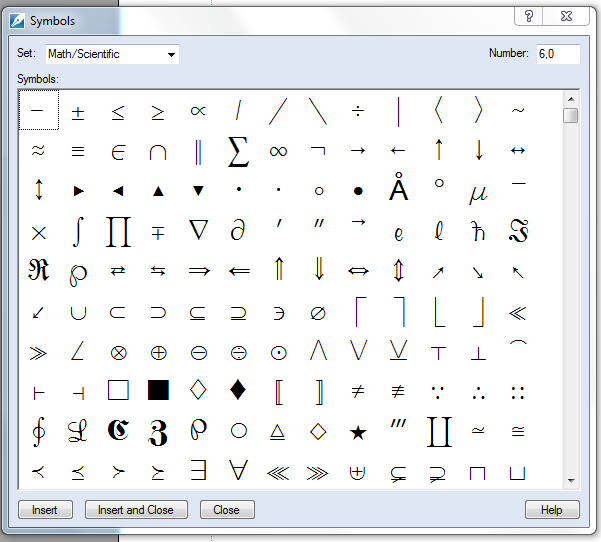
At work I use Microsoft Word, which is installed on all of our office computers. My library of exams, however, old and new, are maintained in WordPerfect format. I've routinely upgraded Corel's product to the point that today I am using WordPerfect Office X5 to write my exams at home, where most of my school materials are prepared. (I've never felt a need to be a wholly-owned subsidiary of Microsoft, and I use enough of its products anyway, whether by my choice or not.)

But now something weird has happened. I replaced my home computer with a newer and faster system, using LapLink's PCMover to migrate my software from the old computer to the new. Unfortunately, on the new computer WordPerfect got balky. I uninstalled it, dug out the original disks, and reinstalled it. The same problem remained: I've lost the gallery of useful special symbols that I used to invoke with Ctrl-W. It's a significant loss, especially now that I have to resort to the equation editor for every little thing, such as merely embedding a Greek letter in text or a prime symbol after a function name.

I am not pleased.

Interestingly enough, the problem has survived a number of attempts to uninstall and reinstall the program. In addition, I now get an error message when trying to implement the Service Pack 2 maintenance upgrade. I'm stuck with the original release version from the installation disks, but without the special symbol feature. Woe and alas!

Gaze upon the stark difference of “Before” and “After”:

Before: The math symbol palette as it should appear.

After: The math symbol palette in its current denatured form
Any bright ideas, anyone?

Thursday, September 22, 2011

You may already be a loser

Are you effing kidding me?

I sometimes get e-mail from students. It happens. Students usually write to ask questions or to tell me why they missed (or are going to miss) class. I like it when students take the trouble to contact me.

Usually.

Then there are examples like this, which initially appears innocuous:
Hello mr Z,

I need help with alot of the materials, is it possible to get some help from you?
Thank you,
Edie

Sent from my iPhone
This plaintive query arrived during the fifth week of the semester and came from a student enrolled in a class that had met nine times. I had given that particular class a total of six quizzes, short one- or two-problem exercises designed to help me keep tabs on my students' progress and to highlight the concepts or formulas I deemed most important.

I took a peek into my gradebook to see how much help Edie might need. Out of six quizzes, with a total of 60 points possible, Edie had racked up a grand total of seven points. She managed a score of 6/10 on Quiz 1 and 1/10 on Quiz 3. She missed Quizzes 2, 4, and 5. I imagine she finally got worried when she took Quiz 6 and earned 0/10. Time to ask for help!

Several possible responses to her plea came to mind. For example:
Hello, Edie. It's way too late. I'm dropping you for non-attendance.

Take care,

Professor Z
But I got a grip on myself and decided to take a milder tack (and included none of the bracketed remarks!):
I can recommend several steps, Edie, to improve your performance in the class, but you have to implement them quickly if you are to do well in next week's exam [after which pigs will fly]. First of all, you can come to my office hours, which are included in the course syllabus (look at the top of the first page) [and which I e-mailed to everyone in addition to handing out a hard copy on Day 1]. Second, you can go to the Campus Tutoring Center for drop-in math tutoring. Check at the CTC's information desk to find out when tutors knowledgeable in our subject are available. Third, you should review the problems on all of the quizzes we've had so far [including the ones that you missed or flunked—which is all of them]. I have been posting solution keys on the course website where you can download them or print them out.

Finally, ask questions in class [if you're ever there]. We will be doing as much review as we can fit into Tuesday's class next week. [Then, when you realize you have no idea what we're talking about, you can drop the class.]

Professor Z

My student was impressed with the helpfulness of my message, which prompted the following response:
Thank you mr Z! I will read the book this weekend and come to you during office hours.

Yeah. That seems reasonable. Four chapters of neglected school work all polished off in a single weekend.

The self-delusion will not be long lasting.

Saturday, September 17, 2011

Clairvoyance: the real thing

My colleague knows the future

Deliveries from the college's repro services ramp up in the days preceding the start of each semester. Our course syllabi and first-week handouts begin to appear in our campus mailboxes. The initial trickle turns into quite a flood as the first day of instruction approaches—and woe betide those who submitted their print-jobs too late to ensure delivery before the semester begins. (You could end up on the doorstep of repro services, hat in hand, while disgruntled employees poke among the just-printed but undelivered jobs to see if your syllabus is ready for the class that's meeting in thirty minutes.)

In our math department, the deluge of printed matter is always punctuated by a singular event. During the last week of summer vacation (or the last week of winter break), a heavily-laden delivery cart arrives from repro services, groaning under stacks of boxes of shrink-wrapped bundles. This particular shipment stands out from all the others because it is addressed to one person, a colleague who always submits her entire semester's worth of print-jobs in advance.

The entire semester. On the first day of instruction her office is stuffed with every handout, worksheet, quiz, and exam that she intends to use in her courses for the duration of those courses. She will not have to write or copy a single instructional document during the entire academic term. Despite having witnessed this for several years, I am still unable to fully grasp the concept. It's quite foreign to me.

I know what lesson plans are. Why, I've even used them. Or, rather, tried to use them. I confess that my “lesson plans” have eroded over my years of teaching. Careful outlines with boxed examples and key concepts have withered away to Post-it notes containing pre-cooked problems with the kinds of results I want. (Well, sometimes. In the interests of full disclosure, I admit that my cluttered brain contains many memorized examples that I can call on at will, or reconstruct on the fly, depending on what comes up. I mean, how hard is it to cook up on the spur of the moment a quadratic equation with complex roots? Who needs a Post-it for that, right?)

Moltke's dictum that “no war plan outlasts the first encounter with the enemy” applies to the classroom as well as to the battlefield. I simply cannot imagine following my colleague's example of preparing every quiz and exam in advance of meeting my students and then managing to stick with my original plans. In fact, I prefer to hold off on writing my exams until after holding a review session with my students, which usually means writing the exam the night before I administer it. It's not procrastination. It's how I find out what I need to test them on. It's a process of reacting and adapting to each class at each moment of time during the semester.

There's a neat counter-argument to my mode of instruction, and I presume it's the one my colleague would use if we were to discuss our differing approaches. She could tell me that course content is pre-determined and learning outcomes are pre-defined. (She's right, of course. All classes have official definitions that can be found in the college catalog.) One can then reasonably focus on those pre-ordained objectives, testing students to gauge their mastery and ensuring a kind of standardized approach that avoids subjectivity and random variation from term to term.

I don't, however, think that I am capricious or random in my instructional approach. I have the prescribed goals carefully outlined in my syllabus and I certainly test student mastery of desired learning outcomes with my exams. But I do not try to anticipate in advance whether a particular class needs more or less emphasis on a particular concept or set of concepts. Every sample from the student population is different in some way from every other. Every semester I need to find out their aggregate strengths and weaknesses and attempt to direct my instructional efforts in the direction that seems the likeliest to do the most good. It's not exactly a science, of course, and it's certainly not predictable. My crystal ball is way too cloudy for that.

I have a grudging admiration for my colleague's industriousness in generating all of her course material so far in advance, but it's mostly the credit one gives to prodigious labor, whether or not the result strikes one as praiseworthy. In addition to being awestruck when I witness the massive delivery from repro services, I also shudder with horror.

Saturday, September 10, 2011

God loves a good splatterfest

An anniversary meditation

The media are full of stories about the tenth anniversary of the 9/11 attacks. Without the slightest hint that they are aware of the irony, Christian extremists are eager to lay special claim to the various memorial services. For example, Catholic League bully boy Bill Donohue is furious that New York City's official commemoration event will not feature religious observances. In classic Donohue fashion, he says that we should demand to know “why Bloomberg decided to censor the clergy from speaking at the 9/11 memorial ceremonies this Sunday.”

“Censor”? Donohue clearly does not understand the word. Bloomberg is heading up a secular municipal government ceremony and decided that sectarian prayers did not belong at such an event. No one, however, is “censored.” The various priests, rabbis, ministers, imams, and snake-handlers are free to conduct as many worshipful memorial services as they like—whether or not Bloomberg thinks it's a good idea. Donohue, however, would like a nice Christian—preferably Catholic—prayer at the event and might even settle for some words mumbled by a rabbi. He still can't get over the idea that religious faith is not as privileged in our society as it used to be. (The secularists who left God out of the U.S. Constitution might be smiling, if only there were an afterlife.) The 9/11 perpetrators shouted prayers of their own; how odd that some people think the main problem is that it simply represented fanatical devotion to the wrong religion. So we need more prayers—of the right kind. (Thank God for the absence of religion-driven violence among Christians!)

Catholic Radio has certainly not been intimidated by Mayor Bloomberg into avoiding the topic of 9/11. They appear not to have noticed the supposed censorship (although I'm sure at some point one of the EWTN programs will point a microphone at Donohue and allow him to complain in public about what he calls the mayor's “gag order”). Just this afternoon I heard a snippet of a program in which a man was interviewed about the way in which religion comforted him on 9/11. This particular individual made his way to St. James Church, where he found solace. Soon afterward, he visited another church: “One of the great things about New York City is that there are churches everywhere!” he told his interviewer.

Then he said, “I felt the presence of God all day on that day.”

I pondered that for just a moment, then realized he was making excellent sense if his God was the deity of the Bible. The God of the Bible is particularly fond of mass murder, whether by his own hand or at his instigation. Such a God would, of course, show up for the slaughter in the Big Apple. He probably brought popcorn, too, because nothing seems to please the Lord as much as a nice splatterfest. Just consider:

“And the Lord said, I will destroy man whom I have created from the face of the earth; both man, and beast, and the creeping thing, and the fowls of the air; for it repenteth me that I have made them.” (Gen. 6:7)

“And Moses said, Thus saith the Lord, About midnight will I go out into the midst of Egypt: And all the firstborn in the land of Egypt shall die, from the first born of Pharaoh that sitteth upon his throne, even unto the firstborn of the maidservant that is behind the mill; and all the firstborn of beasts. (Exodus 11:4-5)

“Now go and smite Amalek, and utterly destroy all that they have, and spare them not; but slay both man and woman, infant and suckling, ox and sheep, camel and ass.” (1 Sam. 15:3)

“Is not this David, of whom they sang one to another in dances, saying, Saul slew his thousands, and David his ten thousands?” (1 Sam. 29:5)

“And when he had removed [Saul], he raised up unto them David to be their king; to whom also he gave their testimony, and said, I have found David the son of Jesse, a man after mine own heart, which shall fulfil all my will.” (Acts 13:22)

Be advised: If your kill ratio is too low, God will oust you and find someone more likely to slake his thirst for blood.

I am certain that many Christians would hasten to point out that the above quotes are either from the Old Testament—when God was more of a bastard—or from a New Testament verse that looks back to Old Testament lore—since in Acts the reference is to King David. I find this unpersuasive. First of all, it's not as though Jehovah God of the Old Testament lost his re-election campaign and was replaced by a kind and loving turn-the-other-cheek Jesus Christ in the New Testament. It's an article of faith with Christians that it's all just one (triple-headed) God. Thus the Christian deity can't escape responsibility for mass murder in the Old Testament. Second, Jesus was all too happy to implicate himself:

“Think not that I am come to send peace on earth: I came not to send peace, but a sword.” (Matt. 10:34)

“If any man come to me, and hate not his father, and mother, and wife, and children, and brethren, and sisters, yea, and his own life also, he cannot be my disciple.” (Luke 14:26)

It is sometimes said that Christianity is a “religion of peace.” Actually, it sounds like Homeland Security should keep a closer eye on those who take their God's advice a little too seriously. It's only a quirk of translation that “jihad” is not in their book.

Sunday, September 04, 2011

The power of prayer

God hates Texas

P.Z. Myers is pointing out that Rick Perry's prayers to God are going unanswered. After all, back in April the governor of Texas summoned his fellow citizens to grovel before God and beg for an end to their unprecedented drought. The U.S. Drought Monitor map makes it abundantly clear that prayer doesn't work. Either that, or prayer just pisses God off. In that case, Gov. Perry's prayers have been answered, and the answer is clearly, “Go to hell!” (which Texas is currently a good approximation of).

Saturday, September 03, 2011

The gravity of the situation

A major contender in the stupid sweepstakes!

All reasonably rational and intelligent people have had occasion to groan in pain and palm their faces in astonished contemplation of the inanities that come from the mouths of creationists, religionists, and other “believers” who rely on faith rather than knowledge. Once they have hung their tiny brains on the peg of revealed wisdom—usually derived from some sprawling and clumsy tome (like the Bible, Koran, or Atlas Shrugged)—they are smug in their ignorance and beyond the reach of reason. Is it even possible to recover from the weapons-grade stupidity displayed by Noah Hutchings and Jerry Guiltner in this exchange from the August 30, 2011, broadcast (at 13:28) of Southwest Radio Church's Watchman on the Wall?
Hutchings: Now, Brother Jerry, we hear all about this Big Bang. That's how everything has come into being. Now some of these heavenly bodies you see out there really have no atmosphere and yet they are perfectly round. Now all the planets are perfectly round. Our moons are perfectly round. The stars are perfectly round. Our sun is perfectly round. Now you mean that they mean to tell us that there was a big explosion at the beginning and all these heavenly bodies come out perfectly round? Now can you explain that?
Yeah. It's gravity.
Guiltner: [Laughter] I wish I could. I can't even explain why intelligent people would believe that. That it's just amazing that these folks that claim to be as smart as they are can't see that— You know, someone said, Brother Hutchings, that it takes more faith to be an evolutionist than it does to be a Christian and I believe that they may be right because that just simply makes no sense at all to me.
Pardon me for pointing this out, Noah and Jerry, but did you realize people occasionally hear things when you broadcast them on the radio? That's right. Folks are going to find out how stupid you are.

Fortunately, most of those who are listening are just about as brain-damaged as you are!