You might not realize the extent to which you're living the Google lifestyle until suddenly you can't any longer. It happened to me over a week ago. Google stopped working. The search engine seemed okay, but clicking on a result entailed unpredictable consequences. Most of the time I would not get the webpage I had selected. The results seemed random. It was perplexing. More than perplexing. It was maddening.
If you're technologically savvy, you know that weird computer behavior is a good indication of a viral infection. It wasn't long before I realized that some weird bug was affecting the way Google behaved. Naturally, I quickly resorted to ... Google to figure out what was wrong!
Damn.
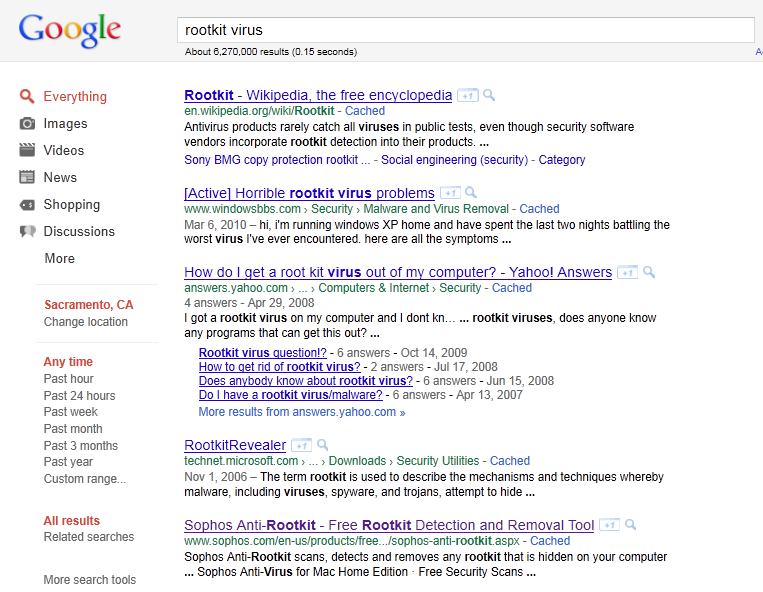
It took a few moments to find a work-around. Google was, after all, doing a perfectly fine job of finding websites related to search-engine viruses. Instead of clicking on an individual result and trusting Google to take me there, I instead copied and pasted the URL directly into the browser. Success! After visiting several sites, I learned that my computer had contracted a form of the “Google redirect virus.” Google referrals were being hijacked and directed to sites that were benefiting from extra hits from infected computers.
 |
| Example of a rogue page from a redirected Google item |
Some of the rogue pages that popped up were plausibly connected to the original Google search, even if it they weren't the pages you asked for. But tell me, would you trust a supposedly anti-virus program that offers itself as a solution to the Google redirect virus if the virus itself suggests it to you? Sorry, Stopzilla, there is no way that I am trying you!

The virus in question creates a “rootkit” problem, where a “rootkit” is a program that gives privileged access to the functions of a computer. Rootkits can be damnably elusive. I've tried ferreting out my computer's infection with utilities from Norton, AVG, Sophos, Zookaware (SpyZooka), Enigma Softweare (SpyHunter), and Kaspersky. Lots of adware cookies were demolished in the process of scanning my computer, but the redirect virus was not caught. Damn. I was especially disappointed when Kaspersky's vaunted TDSSKiller did not track down and kill the lurking rootkit.
My new problem was keeping track of which anti-virus scanner I had used and then disabling or uninstalling those that wanted to fight each other. (You can definitely have too much of a good thing, and anti-virus programs are not fond of polygamy.) I've discovered that Anti-Malware from Malwarebytes is the most active combatant in the battle with the rootkit virus. It often (but not always!) detects attempts to redirect my clicks on Google results and prevents them. I'd much rather, of course, expunge the rootkit entirely and go back to clicking with abandon. But so far it is not to be.
Suggestions, anyone, on the best way to smash a rootkit virus on a PC running Windows 7?


 Posts
Posts