Thursday, August 12, 2010

Based on a true story

A befuddled eyewitness account

Weird things happen sometimes. A year ago at this time I was immersed in a weird thing myself. You'd think I would have a clue why it occurred, but you'd be wrong. Perhaps it was like the pressure building up inside a containment vessel until at some point the vessel ruptures and the contents spew out in a sudden, uncontrolled pulse. Maybe it was like that.

Whatever the explanation, the result was that I spewed out 110,000 words of text in 20 days.

It was pretty awesome.

I have witnesses, too. They watched in bemusement as the pages poured out of my computer. One of my victims was my friend GW:
You've got a lot of nerve, Zeno, sending me pages from your upcoming novel, thereby totally knocking out a good half-hour of my day. How dare you!

I can see the family flames beginning to ignite.
Yeah, GW was instantly aware that I was writing a roman à clef based on my family's history. He started the guessing game. Was this particular character based on my grandfather or my uncle? Is this person based on your dad?

It was immediately obvious that the boy desperate to run away to college was me.
It seems like the character Paul might be playing your role in the story, being a puzzle and a weird mix of genes, and liking Wagner and books. Yeah, in a story about dairymen in Tulare county, that starts to sound like you.
Busted.
So tell me, did the real trial over your grandmother's will involve a handwriting “expert” and, if so, did you simply pull the dialog from the court transcript? I know, that would be cheating and unnecessary for Zeno, but it's so crisp and logical that it made me think, well, that you copied out of the transcript!
No transcript. It was all cobbled up from memory and make-believe, although it might have been nice to have a transcript for reference purposes.

You see, my family really did rend itself into warring camps when my grandmother died and deprived us of the great peace-making matriarch whose disapproving glance could turn the blood in our veins into ice water. We flew to flinders in the absence of the binding force of that formidable center.

That great cataclysm occurred nearly thirty years ago. Some family relationships were gradually repaired. Others never recovered. (My godfather and I never spoke another word to each other.)

Most of my family has yet to see the manuscript. I quietly shared it with my sister. She called me up to say she had had difficulty putting it down. “It brought back a lot of memories,” she said. Even though I wrote it as fiction, the outline of the story is faithful to our family disaster. My sister was also very concerned that I was going to stir up old resentments and spark recriminations. Her son perused the manuscript, but was less concerned:

“The good thing for you is that the characters who would be most insulted by an accurate depiction of what they really are like are dead, incompetent, or almost illiterate,” he said.

I can't imagine where my nephew got his sharp tongue. Such a rascal.

He's heard several of the family stories before. The weird and tragicomic anecdotes are staples at family gatherings. (Some of them have trickled onto this blog.) My sister would often comment after the nth retelling of a family fable, “Someone should really write these down, but it would have to be as fiction. No one could believe they actually happened in real life.”

Every time I heard her say that, I would think, I could do that. But I never did. At least, not until last year. That's when the stories that had been percolating through my brain for decades burst loose and spilled onto the pages of a book-length manuscript. In a way, I had been rehearsing the saga for all those years, so perhaps it's not so surprising how the episodes poured out at a rate of 5500 words per day.

I was rather stunned when it all came together like that, with the fictional mortar binding together the real-life incidents. Thanks to the comments of GW and a few other readers, I revised and expanded the manuscript in a more leisurely fashion over the subsequent months, reaching a “final” product last spring. It tilts the scale at nearly 125,000 words now and that's what is in the hands of a publisher's team of reviewers.

GW was pensive at the end of last August's exercise in prolixity:
Phew, so we're done? I actually read a whole book in a bit less than three weeks, must be some sort of record. I'm really glad I got to participate in this bit of madness. I enjoyed it for the reading, but also to see you crank this stuff out, day after day. I'd say Where does it come from, but we mere mortals don't really want to know.
I shared the manuscript with my college president, under the heading of “What I did during my summer vacation.” He was dutifully amused (one must give moral support to one's faculty members), but then—who saw that coming?—he read the whole damned thing. He sent me a message:

“I got goosebumps, a tug in my heart, and chuckled out loud with the close of your book.”

Damn. That's going in the cover blurb.

Wednesday, August 11, 2010

Need-to-know basis

What they don't know won't hurt you

“How is your blood pressure?”

“It's fine, Dad,” I said. That seemed to be a better response than, “None of your business, old man.”

“So what is it?” he persisted.

“Like I said, it's fine. I don't carry my readings around with me.” It was in the 120s over the 80s, which is pretty fine, all right, but I was not in full disclosure mode. I should never have told him when I was diagnosed as hypertensive. Once you give him something like that, he'll never let go.

“Let's check,” he said.

I looked up. My father was brandishing his home blood-pressure kit, complete with inflatable cuff. He looked eager to spring into action. Instead of recoiling, I schooled myself to keep a neutral expression on my face.

“No, thanks, Dad.”

He looked disappointed, but not surprised. I never cooperate with his intrusive fact-finding missions.

It's one of the ways in which he and I are different. He delights in sharing gruesome details, occasionally spoiling meals. (“No, Dad, we don't need to know what they found when they lanced that boil. Please let us slurp our soup in peace.”)

Maybe it's one of those small-town things, where everyone knows everyone else's business. If it is, that's rather funny. Except for my grandparents, who lived next door, the nearest neighbor was a quarter of a mile away. We couldn't lean over our fences and gossip.

Or maybe we did. Except it was more a matter of leaning out the driver's window of your pickup for a few minutes to chat up an acquaintance who was working the field next to yours. Or shooting the breeze at the local coffee shop where the farmers take turns getting their morning infusions of caffeine.

In a sense, we did all live close together. It was like our yards were all part of the village commons, even though disaggregated and scattered in chunks throughout the county. At any time someone might park a pickup or tractor alongside your house, stroll over to the garden hose, and take a big drink or indulge in a cooling face splash. It would have been an exercise in excessive scrupulosity to knock on the door first to ask if it was okay. Of course it's okay. No question. We do the same at your place.

We also grew up in a drop-in culture. Calling ahead was entirely unnecessary. At completely random intervals, vehicles would pull into your driveway and aunts, uncles, cousins, friends, and acquaintances might come tumbling out. If they knocked on your door and found no one home, it might be because you were pulling into their driveway at the same time. These things happen.

My unexamined acceptance of these practices underwent a complete collapse when I moved out to go to college. When I was still living close enough to home base to make drop-in visits feasible, I discovered how impossible it was to protest that tomorrow's real analysis exam prevented me from dropping everything and going out for a spontaneous but leisurely dinner with my family. Their faces would fall if I insisted that I merely planned to wolf down a sandwich while poring over measure theory. (It was I who was being rude by demanding or expecting prior notification.)

Fortunately, the problem was solved quite naturally once I was living over two hundred miles away. Impulse-driven drop-in visits became impossible and all was well. By then, however, I discovered that the process of individuation had produced someone unlike anyone else in the family.

I had become a private person, perhaps in a kind of weird rebellion from the well-established practices of kith and kin. I began to starve the information mill—or should I call it the “gossip machine”?

Part of it was to avoid arguments, I think. There was no benefit in sending certain bulletins home:
  • “Hey, I'm a member of the ACLU now!”
  • “Guess what? I stopped going to mass this spring.”
  • “I gave Howard Jarvis a bad time during a Q&A in Sacramento.”
  • “I went to Jimmy Carter's campaign rally at the capitol.”
  • “I protested Jerry Falwell's appearance at a Moral Majority rally.”
  •  “I spoke at an AIDS memorial service.”
  • “I'm going back to grad school.”

That last instance is one of my more notable examples of keeping my mouth shut. After a dozen years of full-time teaching, I got itchy to return to grad school to earn a doctorate, not having stayed the course in my previous attempt. However, when I was admitted and began to take classes, I never told Mom and Dad. Instead, I'd occasionally comment to my parents about some seminar or another that I had attended at the local university. All very casual. I didn't report that I was formally enrolled.

It was a lesson learned from my bouts of high blood pressure and life under the microscope (or sphygmomanometer). Once my parents (especially Dad) were aware that I was taking another run at an advanced degree, I would be boxed in. Regular progress reports would be demanded (ever so nicely, of course). I'd be committed. Any decision to bow out would be viewed as a crisis or failure rather than a personal judgment that grad school had become too big a distraction or detour from my teaching career. Thus I didn't tell any tales out of school until I had completed the degree requirements and calmly informed Mom and Dad that the university had approved my dissertation and was awarding me a degree.

“We didn't know you were in school!”

“Oh, it was just a part-time thing. The units gradually added up. No big deal.”

Right.

My parents were quickly reconciled to the idea that I had puttered my way to an advanced degree. It was a new bragging point to share with their friends, so no harm done.

I imagine, though, that Mom and Dad have learned over the years that their eldest is a close-mouthed fellow who keeps his cards close to his vest. They're probably wondering what new revelation I might suddenly spring on them next. Have I secretly gotten married? (Fat chance.) Have I received some fancy political appointment? (No, they turned me down for the citizens' redistricting commission.) Have I pierced my ears? (Heck, no, although it would be funny. Poor Dad lost sleep when my kid brother did.) Have I endorsed another left-wing cause? (Oh, too many to tell!)

Nope, none of those things will be the next big surprise. The next big surprise is going to appear in book form. Only my sister won't be surprised, because she got to read the first draft. I have told my family's epic history in fictional form in a novel and a publisher is currently scrutinizing it. All the names have been changed to protect both the guilty and the innocent, although my sister has warned me I'm going to get into trouble anyway. I doubt it's going to be a problem. Besides, the characters based on Mom and Dad come out pretty well and are definitely not the bad guys.

Still, maybe I should consider what the surprise will do to Dad's blood pressure.

Monday, August 09, 2010

Motes and beams: Gingrich on Catholic television

Whore & whoremonger

Former Speaker of the House Newt Gingrich was kind enough to tape an endorsement in 2008 for Proposition 8, the ballot initiative that placed a ban on same-sex marriage in the California state constitution. He used the cant language of “protecting marriage” and declared, “I can't overstate the dangers of tyranny from elitist judges who believe they have the right and the power to dictate their values to the American people.”

It's good to know that Newt is firmly in favor of “values,” but one wonders just what those “values” might be.

One can derive a clue from Gingrich's appearance last April 30 on “The World Over,” a public affairs and news program from EWTN, the Catholic broadcasting network. While Raymond Arroyo, the program's earnest and epicene host, fawned over them, Newt and his third wife promoted their documentary on John Paul II and spoke humbly about Newt's conversion to Catholicism.

Callista Gingrich, who was Newt's mistress during his second marriage, is a devout Catholic and church choir member who seduced the former House speaker into Rome's arms. I presume this must be one of those “situational ethics” affairs where little sins can be forgiven in the achievement of a noble goal.

“Callista is very, very faithful,” said Newt to Arroyo, giving his former mistress credit for his conversion. (He says this at 14:18 in the video below.)

Faithful? Then I must presume she obtained some kind of fornication dispensation from her local priest. Otherwise Callista would have been committing mortal sins on a regular basis, even if each occasion of sin was very brief.


Newt Gingrich is quite angry about Judge Walker's ruling that Proposition 8 is unconstitutional. He cherishes the sacred institution of marriage and characterizes Walker's decision as a grievous affront to those Americans who have “affirmed that marriage is the union of one man and one woman.” Just to be clear, since Newt did not expand on this point: While a man might seek after multiple women, he should be married to only one at a time. The others have to be mistresses—at least until it's their turn to be the wife. (Keep looking over your shoulder, Callista!)

It's God's sacred plan.

Thursday, August 05, 2010

Could Dr. Nicolosi change?

Only if he really wanted to!

The buttons on my car radio provide a very broad cross-section of the broadcast (and political) spectrum. This week I punched the one corresponding to the far right of the AM dial and found myself listening to a rebroadcast of the August 3, 2010, installment of “Catholic Answers Live.” Host Patrick Coffin was praising the hour's guest, one Joseph Nicolosi.

You may recognize the name. Along with the late and unfortunate Charles Socarides, Nicolosi is known for founding NARTH, the National Association for Research & Therapy of Homosexuality. That is, Dr. Nicolosi is one of those psychologists who offers “reparative therapy” to turn unhappy gays into unhappy straights. (He would, of course, dispute that.)

It helps, naturally, that there are no homosexuals. They don't exist! Dr. Nicolosi makes no bones about it when confronted with potential subjects to confess to being homosexual. “You are not homosexual,” he tells them. “You are a heterosexual with a homosexual problem.”

In case the patient is not persuaded, Nicolosi hits them with scientific reasoning: “Your body was designed for a woman. You are a heterosexual.”

It would be unkind of the patient to explain real life to Nicolosi at that point. One assumes that most don't try.

Nicolosi says that his fees are higher than those of his associates in the Thomas Aquinas Psychological Clinic, but one assumes he's worth every three-dollar bill he gets.

I listened in fascination as Nicolosi trotted out 19th century Freudian doctrine. He scoffed at the idea that sexual orientation might have a genetic component. (The correlations between identical twins must be a gigantic statistical fluke.) To Nicolosi, talk of a “gay gene” is arrant nonsense. (He's probably unintentionally right on that one: the biological components of sexual orientation seem exceedingly unlikely to reside in a compact unit on one gene.) Since he refuses to allow nature to be involved, it has to be all about nurture:

“There's so much more evidence for what we call the classic triadic relationship.” Nicolosi declaims. “Triadic as in visualize a triangle. In one corner you have the over-involved mother, in the other corner of the triangle you have the distant detached or critical father and in the other corner you have the boy who may be temperamentally sensitive, artistic, introverted, that sort of thing.”

And I presume if we reverse the sexes in the triadic relationship to posit a daughter's alienation from her mother, then we get tribadism. Hmm. Triad. Tribad. A coincidence? I think not! (Drop me a note if your university wants to confer an honorary doctorate on me for my discovery.)

Coffin spent much of his time anticipating Nicolosi's remarks and fawning on his guest, who commented, “You've been studying Freud.” Eventually, however, Coffin turned to the phones and welcomed a caller named Monica. She was concerned about her brother, who had declared himself gay and walked out of a twenty-year marriage. Monica hoped that Dr. Nicolosi could help her steer her brother back onto the straight and narrow. She commented that she had been listening to the broadcast and had recognized her family in some of Nicolosi's remarks.

“I'm very much like my mom and we're very strong women,” said Monica.

Nicolosi pounced.

“Yeah, well, typically, you know, a number of studies show that the youngest child tends to be more inclined to be homosexual than the older.”

But he had jumped too soon.

“But he is the oldest,” said Monica.

“He is the oldest?” said Nicolosi, the dismay evident in his voice. (Reparative psychologists should investigate whether coursework in cold reading would qualify as continuing education. It would certainly enhance Nicolosi's professional qualifications.)

“He is the oldest and I'm the youngest,” declared Monica.

She continued with an extensive description of her family, its ethnicity, and its spiritual life. Eventually, Patrick Coffin got impatient and tried to bring the caller back to the point. He asked her a question.

“Monica, how many kids in your family? Your brother is the oldest of how many?”

“My brother is the oldest of four,” replied Monica. “He's the only male.”

Nicolosi, who had evidently been nursing his wounds, came back to life.

“Oh, the only male, so he didn't have any really male figures. He probably wasn't close to his father. Does this fit the usual pattern of being closer to his mother?”

Eager to play along after having so cruelly disappointed the doctor earlier in the program, Monica answered promptly: “What you were saying, yes.”

Success! Another brilliant analysis by the ace psychologist!

It's science! Ish.

Nobody here but us tea partiers!

Oh, and the occasional racist

The tatterdemalion ranks of the Tea Party movement want it clearly understood that there is no significant racist component to their political activism. They oppose President Obama because of his policies. That's all. Certainly not his race. (But maybe his secret religion. Or his secret birthplace. Or his secret plan to round up white people and sterilize them.)

That's the take-home message: The Tea Party movement is a patriotic political movement without a scintilla of racism. (And no minorities, for that matter.) Nowhere is this more clearly demonstrated than at Free Republic, the Fresno-based on-line locus of Tea Party activism. For example, consider the measured tones of Free Republic's commenters (you have to be a member to comment) on the matter of the First Lady's trip to Spain.
Does not matter where our taxes take her..she will always look like she just walked off the plantation in Georgia or Mississippi.
Heck. That's just classy with a triple-K.

While it's not an official state visit when the First Lady is traveling privately in the absence of the President, no such excursion can avoid its political overtones. In the matter of the trip to Spain, Michelle Obama has been invited by King Juan Carlos and Queen Sofia to join the royal couple at their summer palace on Majorca. Naturally the White House was pleased to accept the invitation and Mrs. Obama will therefore be an unofficial goodwill ambassador to Spain.

The press photographers have swarmed the First Lady and Free Republic posted a clip. The Freepers tried to keep it positive, of course, with their acute sensitivity to women's fashions:
Re; blk/white one strap dress
This skank is a stain of the history of First Ladies.
She needs to cover up and try to show some dignity befitting her station.
(How soon they forget how much they hated Hillary.)

Did anyone chide the commenter who made the “plantation” remark? My goodness, no!
“Does not matter where our taxes take her..she will always look like she just walked off the plantation in Georgia or Mississippi.”

You nailed it.
The Freepers also had some concerns for Spain.
Spain is a beautiful country.
By being there, Mrs. Obama spoils it.
Everywhere this trash couple goes is stained forever.
“Forever”? Wow. Not even George W. Bush had that power (except, perhaps, for the permanence of the deaths of the victims of his unnecessary wars).

Some press accounts referred to Mrs. Obama as FLOTUS, a fairly well-known acronym for “First Lady of the United States.” When not describing the First Lady as a human stain, playful Freepers occasionally gave her another nickname.
Frankly, I think the WH has kept Sasquatch relatively under wraps. They probably realize that she is a very polarizing figure, not to mention a big mouth, who would likely reveal her blind hatred of white America in an undeniable fashion sooner or later.
“Blind hatred.” Say, let's go look up “projection” in a psych textbook. I'll bet we are in for an amusing surprise!

Later this month Mrs. Obama is hauling the family to the Gulf coast to encourage tourism in a region of Florida relatively unscathed by the BP oil spill, thereby giving a lift to the local economy. I wonder what the denizens of Free Republic will do then, thinking of President Obama's family in the context of oil slicks and tar balls. Why, it almost writes itself! And that's good, too, because idiotic shit-for-brains racists have trouble coming up with original ideas. They prefer to react reflexively with their unevolved lizard brains.

In the meantime, look at this, bully boys! You'll pee your pants when Sasquatch comes to get you!

Wednesday, August 04, 2010

What a deal!

An old dog learns an old trick

When I was merely a teaching assistant in graduate school, the university provided me with a paid homework grader for my calculus students. I collected homework every class day and had it to return within a day or two. Nice. Today, however, as a full-time college professor, I can only dream of such luxury.

Still, I think homework is important and that students need the practice that homework provides. I therefore encourage my students to do their homework by making it count toward their grades, even though I collect it only on exam days. I don't actually correct it. I just scan it for approximate completeness and dole out some points. Most of the students who hand it in do a decent job and get full credit:

10/10

These students are happy when they hand in their exams and pick up their high-scoring homework. (At least one part of the day has gone well.) Other students come up to me with tales of woe:

“I did my homework, but I forgot it at home.”

“I left my homework in my car.”

“My friend borrowed it and didn't give it back.”

I tell them all the same thing: Bring the homework to the next exam day and receive late credit for it. Late credit means half credit. Students did not generally seem to appreciate my generosity when I scored their homework:

Late credit: 5/10

“But I did the whole thing, Dr. Z!”

“Yes, but it was late. You should have handed it in on time.”

“That's not fair!”

“The rule applies to everyone. That is the epitome of fairness.”

“The what?!”

After more than three decades of teaching, I finally remembered a simple lesson from the retail sector. Most of us have undoubtedly heard a story about the impulse-purchase items near the grocery store checkstand. The grocer is trying to sell something—ball-point pens, or candy bars, or whatever—for 25¢, but they seem to be nailed to the countertop. No one is going for them. Then the grocer has a brainstorm. He marks them with a sign: 3 for $1. Now they fly off the shelf.

It's not the price. It's the perceived bargain.

I pondered.

The next time I scored late homework, I changed my tack:

Late credit: +5

That's right. The same number of points, but no denominator to remind anyone that it's half credit. I also made the plus sign nice and big. Students were pleased.

“Cool. Thanks, Dr. Z!”

“All right!”

“Whoa! Five more points! Thanks, Z-man!”

The Z-man says you're welcome.

Saturday, July 31, 2010

Students are present

Some with presence of mind

Students naturally groan when their teachers whip out a pop quiz. Mine are no different, except perhaps that they're a bit more jaded. There's not a lot of “pop” in a quiz when it's anticipated as a routine part of the class. I prefer short in-class quizzes as an alternative to collecting and grading homework. The results show me whether my students are following me and the degree to which they're mastering the material.

Eventually, many of my students figure out that keeping up to date gives them a major edge in quiz-taking. Some begin looking forward to quizzes as opportunities to rake in some fairly easy points for knowing basic material. They begin to anticipate quizzes and even ask for them. (By no means do all students do this!) This recently reached a fever pitch when we were approaching the end of the class period and no quiz had been given. I was disappointing them. We got down to five minutes.

“We're down to five minutes,” I said, displaying my gift for the obvious. “What can we do with only five minutes?”

“Let us out early!” chorused a few—always a crowd-pleasing response.

“Give us a quiz!” cried another group (quite distinct from the first, I might add).

Most of my quizzes are more than five minutes long and I had not prepared one.

“How can I give you a five-minute quiz? That's not enough time.”

“Make it easy!” they sang out.

Good answer.

“Well, I did once give a one-minute quiz,” I admitted.

Consternation and curiosity appeared on their faces.

“It was an attendance quiz,” I continued. “The quiz was ‘Write down your name.’”

I don't actively take roll after the first few days of a semester, but the frequent quizzes do a good job of tracking attendance. I expect my students to show up and I'm disappointed when they don't. I also like rewarding good attendance and had not yet taken any special steps to do so that term. The students (even the ones who wanted to leave early) brightened at my suggestion.

“Yeah! We can do that!”

“Okay. Deal. Take a piece of paper, write your name down, and hand it in.”

There were ripping sounds as paper was torn from notebooks.

“Is it okay if we share paper?” asked one green-minded student.

“Sure,” I said.

He and two other classmates used one sheet of paper to submit their names.

Another student strolled up and handed in his paper. He had written “your name” on it.

“I thought it might be a trick question,” he said with a smile. “You said ‘Write your name.’”

He had also written his actual name across the top of the paper.

“Thanks,” I said. “Now get on out of here.”

The next student had drawn a box around her name, like the answer at the end of a calculation.

“Nice,” I said.

Jonathan then handed in an odd piece of work:
Jessica Jones


Jonathan Smith
“I started to cheat off Jessica's paper,” he said, “but then I figured out how to do it on my own.”

“That was good of you,” I replied.

Then Ian sauntered up and placed his paper on my desk:
Ian Doe.0000
"You didn't say how many decimal places of accuracy you wanted, so I assumed four.”

“Uh, thanks. It's true that your name would go on forever if it's irrational.”

The next student had quadrille-ruled graph paper. He had written his name in block form by tracing grid lines.


“You didn't provide equations,” I pointed out.

He grinned and handed it in.

My students are a curious lot, but I'm sure I'm not responsible for this condition.

Wednesday, July 28, 2010

Where's my money?

Teaching for dollars

San Francisco's KSFO, bastion of right-wing talking points for the poor out-numbered arch-conservatives who live in the Bay Area, has been cutting back. High-priced hosts like Melanie Morgan and Lee Rodgers have been shown the door and their erstwhile sidekick, Brian Sussman, has been elevated into the anchor chair. His feet may not be able to touch the floor as he sits in it, but Sussman is now KSFO's monarch of the morning drive time (although actual traffic reports come from “Officer Vic,” who now gets to be Sussman's yes-man).

My inner masochist occasionally takes over when I'm driving and tunes the radio to KSFO, just to see what the crazies are promoting at the moment. On Tuesday, July 27, 2010, listeners were treated to yet another paean to the wonders of running government “like a business.” This shows remarkable resilience in right-wing ranks, especially after the debacle of George W. Bush's “MBA presidency.” Yeah, another dose of the business acumen that destroyed the world economy is just what government needs these days!

During the 7 o'clock hour, Sussman started a little rant about the Obama administration's shocking lack of business people in its top ranks. While Reagan and the two Bushes had over fifty percent of their appointees coming from the world of business, the current administration's tally is only eight percent. Shocking! (While the numbers may be true, they came from one of Sussman's devoted listeners, so a block of salt might be indicated.) With Officer Vic providing sycophantic punctuation, Sussman began to rail against academia—the reputed source of the bulk of President Obama's political appointments.

By itself, this is no surprise. Right-wing talk-show hosts really don't like higher education and its purveyors. We tend to be too liberal for them. (Funny how education tends to make people more liberal, open-minded, and opposed to right-wing radio bigots. No doubt Beck University will fix that.) Nevertheless, Sussman managed to surprise me, a jaded liberal listening to a usually predictable spewing of right-wing talking points from KSFO. You might not guess, however, just how he managed to surprise me.

Check it out:
Sussman: Herein lies the problem. These people live in a parallel universe. They don't understand. How do you get ahead in academia? It's not about being the best. It's not about being— There's no competition.

Officer Vic: No.

Sussman: Basically you go out there and get a degree and maybe another degree and another degree. And then you work your way into— You get a job at a university and you publish papers that no one reads and you publish books that are unreadable and you speak [Officer Vic: You get tenure.] and your speaking can be completely boring and you teach and you can be the worst teacher on the planet but you get tenure.

Officer Vic: Yep.
I begin to suspect that Sussman has never been on a university campus. Good thing tenure is so easy to obtain, though. Practically automatic.
Sussman: And then, you're in! That's it. You're in the club. It's nothing about being the best. There's no competition involved to move up the ranks of academia. It's not like in the real world. And that's who Barack Obama's surrounded himself—a bunch of propeller-heads, who have never produced anything. They've never produced a job. They've never managed large numbers of people. But it's all unraveling for these guys.
It's true. Competition is anathema in academia. We don't compete for choice assignments, office space, grant money, promotions, or anything else. Never, ever. It's contrary to our communitarian nature.
Officer Vic: Payroll.

Sussman: Never had to make payroll, never had to balance a budget. Never had to manage a profit-and-loss statement. Oh, they'll write about profit-and-loss statements, they'll write about how to manage people, they'll write and write and write and write, they conduct all this research. And again, I think it's hilarious. You read some of the books that these people write and they are unreadable. You hear some of the speeches that they give and you can't listen to them. You go to their classes and you listen to them teach and they're awful. But they've got their jobs and they're millionaires.
I don't think Sussman actually goes into classrooms to listen to professors and deem them awful. He strikes me as a class-skipper. But that last sentence? Yeah, that's the part when Sussman took me by surprise. Millionaires? I think I need to talk to my union rep. I may be getting cheated! (Of course, I'm not a university professor, so perhaps I shouldn't quibble—except that I know plenty of university professors who earn less than me.)

So Sussman thinks professors are millionaires who never have to make payroll, never create jobs, and never balance a budget. What an ignoramus. One of the problems at universities is the management of research teams, the budgeting of grant monies, and the allocation of lab space. One jumps through all kinds of hoops to get the funding the first place and then gets to do further mountains of paperwork to document its expenditure on personnel and resources. We even have similar challenges at my community college, even though on a smaller scale. (We seek external funding more frequently now that the state budget is such a mess, but it all comes with strings.) Maybe we have to deal with the NSF instead of the SBA, but many of us can commiserate with the entrepreneurs who deal with the latter.

KSFO's morning oracle continued:
Sussman:I get a kick out of— You go to UC Berkeley, you go to Stanford, you go to these various campuses and these students are out there protesting, “We need more money for our schools!” And standing next to them are the professors. “We need more money for our schools!” Hey, have you ever asked that professor how much money they're making every year? These professors are all millionaires. They're millionaires with big, big salaries and big, big retirement packages. And yet they dress like little schmoes, you know, with their crummy jackets [Officer Vic: Patches on the elbow.] that are twenty years old, yeah, and patches on the elbow. And their ties are askew and their hair's kinda crappy and they drive crummy little cars and they're millionaires. They're all millionaires! And they actually have the gall to stand next to the kids who are protesting because their fees are too high. “We need more money for our schools!” So you can pay these millionaires!
Oh, good. Fashion advice from a radio jockey. Nice hair, Brian. What training academy does it for free just for practice? As a millionaire professor, I shell out $14 for each of my haircuts.

Sunday, July 25, 2010

Hit bottom, kept digging

Conservapedia finds new lows

When P.Z. Myers shared the happy news that Conservapedia honored him with its article of the week, I naturally had to see for myself how he was being celebrated over at Andrew Schlafly's Fortress of Ineptitude. It was a fun-filled visit, punctuated with peals of sudden laughter at the many pages of inadvertent humor.

These guys are funny.

While I was there, I had to revisit the Conservapedia entry on President Obama, which I cruelly mocked in a post last year, just before the presidential inauguration. Naturally, I was curious to see whether it had been improved in any way.

The answer depends on whether your metric involves laughter.

Here is the opening paragraph:
Barack Hussein Obama II (birth name Barry Soetoro,[1][2][3] allegedly born in Honolulu August 4, 1961[4][5][6][7][8]) is the 44th President of the United States, and the first President who is biracial. He previously was associated with several radical causes[9] and served less than four years as a first-term Democratic Senator from Illinois (2005-2008).
Try to remember that this is supposed to be a source of reliable information (“The Trustworthy Encyclopedia,” they claim). Were you able to spot any mistakes? I admit I wondered how the president's birth name could be “Barry Soetoro” given that Lolo Soetoro was his step-father and was nowhere on the scene when Barack was born. Both birth announcements in contemporary Hawaiian newspapers reported that the father was Barack H. Obama. The president's birth certificate (I know, I know; Schlafly and his crew refuse to accept Hawaii's official document) gives his name as “Barack Hussein Obama II.”

No Soetoro.

After a flub like that, I'm surprised that Conservapedia got his presidential number right. Yes, it is 44. They also noticed that he did not serve out his term as U.S. senator. Good catch! (Getting elected president does that to you.)
Upon taking office Obama promised relief for unemployed workers and warned failure to pass his proposed stimulus scheme would turn a “crisis into a catastrophe.”[10][11] The unemployment rate has hovered in the 10% range throughout his presidency, up significantly from the 7.8% rate in January 2009. Since passage of the president's stimulus package, 2.4 million Americans have been added to the unemployment rolls.[12]
Conservapedia loves post hoc, propter hoc insinuations. The stimulus package passed and then unemployment soared. There are two reasons for that which most sane people are able to identify: (1) the stimulus package wasn't big enough (and Paul Krugman warned us, too!) and (2) the collapse of the U.S. economy under the Bush administration still had plenty of momentum in January 2009, right when its chief enablers scrambled out of town. Who knows how much worse off we might be without the cushioning effect of the stimulus package (which, once again, was not large enough).
After the “War on Terror” was abandoned during his first year in office the rate of terrorist attacks on the United States has gone from zero per year during George W. Bush's last year, [13] to at least four.[14][15][16][17][18].
Such careful choosing of time periods! (Cherry-picking, anyone?) Why not compare Obama's first year with Bush's first year. Oh, yes. September 11. Too bad about ignoring terrorist threats until it was too late (and then exaggerating them for political benefit and war justification). I will admit, however, that I like the quotes around the “War on Terror.” Is Conservapedia admitting that the president is merely avoiding some of the cant phrases and reducing the bully-boy rhetoric that characterized the Bush-Cheney years? That's certainly a relief. In the meantime, in terms of reality, Obama is aggressive against terror in ways that may or may not pay off. You know, little things. Little things like tripling the number of drone attacks against targets in Pakistan. I have my doubts about it, but the Conservapedists should be yelling their heads off in support.

The president is not anything close to a pacifist, but his actions are not loud enough or indiscriminate enough to please the troglodytes who live in the dark caverns of Conservapedia.
President Obama authorized offshore oil drilling in the Gulf of Mexico[19] and has been widely criticized for mishandling the “worst environmental disaster in US history.”[20][21] Obama declared, “oil rigs today generally don’t cause spills. They are technologically very advanced.”[22][23][24]
Well, generally they don't cause spills. There's only one that really causing trouble right now. Of course, it's a doozy. That's the catch. One big spill can do gigabucks of damage. That's why many people reacted negatively to the president's comments about authorizing more oil drilling. However, the drill that spilled was in place long before Obama said anything. The disaster was a legacy of Bush administration neglect and lack of enforcement of safety standards and procedures.

The Gulf spill might, of course, have been mitigated if the Obama administration had promptly ramped up safety inspections and enforcement of maintenance regulations, but I can easily imagine how Schlafly and his minions would have reacted. “Anti-business!” (I think it was Stalin—or was it Hitler?—who was really keen on state enforcement of safety regulations.)

Did you notice the sly post-hoc implication of the paragraph's initial compound sentence? (1) Obama authorized drilling. (2) Worst environmental disaster in U.S. history.

Sentences like this don't get constructed by accident. Schlafly really wants readers of Conservapedia to think that BP's Gulf of Mexico disaster was the direct consequence of Obama's statement about offshore oil drilling.

The president's words are powerful.

The initial paragraphs of Conservapedia's entry on Barack Obama is all of a piece. A piece of propaganda. The article deliberately misleads. That's curious, isn't it? The overtly religious perpetrators of such mendacity are evidently so full of good intentions that they regard themselves exempt from the commandment about bearing false witness.

The morality of the people at Conservapedia is very much like the God they purport to follow. There's damned little evidence for the existence of either.

Saturday, July 24, 2010

Judging a book by its author

Something I don't need to read

Nepotism poster child Tori Spelling is on a signing tour to promote her new book. The formerly reputable McClatchy Company is helping out with breathless little stories like an interview article in The Sacramento Bee:
There's an anecdote in it about you contacting the late Farrah Fawcett.

It was during a reading on the phone with (celebrity psychic) John Edward. We have the same publicist. I thought, “Oh, this'll be cool, maybe my dad will come through.” Instead, John said, “Farrah Fawcett's coming through.” He was really surprised, too. She wanted me to let her family know she's happy and OK. I wrote a letter to Ryan O'Neal, explaining the story. I said, “Please don't think I'm crazy, I'm simply passing on a message.”
Gosh, Tori? Think you're crazy? Never! Think you're gullible and maybe just a little bit stupid? From now till eternity!

Perhaps I am being too mean. After all, she shares a publicist with John Edward, famous for being “The Biggest Douche in the Universe.” It may be that Tori is just a good little trouper who cooperates with her p.r. person in trying to gin up some press coverage for a fellow celebrity from the same stable. I can't tell, though, if Tori is being cynically manipulated or just cynically playing along.

In a way, of course, it doesn't matter. The stupid is right there on the page for us to see.

Let's look the other way.

Wednesday, July 21, 2010

Lucy Van Whitman runs for governor

The campaign budget is peanuts

The insight was not mine. It was a friend's daughter who said, “You know who Meg Whitman reminds me of? Lucy Van Pelt!”

Suddenly it all became clear. That's right. Whitman is exactly like the self-proclaimed fussbudget from the Peanuts comic strip. She promises faithfully to hold the ball steady while California—in the guise of Charlie Brown—runs up to give it a good kick.

We all know what's going to happen if we fall for it, don't we?

Speaking of boys named Brown, Meg is both eager to remind us that Jerry Brown is one of California's historical figures and hopeful that we remember none of the historical details. While she labels him a failure, his eight years in the governor's office seem like the good old days relative to the current political and budgetary environment. In particular, Whitman wants us to think that Jerry Brown was such a profligate big-government spender that he broke the bank:
His big spending turned a surplus into a billion-dollar deficit.
Actually, Meg, the voters broke the bank with Proposition 13. Brown was an exceedingly frugal governor. So frugal, in fact, that the tax increases enacted under Governor Reagan (that's right, Reagan) were creating a surplus.

Perhaps Meg is not aware of Brown's penny-pinching history. Back in those days she was far away from California, going to school at Princeton and Harvard. More likely, though, Meg and her people are consciously distorting Brown's record. That's what politicians tend to do during campaigns and Meg has certainly become a politician, complete with a well-funded propaganda campaign.

The truth about that era of California politics is difficult for right-wingers to swallow. I remember being called a liar in 1980 during Reagan's unfortunately successful campaign for president. A Reagan supporter blew up at me when I pointed out that California budgets had grown more rapidly under Reagan than they were growing under Jerry Brown. Knowing that Ronnie was the patron saint of tight-fisted budget-slashers, the Reaganite told me quite emphatically that I was either a fool or a liar.

It's easy, however, to check the numbers for yourself. The California state treasurer's office in the spring of 1986 put out the Annual Long-Term General Fund Forecast that I still have on my shelf. It's replete with historical data. In 1967, Reagan's first year in office, state expenditures totaled approximately 2.939 billion dollars. By 1974, the last year of his two terms, expenditures had reached 7.245 billion dollars. On a point-to-point comparison, that's a 46.5% increase. It amounts to an average increase of 13.8% each year.

In 1975, Jerry Brown's first budget came in at $8.264 billion. Three years later, his 1978 budget (before Proposition 13 passed) was $11.612 billion. His budget increases were averaging 12.0% per year, nearly two points less than those of supposedly fiscally conservative Reagan (who would soon be running up a deficit as U.S. president).

People couldn't help notice that Jerry was spending less money than the state was taking in. The state surplus ballooned to nearly four billion dollars, an awesome amount. It helped spur Californians into voting for Proposition 13 on the June 1978 primary election ballot, slashing property taxes to the bone and putting the Golden State into a fiscal straitjacket.

The state government had not exactly stood idly by while the surplus grew and the voters got antsy. The governor's office supported a reduction in property taxes. However, a concerted effort to enact property-tax relief for California's homeowners was consistently opposed by conservative legislators who wanted it to fail. They wanted things to get worse so that middle-class voters would support an initiative written to principally benefit corporations and owners of commercial property. It worked, and California took a quick tumble into the fiscal frailty from which it has never fully recovered.

The 1979 state budget incorporated major subventions to local governments and school districts to soften the blow of the gutted property tax. As a result, that budget totaled $16.174 billion, a dramatic one-year increase of 39.3%, largely at the expense of the rapidly shrinking surplus. As the surplus dwindled and Brown reasserted his fiscal frugality—now underscored by the draconian Proposition 13—the governor ended his final year in office, 1982, with a budget of $21.522 billion. Compared to 1975, that was a 60.4% increase. Averaged out, it represented a growth of 14.7% per year.

Thus the impact of Proposition 13 pushed Brown into a position where he exceeded Reagan's overall growth rate. Nevertheless, his average ended up less than one point higher even after absorbing the 39.3% kick in the teeth occasioned by Proposition 13. It strains credulity to portray Brown's record as governor as one of irresponsible spending. As a budgetary manager, he did a good job. In light of his successors, he did a damned good job. It is endlessly regrettable that Brown and the contending forces in the legislature were unable to forestall Proposition 13 by coming to terms on a reasonable and timely property-tax relief measure. The Golden State still suffers the scars of that battle and that proposition's enactment.

Now here comes Meg Whitman to save us! She presumably knows how to solve our state's problems because she's cut from the same cloth as the people who imposed them on us. How much irony is there in her free-spending quest for political office? She spent $76 for each vote she got in the state primary. And now her general election campaign trail is carpeted with the greenbacks spilling from her deep pockets, much of that money going to a statewide media campaign that smears Jerry Brown as a big spender.

Good grief!

Tuesday, July 20, 2010

It's just another day

Irrelevant ancient history

Today is July 20. Remember when Olin Teague kept trying to make a national holiday of it?

Of course you don't. In fact, you're probably saying, “Who the heck was Olin Teague?”

That's okay. He's been gone awhile. U.S. Representative Olin Teague held a congressional seat from Texas for a big chunk of the 20th century. He chaired the Select Committee on Astronautics and Space Exploration. The Apollo moon program occurred on Teague's watch. You could say he was a big space booster.

By now you've recalled (or figured out) that July 20 is the anniversary of the first Apollo landing on the moon, the Apollo 11 mission that took Neil Armstrong and Buzz Aldrin down to its dusty surface. Sometimes, in a fit of nostalgia, I bother to mention it to my summer school students (if I'm teaching summer school that year, of course). Their reaction is usually dispiriting.

The last time I did it, I wrote “July 20” on the board and left it there for a while. Since I don't normally bother writing the day's date on the board, it was anomalous behavior. Successfully stifling any curiosity—intellectual or otherwise—my calculus students did not ask the date's significance.

So I did.

“Does anyone know what today it?”

A couple of my more insightful students said, “July twentieth!”

I gave them a sickly smile.

“Thank you for the obvious answer. Can anyone dig a little deeper than that?”

“It's my niece's birthday!”

“Okay,” I said, with great forbearance. “I hope you got your niece an appropriate birthday present.”

“I don't know. I'll find out this afternoon when Mom gets back from shopping.”

Things were not developing in an encouraging direction. I abandoned subtlety.

“Today is the anniversary of the first moon landing,” I said.

They looked at me, mostly blankly. A couple of students said “oh” without much enthusiasm in their voices.

“Yes, I realize we're talking about ancient and boring history,” I said. “No doubt you've heard of the Apollo program and seen photos or videos of it, but it's probably difficult to imagine how exciting it was to see it all occur in real time. We saw the lift-offs and moon landings on live television, just as it occurred. It was a thrilling time to be a witness to history.”

“My father said he actually got hives on the day of the moon landing,” said one student, a small smile on her face. “But he's an electrical engineer.”

“Oh, an engineer. That explains it, of course,” I replied.

Students nodded their heads as if everyone knew that's the way engineers are. They're easily susceptible to hives and other allergy-related afflictions. It's possible—or even likely—that they were dutifully humoring me, having no particular opinions of their own. One should always encourage a teacher who is off-topic and telling stories instead of lecturing.

“The space program was a great motivator when I was in high school. It was exciting to all of us who were interested in math, science, and engineering. The Apollo moon rocket generated seven and a half million pounds of thrust to lift a six million pound vehicle from the launch pad. It began painfully slowly, but the final stage reached speeds of seven miles per second as it left earth orbit. That's about twenty-five thousand miles per hour. Residents of Hawaii actually got to see the third stage of Apollo 11 light up overhead as it pushed the spacecraft toward the moon.”

Some of my students goggled as I reeled off the numbers. I had either captured their attention or they were good at feigning interest. (Either—or both—is entirely possible.) I turned to the board and wrote “F = ma.”

“What does that mean?”

Many students were ready to blurt out the answer.

“Force equals mass times acceleration.”

“Indeed. As I was watching the moon rocket take off on live television, I saw how slowly it rose during the first moments of its flight. It took several seconds to clear the tower. Since I knew its mass and the force of its rocket engines, I could compute its acceleration. Only one problem, though.”

I paused for a long moment, waiting.

“The mass wasn't constant!” a student proudly announced.

“Exactly!” I said. “The first stage was burning off fuel at a rate of fifteen tons per second.”

Even some of the more jaded students were a bit slack-jawed with wonder now.

“So, what to do? Well, I broke the time interval into short segments.” On the board I wrote t0, t1, t2, and so on. “Since I knew the rate of fuel consumption, I knew the mass of the rocket at the beginning of each subinterval. I could compute the acceleration for that interval and calculate the rocket's change in altitude. The computations were simple, but there were a lot of them. How could I get my results to be even more accurate?”

“Do even more calculations,” they said. “Use shorter subintervals!”

“Quite right! And how does that compare to something you've learned in this class?”

“Smaller intervals for more accuracy in Simpson's rule. Or in Riemann sums!”

“Indeed,” I agreed.

“Hey, you were giving a math lecture after all!” cried a student.

“Gotcha!” I admitted.

Saturday, July 17, 2010

Believing your lying eyes

One picture is worth a thousand misstatements

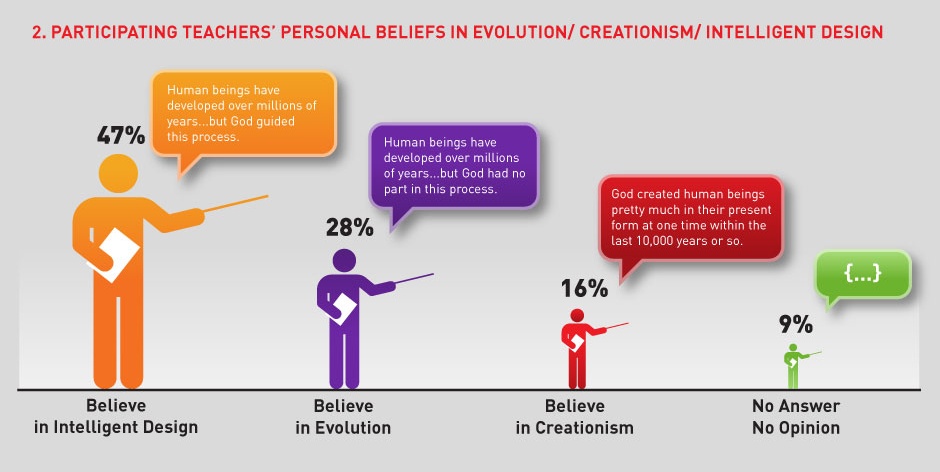
PZ Myers over at Pharyngula is more pleased than he should be with some “flashy illustrations” of the creationism menace. “Use these!” he admonishes. Um, maybe not.

While the graphs are flashy and, in their way, are informative (though I'm not crazy about the choice of pale red [is not explicitly mentioned] as intermediate between green [is mentioned directly] and dark red [isn't mentioned]—pick a better color palette, guys!), there are significant scaling problems. When one ostensibly represents ratio data with the linear dimensions of objects possessing area, the visual impact is seriously misleading. Perhaps this sounds fancy, but it's not.

Suppose you want to compare a data value of 16% with a data value of 32%. The latter is twice as much as the former. In a bar chart, one would be twice as tall as the other. Simple:


You can't get much more basic than that. However, what if you decide to represent your data with cute little gingerbread men? It's quite obvious that the one representing 32% must be twice as tall as the one representing 16%, right? Except look at what happens:


It's the classic problem of scaling. Doubling the linear dimensions of a two-dimensional figure results in a quadrupling of its area, immediately creating an exceedingly misleading visual impact. To maintain a correct visual impression in a situation where two-dimensional area rather than one-dimensional length catches the eye, the linear scaling factor should be the square root of 2 (approximately 1.4142) rather than 2 itself. The results are much better:


This is exactly the problem with the Campus Explorer's iconic graph of teachers' personal beliefs in evolution vs. creationism and intelligent design creationism. The purple figure representing 28% looks like it's quite a bit more than twice the 16% icon. The 16% icon similarly looks a lot bigger relative to the 9% icon than it should. The Discovery Institute will certainly be delighted with the colossus representing adherence to ID creationism.


With some elementary (and not particularly elegant) picture editing, I offer this statistically improved version, whose visual impact is not misleading:


Darrell Huff warned us about misleading data graphs in How to Lie with Statistics, originally published in 1954. We have yet to learn the lesson he tried to teach us.

Friday, July 16, 2010

Advice from my nephew

An expert in his field

He calls me “uncle,” so I call him “nephew.” He currently lives on the East Coast, so it's been quite a while since I've seen him or his father (who many years ago was a student of mine). In need of some information, I dropped the boy a note via e-mail:
From: Zeno Ferox
To: Ian Rhys
Sent: Fri, July 9, 2010 8:44:56 PM
Subject: Birthday gift list

Hi, Ian. I know someone who is turning 11 years old next month and I was wondering what a good birthday present would be. If you were choosing a nice gift for an 11-year-old boy, what do you think he might like?

I welcome your suggestions, as I regard you as an expert in this field.

Love,

Uncle Zeno
Ian is not normally a prompt correspondent, but my missive evidently touched a responsive chord. A reply was soon in my in-box:
Date: Sat, 10 Jul 2010 05:44:58 -0700 (PDT)
From: Ian Rhys
Subject: Re: Birthday gift list
To: Zeno Ferox

Well I actually think it depends on what the boy's charechtoristics are. E-mail me his charechtoristics. okay?
Ian has rather creative spelling, but his response was an entirely reasonable one. I hastened to provide the requested information on the birthday boy's “charechtoristics”:
From: Zeno Ferox
To: Ian Rhys
Sent: Sat, July 10, 2010 9:48:58 AM
Subject: Re: Birthday gift list

Good point, Ian. Unfortunately, I haven't seen the boy in question in quite a while, so I'll have to go from memory. I seem to recall that he was very smart. He was interested in lots of different things and very good at reading and math. Good sense of humor, too.

I realize that's not very specific, but perhaps that's enough for you to work with. Any ideas?

Uncle Zeno
Despite the paucity of specifics in my message, it was apparently enough to inspire some recommendations from my consultant:
Date: Sat, 10 Jul 2010 15:21:04 -0700 (PDT)
From: Ian Rhys
Subject: Re: Birthday gift list
To: Zeno Ferox

Well if hes smart I guess he might like these items:

Redwall: Bellmaker

Redwall: Outcast

Monopoly

Star wars Lego set

I think any of these would work for a boy like that.

Tell me if you think he will like one of these.........

- Ian
This was exceedingly helpful, but now it was my turn to ask for some characteristics:
From: Zeno Ferox
To: Ian Rhys
Sent: Sat, July 10, 2010 6:36:03 PM
Subject: Re: Birthday gift list

Why, yes, as a matter of fact. I think he might like all of the items you mentioned. Of course, if I were to choose to give him a Star Wars Lego set I would have the difficulty of picking which one to send him. There are many, many choices. Perhaps an intelligent young man such as yourself might offer me some additional guidance?

Cheers!

Uncle Zeno
He was clearly poised to answer. I soon had the specifics I had requested:
Date: Sat, 10 Jul 2010 15:43:43 -0700 (PDT)
From: Ian Rhys
Subject: Re: Birthday gift list
To: Zeno Ferox

this is the full name that I found for it:

LEGO 8086 Star Wars Trifighter Droid

I think he will like this one...

If you cant remember the name then print it out and bring it to the store

A good store would be toys are us or a lego store, oh and wallmart maybe..

If its too much just get any type of star wars lego set.

He will like it..

- Ian
He seems to have no doubt in the matter (even if he's concerned that doddering old Uncle Zeno might forget the details). Who am I to question his judgment concerning the birthday presents currently favored by 11-year-old boys? I dispatched a note of thanks:
From: Zeno Ferox
To: Ian Rhys
Sent: Sat, July 10, 2010 9:20:39 PM
Subject: Re: Birthday gift list

I consider your advice definitive in this matter and am confident that you are correct about the birthday boy's appreciation of the gift. Thank you exceedingly for your kind counsel.

Lots of love from your Uncle Zeno
You will appreciate how cleverly I have outsmarted the little rascal and gotten so much information out of him. Ian sure is going to be surprised when he receives a Star Wars Droid Tri-Fighter Lego set and a couple of Redwall books for his 11th birthday from his sly Uncle Zeno.

Wednesday, July 14, 2010

Solution by coincidence

Lucky Larry asks for full credit

My introductory calculus class had arrived at the section on finding critical numbers for given functions. These numbers, as you recall, provide the candidates for possible maxima and minima for the functions. They come in two forms: (1) numbers for which the first derivative is zero and (2) numbers for which the first derivative does not exist. After some practice and review of the topic, I gave my students a quiz containing the following function f(x) = x5/3 + 5x2/3.

The fractional exponents are a dead giveaway that mischief is afoot. The derivative is straightforward:


The factored form makes clear that there are two critical numbers. The factor x + 2 yields x = −2 as a number for which the first derivative is zero. The factor x−1/3 shows that x = 0 is also a critical number, since division by zero is undefined and the negative exponent is an indicator of an implied division.

It's a nice little problem that provides a critical number of each type. But one of my students was miffed when I didn't give him full credit for having successfully winkled out the two numbers. When he protested, I gently explained to him that his work was invalid. As a clever student who fully believes in his cleverness, he was certain that an injustice had been committed. “This isn't over,” he muttered. “I can prove that I'm right.”

“Go right ahead,” I said in my most agreeable tone of voice.

We huddled over his paper as he explained his solution to me. Instead of factoring the derivative after setting it equal to zero, he had divided both sides of the equation by 5/3, obtaining

x2/3 + 2x−1/3 = 0

“Then I applied the quadratic formula,” he proclaimed. “I had a = 1, b = 2, and c = 0.”

“You could have factored,” I pointed out.

“Yeah, well, factoring and the quadratic formula give the same result,” he said.

“Um, sure,” I agreed, “but only if you're applying them to a quadratic equation. This equation is not quadratic in form.”

“Hold on a second,” he persisted. “Look at what I get.”


“See?” he concluded triumphantly. “When I simplify, I get the critical numbers 0 and −2. I'm right!”

“The numbers agreed with the correct answers, but it's a coincidence. The quadratic formula doesn't apply.”

He was not pleased.

“What do you mean?”

“Look at your equation,” I said. “Your lead term contains x to the two-thirds power and your second term contains x to the negative one-third power. The former is not the square of the latter, which is the necessary condition for treating an equation as a quadratic.”

His face fell.

“But I got the right answers!”

“It's a coincidence.”

He fussed over it a bit more.

“But it'll work every time, won't it?”

“In a problem of exactly this kind? Yes, because the derivative-does-not-exist critical number got converted into a derivative-equals-zero critical number.”

“So can I use this? I just showed that it works.”

“No, you just showed that you lucked out. A coincidentally correct result from an invalid process is still invalid.”

“But if it works—”

“I'll tell you one more time: No credit for lucky accidents. If you use quadratic techniques when they don't apply, you don't get credit. Besides, factoring is easier and gives correct results. Try to remember that.”

He still thinks he was cheated of full credit by a hard-nosed teacher.

He's half right.

Monday, July 12, 2010

Majority rule

Democracy invalidates all religions

It's fun to read the letters to the editor. One learns so much about the way other people think (or don't!). Last month someone decided to give everyone the benefit of her deep thought and reasoned argument. She was upset that Proposition 8 was being challenged in court:
We have the right to preserve and protect the definition of marriage. We did so, twice. We have voted. Judge Vaughn Walker should uphold our vote and not be swayed by the unhappy minority. Judges are to interpret the law, not make the law. Again, the majority has voted. Uphold the vote and be done with it. Quit listening to the minority of California.
So there!

I guess it doesn't matter that this might be a matter of fundamental human rights. A majority of the voting population should be allowed to trample upon them. (I also presume that the letter-writer sees no significance in the falling level of support for hetero-only marriage in the two votes she cites. Third time could be the charm! It ain't over, baby.)

Nevertheless, the writer's abasement before the god of majority rule makes me wonder how far she would allow it to be taken. I'm pretty sure she would pull up short if I were to point out that the majority opinion is against her religion. While nowhere in her letter did she mention religion, Proposition 8's noisiest supporters are right-wing Christians—and Christianity is a minority religion.

Let's do the math. While membership numbers are often unreliable and religions aren't required to audit their membership rolls, it scarcely matters. Most of the 6.7 billion people in the world will reject any particular religion you claim to name. Let's look at Christianity, since that's America's most popular religion.

Only 34% of the world's population purports to be Christian. Thus our nation's most widely shared delusion is spurned by a two-to-one margin. In political parlance, that would be a landslide.

What about Islam, which considers itself the religion fated to replace Christianity (and, for that matter, all other beliefs). The news isn't so good.

Yes, Muhammad's followers are on the wrong end of a three-to-one split. That's got to be discouraging. And it's downhill from there for other forms of devotion. Buddhism can scrape up a similar number of adherents if you generously aggregate all of its many flavors (much as I did with the sects in Islam and Christianity).


It's barely one out of five. However, that's still better than Hinduism, which can claim almost one person in six:

There is no winner. The religions are all obvious losers. Furthermore, these demographics almost certainly represent best-case scenarios where casual or lapsed adherents may be bundled into the head count.

Sometimes I wonder if my home parish still has me listed as a member of the local Roman Catholic congregation. It's possible. The church register is notoriously unreliable. If so, this final result is also inflated.

Sorry, Benny Hex. You don't have any many followers as you think you do—and the ones you have are terribly outnumbered..

All religions are therefore minority religions. Folks who are eager to tromp on minority rights might want to keep that in mind while they are embracing majority rule and demanding the right to gang up on others. Next time it could be your turn.