Showing posts with label creationism. Show all posts

Friday, December 21, 2012

Religion: the cure for science

Praying instead of studying?

I'm not sure what Bob Christopher was doing in college during his years as a biology major, but it sure wasn't learning science. Christopher had occasion during today's installment of “People to People” on Christian radio to discuss how learned-up he was about science. Seems, however, that it didn't take. During a program on Christmas titled “Jesus is the Reason,” Christopher fielded a question on evolution from a young man named Shawn, who hails from Waco, Texas. He promptly trotted out the “only a theory” meme:
Shawn: I'm really wondering, though, about evolution. I hear this a lot. I hear, of course, you know, we're descendants of Adam and Eve. You know, just kind of wondering what your thoughts are on evolution.

Bob Christopher: Well, Shawn, my degree in college is a degree in biology, so I spent a lot of time studying the theory of evolution. And that's exactly what it is: it is merely a theory. There's no scientific fact that supports evolution as the way we came into being. There is microevolution, there are small changes that occur within the species, but the species always remains the same. We don't see one species changing into another as evolution would have it. That's just not supported with the facts. But it is a theory. It's an intriguing theory. It's an interesting theory. It held no water until geologists came along and started proposing the idea that the earth was much older than we first believed. Up until the mid 1800s it was just a known fact—or at least everybody believed—the world was no older than six thousand years as far as the age was concerned. But geologists started proposing that quite possibly that it would be older than that, could be millions of years. And without that assertion into the scientific community, the theory of evolution would have died. Why? Because that theory requires time for it to be a reality. So the geologists helped move it along just a little bit and it took root in the scientific community and they've been exploring it and trying to figure it out ever since. But, quite frankly, I think it's a veil that they're using to cover up what they really believe, and what they really believe is that there is no God. And so they're using that veil of evolution to hide that fact.
Who is this “they” that Bob Christopher keeps talking about? This mysterious entity appears to comprise all scientists and teachers of science. Christopher's further remarks do not clarify his meaning. In fact, he concludes his argument with a shocking revelation.
Bob Christopher: And so schools have bought into it hook, line, and sinker, they're teaching it as if it was truth, but it's not truth. It is just a theory. It's a person's theory on how things came into being. It stands in opposition to what the word of God has to say, and as far as science is concerned— I love science. I was, like I said, a science major. I thought the courses I took in college were absolutely fascinating. I was intrigued by every single one of them. But science, if you follow the evidence, I think that evidence is going to lead you right back to God. It has to. God is the author of science. God knows how this world works. God is the very force that holds it together. He understands physics better than our best physicists that are out there. He understands the way the body functions better than any medical doctor, better than any biologist. He knows how our chemicals work inside of us better than any biochemist. He knows us better than anyone else. He knows how this thing works. So any study of science, any real study of science, that looks at the evidence and looks at the facts and lets the evidence and the facts speak for themselves, that person is going to be led to the Creator. And I think more and more scientists, up in the upper echelons of the scientific community are coming to that reality.
Really, Bob? The most prestigious members of the science community are embracing the God hypothesis? You'd think someone would have noticed this trend by now, especially since it entails a dramatic reversal of a highly publicized result from 1998, when it was determined that only 7% of the members of the National Academy of Sciences (is that “upper echelon” enough for you, Bob?) believe in a personal God. The God-botherers within the nation's scientific elite could hold a convention in a phone booth with room left over for the catering staff.

Better do it soon. Phone booths are going the way of the dodo.

Tuesday, June 12, 2012

Here be dragons

Not!

The competition for stupidest creationist argument is fierce, as any perusal of WildwoodClaire's “Dim Bulb of the Week” or Potholder54's “Golden Crocoduck” competition will amply demonstrate. Undaunted, they continue to strive to outdo one another.

I just stumbled across a most delightsome example of creationist inanity, laced with a generous dollop of cryptozoology. It's a video titled “The Secret History of Dinosaurs,” and you'll be charmed to learn that it has scraped together all of the spurious evidence for the survival of dinosaurs into the modern era (you know: dragons, Nazca, Ica stones, petroglyphs, la, la, la). In addition, however, it contains one of the loveliest examples of misinterpreted evidence I've ever seen. It's a small thing, but quite entertaining.

Apparently evolutionists have been suppressing the evidence related to dragons and sea monsters, now-endangered species of dinosauria that nevertheless linger in African jungles, Scottish lochs, and other obscure ecological niches. As the narrator explains, the coexistence of man and dinosaur has been disguised by shifts in language. He flashes a page from an old dictionary and points outs that “dragon” is now a disparaged term. At 3:55 into the video, he darkly observes that “dragon” is Now Rare.
The name that you are probably the most familiar with is “dragon.” Even up until 1946 the word “dragon” was found in dictionaries and has in its definition this telling description.

But do you see what the “telling description” really means? It's just a label on definition #1: A huge serpent. Apparently people seldom refer to big snakes as dragons. It doesn't mean that we nasty old evolutionists are suppressing the word.

And, yes, the rest of the video is just about as stupid. Big surprise.

Saturday, April 07, 2012

Creationist word salad

What a tosser!

The latest issue of Acts & Facts from the Institute for Creation Research offers its usual collection of antievolution essays and articles. A one-page “research” piece (that's how the page header describes it) by Jeffrey Tomkins offers yet another in a long series of ICR pokes at natural selection, a concept that ICR really seems to think they have on the ropes. Once again, evolution is on the brink of utter demolition. Surely it cannot stand much longer!

It's a good thing that creationists are about as patient in anticipating the demise of evolution as they are in awaiting the return of Jesus Christ. I believe that the one is just as imminent as the other—and I'm sure they agree with me in that statement (if not in my interpretation of it).

Acts & Facts contributor Tomkins boasts a Ph.D. in genetics from Clemson, but apparently failed to grasp the context in which genes operate. He seems to have studied them without managing to recognize them as the mainspring of evolution. Tomkins has, however, a explanation why evolution through natural selection cannot be the creative force responsible for today's diversity of life on planet earth. Brace yourself for this key paragraph from his article:
Environmental stresses and stimuli cannot exercise the creative causation of highly complex pre-coded genetic information that underlies irreducibly complex systems of adaptation. Organismal interaction with the environment involves highly complex and dynamic physiological and genetic responses to a wide range of physical and chemical sensory cues. These environmental cues are perceived by complex systems of cell sensor networks that interact with an organism’s highly engineered genetic system. While adaptation systems are complex and flexible, they are not evolvable on a grand neo-Darwinian scale. They are pre-engineered, pre-programmed, and irreducibly complex in the strictest sense of the term, and they unequivocally imply the infinite intelligence of our Creator God.
Well, that was clear, wasn't it? It takes begging the question to new heights of redundant prose.

Dare we try to unpack some of the word salad that Dr. Tomkins tossed for us? Let's give it a shot by considering specific words and phrases:
  • highly complex: the warning shot across the bow!
  • pre-coded genetic information: “pre-coded” implies a coder!
  • irreducibly complex systems: it's Behe time!
  • highly complex: What I tell you three times is true!
  • complex systems: so four times is a total clincher!
  • highly engineered genetic system: the coder has transmogrified into an engineer now.
  • pre-engineered, pre-programmed, and irreducibly complex: the engineer, coder, and Behe in three-part harmony.
  • unequivocally imply: no room for doubt!
Are you as persuaded by the author's argument as I am? Yes, that's what I thought.

Tuesday, December 27, 2011

Adroit gaucherie

A left-handed backhand tribute

David Berlinski has brilliantly resolved the sovereign conundrum of his existence: How can he remain modest while being the smartest member of an anti-intellectual cult? His elegant solution is to not even try. Another effortless triumph!

He again puts his sumptuous vocabulary and self-conscious prose on display as he preeningly pretends to celebrate the life of the late Christopher Hitchens. While Hitchens was a master of the finely honed, sharp-edged phrase, Berlinski prefers to poke about with a dull-tipped poniard. The jewels on his stiletto's hilt are of more interest to him than the blunt tip's inability to make a point. Watch as he uses his supposed tribute to Hitchens as a vehicle for self-aggrandizement, attempting to clamber up to Hitchens' level and stand by his side as a co-equal polemicist. It is an intriguing spectacle. Some excerpts:
Christopher Hitchens's reputation rests on his literary works, his panache as a public speaker, and on his defiant atheism. He wrote on a very wide range of subjects, and his book reviews were often very fine. He liked to praise the writers and poets he loved: Oscar Wilde, Vladimir Nabokov, Evelyn Waugh, W.H. Auden, Wilfred Owen, James Fenton, many others. He read closely and he read well. As an essayist, Christopher Hitchens is often compared to George Orwell. The comparison is careless, and it is one that in his final interview with Richard Dawkins, he rejected. Hitchens wrote fluently, Orwell, unforgettably. The difference is very considerable, but it is not to Hitchens's discredit. No man is obliged to be what he might have been.
Poor Hitch. He was no more than he was, but that's not his fault. Berlinski understands, and sympathizes. (As well he should.)
Hitchens was an engaging public speaker, and he had the gift of gracefully holding an audience. His intimate interviews were often wonderful because invariably, he was more elegant and far more articulate than his interlocutors. When faced with a rhetorical bruiser like George Galloway, his natural register failed him, and he did not have the dexterity to secure by means of an ironical divagation what he was otherwise unable to secure by matching bruise to bruise.
Poor Hitch. He was better at fencing than at crotch-kicking. (Really? Perhaps Berlinski overlooked Hitchens' well-known stone-crushing skills. Or maybe David wisely kept his knees clasped tightly together during his debate with Christopher.)
With the publication of God Is Not Great, Christopher Hitchens reached a mass audience. He became celebrated. When he discovered how well he had been received by the public, he tended to regard his own religious beliefs with the indulgence of a man who on discovering that he has been lucky in attracting admirers very naturally concludes that he has been justified in attracting them.
Poor Hitch. He mistakenly thought he deserved the attention he got. Berlinski desperately wants to know how he got that attention and would sell his soul to achieve the same level of recognition. (Perhaps he already has. The house intellectual of the Discovery Institute has a lot to answer for.)
His atheism nonetheless had a kind of shambling boisterousness that made Christopher Hitchens seem a Mirabeau to Richard Dawkins's Saint Just [sic] or Sam Harris's Robespierre.
Poor Hitch. Did he never suspect that he was playing a part in a zany recapitulation of the French Revolution? (By the way, David, the name of Louis Antoine de Saint-Just is usually rendered with a hyphen. Not, of course, that this significantly detracts from your light-shedding simile. Pas du tout!)
Hitchens was uninterested in subtle analysis. On the masthead of the Daily Hitchens, there is the legend: What can be asserted without proof can be dismissed without proof. The difficulty with this assertion is straightforward. If it has been asserted without proof, why should it be believed, and if not, where is the proof?

I asked Hitchens about this during a break in our debate. We had retreated to a forlorn hotel loading ramp in order to have a cigarette. “Well, yes,” he said, “it's just a sentence.”
Oh, that Hitchens! Such a sly boots, and yet hoist by his own petard when caught making a statement without proof about statements without proof. Sneaky, clever Berlinski, to catch him out like that! It was also wise of Berlinski, who routinely plays the part of a math expert, to refrain from making the obvious point that every theoretical discussion must begin with unproven axioms at its foundation. Ceding this point to Hitchens would have deflated Berlinski's elegant gotcha. How unfortunate that Hitchens neglected to cringe in humiliation at Berlinski's sly riposte.
Christopher Hitchens found objectionable the very idea of a source of authority, and so of power, greater than his own. This has seemed to some of his readers all of the time, and all of his readers some of the time, both defiant and uplifting. The very same idea is at work in the terrible crimes of the twentieth century. It is inseparable from them.
I hasten to point out that Berlinski is not running afoul of Godwin's law here. Our elegant elegist deftly ducked this faux pas by not elucidating the nature of the twentieth century's terrible crimes. Hitler is only implied. We all understand perfectly well that Hitchens would never have supported Hitler—that is, of course, if he had only possessed the wit to realize that “the very same idea” of disdaining an ultimate authority is “inseparable” from campaigns of mass murder.

At least, that's one way to read Berlinski's prolix paragraph. Antecedents are difficult to pin down. (Does “the very same idea” refer to “the very idea of a source of authority” or the notion that this source itself was “objectionable”?) One of the glories of his prose is that the author will be on a firm footing if he objects to this characterization on the grounds that the sentences are ambiguous and subject to many (and divergent) interpretations.
Christopher Hitchens chose to greet death publicly. Had he thought of it, he might well have invited an orchestra. We signed books together after our appearance in Birmingham, and to admirers on his very long line inquiring after his health, Hitchens replied that he was dying. It was a response that inevitably took his interlocutor aback, the more so since it was true. I followed his interviews and read his essays about cancer and death. I found them moving. But they do not evoke the man.
And neither does Berlinski's supposed encomium.

Saturday, September 03, 2011

The gravity of the situation

A major contender in the stupid sweepstakes!

All reasonably rational and intelligent people have had occasion to groan in pain and palm their faces in astonished contemplation of the inanities that come from the mouths of creationists, religionists, and other “believers” who rely on faith rather than knowledge. Once they have hung their tiny brains on the peg of revealed wisdom—usually derived from some sprawling and clumsy tome (like the Bible, Koran, or Atlas Shrugged)—they are smug in their ignorance and beyond the reach of reason. Is it even possible to recover from the weapons-grade stupidity displayed by Noah Hutchings and Jerry Guiltner in this exchange from the August 30, 2011, broadcast (at 13:28) of Southwest Radio Church's Watchman on the Wall?
Hutchings: Now, Brother Jerry, we hear all about this Big Bang. That's how everything has come into being. Now some of these heavenly bodies you see out there really have no atmosphere and yet they are perfectly round. Now all the planets are perfectly round. Our moons are perfectly round. The stars are perfectly round. Our sun is perfectly round. Now you mean that they mean to tell us that there was a big explosion at the beginning and all these heavenly bodies come out perfectly round? Now can you explain that?
Yeah. It's gravity.
Guiltner: [Laughter] I wish I could. I can't even explain why intelligent people would believe that. That it's just amazing that these folks that claim to be as smart as they are can't see that— You know, someone said, Brother Hutchings, that it takes more faith to be an evolutionist than it does to be a Christian and I believe that they may be right because that just simply makes no sense at all to me.
Pardon me for pointing this out, Noah and Jerry, but did you realize people occasionally hear things when you broadcast them on the radio? That's right. Folks are going to find out how stupid you are.

Fortunately, most of those who are listening are just about as brain-damaged as you are!

Saturday, July 02, 2011

Punctuation for thee and me

Bringing reason to a full stop

The back page of a recent Answers Update (Vol. 18, No. 6) carries a bright little apologetic nugget by Ken Ham himself, the strikingly australopithecine leader of Answers in Genesis. Ham is talking about the earth's effing magnetic field. How does it work?
[G]eophysical and archaeological evidence indicates that 1,000 years ago, the magnetic field of the earth was 40% stronger than today. This field is actually decaying at a rate of 5% per century.

The decay rate may not sound like much, but it's a very important factor in determining the age of the earth. Using the current rate of decay, it's been calculated that just a million years ago, the magnetic field would have been so strong that it would have melted the planet! ...

Creationist physicists declare that the magnetic field is a very strong indicator that our planet cannot be any older than 10,000 years. This, of course, confirms the roughly 6,000-year timeline in the book of Genesis.
Please don't be distracted by Ham's use of amusing little oxymorons like “creationist physicists.” We can easily detect what he is up to. There's a useful word to describe the theoretical foundation for Ham's argument:

Uniformitarianism.

Obvious. Right? Ham is assuming that conditions affecting the earth's magnetic field have remained exactly the same throughout history. What else is that besides uniformitarianism? Of course, Ham might beg to differ. Let's see how he described uniformitarianism in the 1987 edition of his book The Lie: Evolution:
Geologists have the idea that the processes we see operating in the present world have been going on for millions of years at essentially the same rate, and will probably go on for millions of years into the future as well. The technical word used in geology for this belief is “uniformitarianism.” For example, the desert museum in Tucson, Arisona, not only has a display for people to see what supposedly has happened over the past millions of years, but it also has a display of what many scientists believe will happen to Arizona over the millions of years yet to come!

Evolutionists, atheistic and theistic, use the phrase “the present is the key to the past.” In other words, they say that the way to understand the past is to observe what happens in the present.”
Bingo! Ham's magnetic-field argument for a young earth is a page ripped right out of the uniformitarianism playbook. He stands self-accused.

One imagines that Ham might wish to quibble. He could claim that he was using a reductio ad absurdum argument—or proof by contradiction—having demonstrated that the assumption of uniformitarianism leads to an impossibly high level of magnetic flux in the prehistoric past.

Sorry. That won't work. He is not just arguing that an old earth is impossible. Ham explicitly declares that some simple computations provide evidence consistent with a young earth. He is making a “pro” argument for his position every bit as much as he is making a “con” argument against his opponents (which constitute 99% of the scientific community).

Ham may not like uniformitarianism, but he is certainly willing to use it when it suits him. Perhaps he needs to create a new label for it. May I suggest “punctuated uniformitarianism”? He can use it to argue that physical laws and natural processes are uniform between occasional catastrophes—like his magnetic-field argument.

Saturday, April 02, 2011

A repeated lie

It's okay if it's for Jesus

The Institute for Creation Research likes to honor its founder, the late Henry M. Morris, by reprinting his articles in Acts & Facts magazine. The April 2011 issue recycles Morris's essay on “Defending the Faith.” According to the tag at the end, the article was originally published in January 1997. I presume the following paragraph was carried over intact from Morris's initial version:
The excellent book Of Pandas and People was written to present biology in terms of “intelligent design,” without any reference to God, the Bible, or creation, hoping that it could be adopted as a high school biology textbook. Again, nothing doing! It was merely a sneaky way of getting creationism into the schools, said its opponents, and they won.
How closely must one have followed the creation/evolution argument to laugh at Morris's claim? Anyone who has paid even a modicum of attention to the attempts by creationists to subvert public school science is aware that Pandas and People was not written as a intelligent design textbook. The original manuscripts conclusively demonstrated that “in the beginning” it was overtly a creation-science book. This was amusingly revealed during the Kitzmiller trial, when the search-and-replace revision of the manuscript was shown to have produced “cdesign proponentsists” as the undeniable intermediate form between creationists and intelligent design advocates.

We can try to be charitable about Morris's blatant mischaracterization of Pandas and People. It's possible that he took the published 1989 ID-based edition at face value and was innocently unaware of the book's true origins. It is not, after all, an ICR publication. However, what excuse does ICR have for republishing Morris's misrepresentation—deliberate or not—in 2011? Kitzmiller occurred in 2005. The current editorial staff at Acts & Facts has had more than five years to absorb its lesson. Nevertheless, they reprinted “Defending the Faith” without so much as a footnote to indicate that Morris was mistaken about Pandas and People. A decent respect by Christians for their own cherished scriptures should prompt them to pay attention to the injunction against bearing false witness.

They have no excuse.

Tuesday, October 12, 2010

A too-easy question

Ooh! Ooh! I know! I know!

The October 2010 issue of Acts & Facts from the Institute for Creation Research is emblazoned on its cover with a colorful display of astronomical images, including the planet Saturn. Text is laid over the cover art, spelling out the question, “Why does the universe look so old?”

I think I know the answer to this one:

Because it's old.

Poor creationists. They have to labor so diligently, so faithfully, and so blindly, to rationalize their God's duplicity. He may have implied in his holy book that the universe was created a scant few thousands of years ago, but then he went and made it look billions of years old. Either their God is a liar or he is a prankster. Loki or Coyote. It's not a very satisfying choice, is it?

Sunday, August 29, 2010

Science saves volcano virgins

The Sunday funnies

Sunday mornings are a good time for enjoying the funnies. I am not, however, limiting myself to what I discover in the comics section of the daily newspaper. Some of the most entertainingly amusing stuff is on television, where religious broadcasters present surreal comedy routines that they deliver with astonishing earnestness. (I marvel at how they manage to keep a straight face.)

This morning's entertainment was provided in part by Shawn Boonstra, an earnest and soft-spoken television preacher who styles himself as the “speaker/director” of his It Is Written ministry. He had set himself the task of discussing Einstein's brain and using it as an example of the insufficiency of natural processes to explain the existence or intelligence of humanity.
You know, on paper, sometimes the theory of evolution makes pretty good sense, but don't you find there's this nagging doubt in your heart that tells you this place couldn't possibly have come into existence by accident? How in the world does a cosmic accident develop to the point where we can generate nuclear power? What can we learn from a literal chunk of Einstein's brain?
Ah, yes, the “cosmic accident.” Time to pull God out of the hat as a convenient explanation.

If that were all, Boonstra's presentation would have passed by, unremarked and unremarkable. Fortunately, however, for the sake of my morning entertainment, he had a compelling argument for God's existence based on morality. Without a divine lawgiver, you see, anything goes! While I had heard that before, too, I hadn't heard his precise example before:
If we accept the atheist view of our origins then we have to admit that ideas like good and evil or right and wrong are nothing but human concoctions, the products of our culture. And if you accept that morality is something invented by human beings, you run into a pretty big problem. If one culture says that it's okay to throw young virgins into an active volcano in order to appease the gods of the underworld, then who's allowed to say that's wrong? By what authority can they possibly critique that behavior?
By the authority of science, of course! Science amply demonstrates that volcanoes are not propitiated by virgin sacrifice. The virgins thus spared can then be employed in more productive ways.

Yay, science! Boo, volcano gods!

But Boonstra had worked up a head of steam, so he kept rolling along:
Not only do I believe in a creator God, I also believe in a moral God, a great lawgiver who gave us a perfect moral code. And far from being a outdated set of do's and dont's from some ancient outmoded religion, the Ten Commandments still remain God's standard for right and wrong today. They're laws that just make sense.
A perfect moral code? I'll bet that Boonstra can't define it. Or, at least, he'll have a hell of a time explaining why it's important to avoid eating shellfish while stoning one's recalcitrant children. Or raping virgins that belong to enemy tribes (assuming you don't need them for the volcanoes).

And the Ten Commandments make sense? Excuse me, but I think George Carlin has persuasively demonstrated that they are terribly overwritten and fraught with the insecurities of a compulsively jealous deity.

Amen.

Saturday, July 17, 2010

Believing your lying eyes

One picture is worth a thousand misstatements

PZ Myers over at Pharyngula is more pleased than he should be with some “flashy illustrations” of the creationism menace. “Use these!” he admonishes. Um, maybe not.

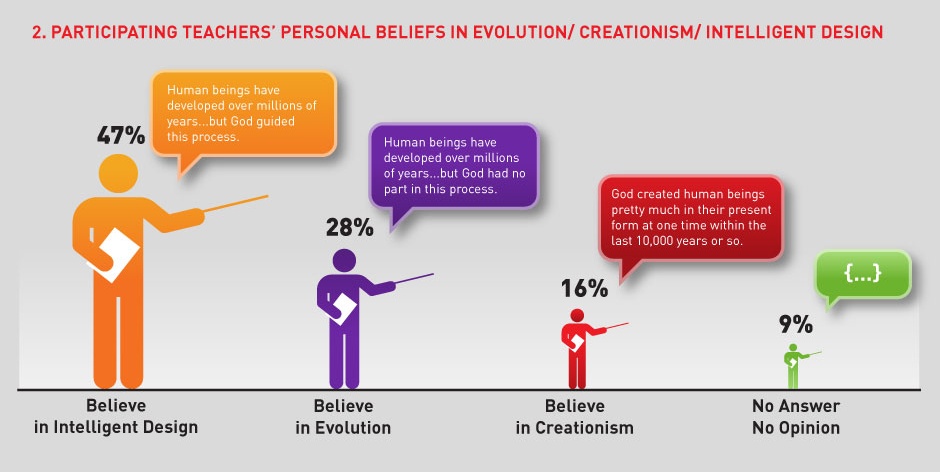
While the graphs are flashy and, in their way, are informative (though I'm not crazy about the choice of pale red [is not explicitly mentioned] as intermediate between green [is mentioned directly] and dark red [isn't mentioned]—pick a better color palette, guys!), there are significant scaling problems. When one ostensibly represents ratio data with the linear dimensions of objects possessing area, the visual impact is seriously misleading. Perhaps this sounds fancy, but it's not.

Suppose you want to compare a data value of 16% with a data value of 32%. The latter is twice as much as the former. In a bar chart, one would be twice as tall as the other. Simple:


You can't get much more basic than that. However, what if you decide to represent your data with cute little gingerbread men? It's quite obvious that the one representing 32% must be twice as tall as the one representing 16%, right? Except look at what happens:


It's the classic problem of scaling. Doubling the linear dimensions of a two-dimensional figure results in a quadrupling of its area, immediately creating an exceedingly misleading visual impact. To maintain a correct visual impression in a situation where two-dimensional area rather than one-dimensional length catches the eye, the linear scaling factor should be the square root of 2 (approximately 1.4142) rather than 2 itself. The results are much better:


This is exactly the problem with the Campus Explorer's iconic graph of teachers' personal beliefs in evolution vs. creationism and intelligent design creationism. The purple figure representing 28% looks like it's quite a bit more than twice the 16% icon. The 16% icon similarly looks a lot bigger relative to the 9% icon than it should. The Discovery Institute will certainly be delighted with the colossus representing adherence to ID creationism.


With some elementary (and not particularly elegant) picture editing, I offer this statistically improved version, whose visual impact is not misleading:


Darrell Huff warned us about misleading data graphs in How to Lie with Statistics, originally published in 1954. We have yet to learn the lesson he tried to teach us.

Saturday, February 13, 2010

The cold truth about PZ Myers

Not exactly TMZ on PZ

While on tour in the Golden State, PZ Myers was resilient enough despite minor jet-lag to hoist a few brews after his talks. Smiting ignorance and prejudice can be dry work.

I tagged along to two of the post-presentation chat sessions. The chosen venue after the Sacramento City College talk was the Fox & Goose, which bills itself as a “public house” in the British style. (That's right: a “pub.”) It was a slow evening when we dropped in. PZ and a dozen other people gathered around some shoved-together tables and kicked back for some casual conversation. (No, we did not array ourselves in the manner of Da Vinci's “Last Supper.”)

During the course of that colloquy, PZ off-handedly made two shocking revelations. The first was his youthful rebellion against his father's carefully mapped-out plans for PZ's life. PZ, you see, was destined to be a ... refrigerator repairman.

You can easily imagine his father's horror when PZ threw it all over in favor of going to college. Even worse, PZ became a hardcore academic, ending up as a tenured professor. While it seems that his family eventually became reconciled to PZ's academic bent, his father never quite understood why PZ tossed over a sure thing like major appliance repair for the uncertainties of university life. Instead of associate professor of biology at the University of Minnesota, PZ could have been Refrigerator Repairman—but it was not to be.

All habitués of Pharyngula know that PZ is a prodigious writer (except, perhaps, for the book he is always supposedly finishing up). It's not surprising to learn that he is also a prodigious reader. Of course, we know this because we see his reading as the grist for his blog's mill. However, there's more to it than that. PZ is a big fan of science fiction author Iain M. Banks. In fact, he's also a big fan of Iain Banks, this latter being the name that Banks uses for his non-sf novels.

I lean toward the Culture novels myself, my favorite Banks work being The Player of Games, one of the few books I have read multiple times. PZ expressed a fondness for the semi-notorious Wasp Factory and its sociopathic protagonist. My Simon & Schuster paperback copy of The Wasp Factory includes on its back cover such paeans as “One of the top 100 novels of the century” and such slams as “A literary equivalent of the nastiest brand of juvenile delinquent.” I rather admire the cheekiness of running negative comments among the usual positive blurbs.

(Shocking revelation of my own: My copy of The Wasp Factory is brand new. Despite an assiduous search through my bookcases, I find no trace of the white-covered edition I see so clearly in my mind. And paging through the new copy leaves me befuddled, since the story seems only vaguely familiar. Have I forgotten it or have I never read it? Both are hard to believe. The book is now on my “read soon” stack and I'll see whether Frank's nefarious adventures ring a bell.)

PZ and I were not the only Banks fans present. One of the other attendees offered his opinion that Banks wrote scenes that were impossible to turn into movies. (An attempt to turn The Player of Games into a film foundered several years ago.) PZ disagreed. He suggested that the scene with the Eaters in Consider Phlebas would make for a very nice horror movie.

He's probably right, but you wouldn't want to be munching popcorn during that episode (“we are the Eaters, the Eaters of ashes, the Eaters of filth”).

The venue for the post-talk gathering after PZ's Sierra College presentation was BJ's Restaurant & Brewery in Roseville. The contrast with the Fox & Goose was dramatic. BJ's was crowded with patrons and PZ was accompanied by a much larger entourage. Long tables were pushed together to make enough space for the dozens of people in the party.

I got to sit close enough to PZ where I was able to get his autograph (like the geeky fanboy that I am). He observed that we carried closely matched Moleskine pocket notebooks, including the same quadrille rule (no mere lined paper for us science types!). He also complimented me on having neater handwriting than his, but PZ also pointed out that he takes notes in multiple colors and has a Moleskine customized with the Seed Media Group logo. Point to PZ.

I was suitably abashed, of course.

Creationist Robert O'Brien eventually showed up and was wedged into a tight space next to a cadre of Sierra College students. He got to hear them explain to me how Sierra College differed from the neighboring American River College. The recently ousted right-wing ARC student government had campaigned with a strong anti-gay plank in its platform, pandering to the homophobia of its Slavic immigrant base. The candidates ran a fearmongering campaign that claimed that militant gay activists were trying to take over the student government.

“At Sierra College,” said one of the students, “that's exactly what we did!”

I congratulated them on realizing the worst fears of the local bloc of right-wing, anti-gay, creationist extremists.

The anti-gay O'Brien did look a little uncomfortable, although I have to give him credit for a good poker face.

PZ's phone rang later in the evening. He saw that it was the Trophy WifeTM and dutifully said he had to take the call. After he chatted with her about his connections for his trip to the United Kingdom, PZ's companions all yelled out a greeting to his distant spouse.

We were heard in Minnesota.

Saturday, January 30, 2010

PZ does Rocklin

The Q&A at Sierra College

Three out of eight. That's how many of the talks by PZ Myers I attended during his California tour. PZ's presentation on Thursday evening at Sierra College in Rocklin (just north and east of Sacramento) was his valedictory. He chose for this occasion a slight variant of the presentation he gave his UC Davis audience last week. Ray Comfort was once again front and center as the embodiment of creationist stupidity, providing an all-too-easy target and generating lots of laughs from a capacity crowd in 110 Weaver Hall. (A sign on the wall said the lecture hall could hold no more than 133 people, but I suspect that a few more than that were actually present.)

While PZ's two-lecture repertoire for his “Complexity and Creationism” tour produces a series of similar talks for those of us who attended multiple events, each venue generated its own unique Q&A sessions with the audience. In my reports on the California tour, I've concentrated on this aspect of the presentations. After a brief recap of the main body of PZ's presentation at Sierra College, I'll give my account of the audience reaction. In my opinion, it was the most spirited of the three events at which I was present, although the number of attendees was also the smallest.

The main event

After a Mr. Deity clip, which PZ has been using at his stops to settle the crowd, Brett Ransford of Freethinkers of Sierra, the local sponsor of PZ's appearance, introduced the evening's speaker. Brett recounted PZ's expulsion from a screening of Expelled while Richard Dawkins was permitted to stroll into the movie theater unmolested. Upon taking center stage, PZ quipped that he was pleased to have been regarded as scarier than Dawkins and launched his presentation.

“Creationists have no good arguments for anything,” declared PZ, providing his audience with the central theme of his talk. He cited the example of Geoffrey Simmons, M.D., who has written a book titled Billions of Missing Links, only to demonstrate in a radio debate with PZ that he was completely ignorant of the existence of a rich trove of whale ancestors. PZ freely admitted that he was rude enough to label Dr. Simmons as ignorant (the usual definition of lack of knowledge, after all), which caused a lot of gasping and clutching at pearls among the radio station's delicate religionists.

It turned out that Simmons had limited his research on whales to a perfunctory reading of a Scientific American article on cetacean evolution—although apparently not turning enough pages to discover that the magazine had included a lengthy list of the whale's extinct ancestor species.

“That's just the standard creationist approach to research,” said PZ.

Several of PZ's slides served up jaw-droppingly stupid statements by Ray Comfort, famed banana connoisseur and the star of the evening's creationist freak show. These included Comfort's claim that Darwin thought human males and females had evolved independently, his similar statement about elephants and dogs.

It doesn't help Ray Comfort's credibility that his introduction to a special giveaway edition of Darwin's Origin of Species was a cut-and-paste job that included outright plagiarism.

PZ also touched on creationists' excessive literalness. (Well, they are rather hung up on “the Word.”) Michael Behe sees “little trucks and busses” in biological systems. “I mean, literally,” he says. In a similarly wacky vein, Ken Ham's Creation “Museum” sports signs boasting that the facility presents a “literal interpretation” of the Bible story of Genesis.

Literal interpretation? “Those are two words that don't go together,” said PZ.

Creationist Jerry Bergman once debated PZ over the question of whether intelligent design ought to be taught in school (presumably as a legitimate subject and not as a good example of pseudoscience). While PZ argued that ID creationism lacks the theoretical framework and evidence that science requires, Bergman responded that you don't need a theory—all you need are facts. (Huh?) Besides, according to Bergman even a carbon atom is irreducibly complex (Wha—?) and, as we all know, blah, blah, blah, Hitler!, blah, blah.

That sterling performance by Bergman qualified him for selection as PZ's example of the derangement of creationists. Hard to argue with that one.

PZ was also sorry to note the existence in his backyard of the Twin Cities Science Association. At its website, the TCCSA offers a gibbering essay by Bergman in which he states,
All functional systems that require two or more parts to function properly are irreducibly complex.
Michael Behe would beg to differ.

Both versions of PZ's “Complexity and Creationism” talk (the ones that I saw, anyway) conclude with his slide in support of the pillars of science—reason, evidence, critical thinking, and naturalism—and denouncing the myriad aspects of irrational belief—namely, gods, demons, angels, etc. He expressed the hope that religion would someday be nothing more than a mildly eccentric hobby, rather like knitting, playing Dungeons & Dragons, or writing poetry.

The Sierra College audience was engaged and vocal even before PZ officially inaugurated the post-talk question-and-answer session. Quips and comments abounded. (When PZ poked fun at the “design requires a designer” trope with a slide that asked, “Does thunder require a thunderer?”, an audience member asked, “Would someone who turned away from belief in a thunder god be a Thor loser?”) We also discovered that the audience included a famous young polemicist for whom Ed Brayton named an award for creationist inanity. It added some excitement.

As usual, the following is not a literal transcript (except in the few instances where I dare to enclose text in quote marks). It's an abridged narrative based on my notes and it tries to present the gist of the exchanges rather than a verbatim account. To the best of my ability, I try to give an accurate sense of the discussions. A few asides from yours truly appear in brackets. Anything labeled with a “Q.” is from the audience, but sometimes I add “[Audience]” to highlight that an exchange is occurring among the attendees (while PZ watches in bemusement).

The Q&A

Q. I feel like I must be missing something that everyone else seems to understand. What is a crocoduck?

A. In a debate between the Rational Response Squad and Ray Comfort and Kirk Cameron, Cameron pulled out a large picture of the “crocoduck” as an example of something that evolutionists are supposed to believe in. And it's not even original with them. They apparently got the idea from a Worth 1000 chimera contest. It's an example of how creationists don't even understand what they are attacking. This crocoduck tie was designed by Josh Timonen and is one of only two in existence. Richard Dawkins has the other one. If you see someone wearing this tie, it's either me or Richard.

[PZ may be unaware that the world of fashion is notorious for knock-offs. Zazzle.com is advertising a “Crocoduck tie like Richard Dawkins wears!” We'll all be wearing them the next time PZ comes to California.]

Q. [Robert O'Brien] “I don't know if you recognize me, PZ. In your own words, your contributions to science are piddling. Those are your words, not mine. I just happen to agree with them. To that I would add that your arguments against God are just as risible as those of Dawkins and the other occupants of the new atheist clown car. Given that, why should anyone who is not already one of your chamchas pay attention to you as opposed to others who are far more accomplished and rational?”

[O'Brien appeared to be reading his remarks and he spoke faster than I could write. As previously noted, this report is not a literal transcript. However, O'Brien showed up in the comments, as you can see below, and was kind enough to provide a definitive take on his screed. The use of the word “chamchas” is rather affected when perfectly good words like “sycophants” and “kiss-asses” are available, but perhaps it merely means that O'Brien and I share a penchant for vocabulary building.]

A. Well, it seems we have a creationist in the audience after all. And you did a standard creationist thing. You took my words out of context. When I say that my research is “piddling,” it means that my work—like that of many others—is a small contribution to the aggregate of science. That's what science is, a collection of evidence in a theoretical framework. Religion and creationism is not based on evidence.

Q. [Robert O'Brien] We have evidence, too!

A. Where, for example, is the evidence for the existence of God?

Q. [Robert O'Brien] There are many proofs for the existence of God.

A. So give us one. Which is your favorite? Which is the strongest argument for the existence of God?

Q. [Robert O'Brien] I like Gödel's ontological argument, which is a mathematical proof. The definition of God is that he possesses all positive properties. If he exists, then he has all of those positive properties. Not existing would be a negative property, which he cannot have, so he has to exist.

Q. [Audience] That begs the question. You said, “If he exists.”

Q. [Robert O'Brien] That's a starting point in the argument. It's more complicated than that. I'm not presenting a formal proof.

Q. [Audience] That's just “proof by definition.”

Q. [Robert O'Brien] No, it's not.

Q. [Audience] Yes, it is.

Q. [Audience] PZ, I won't presume to speak on behalf of all of my fellow mathematicians, but I'd like to point out that Gödel's ontological argument would make 99.99% of us into theists if it were really a rigorous proof. However, mathematicians are as big a hodgepodge as any other segment of the population. Gödel's argument is clearly not regarded as a proof by the mathematical community.

Q. [Robert O'Brien] It is a proof. Speaking as a statistician—

Q. [Audience] Then you're not a mathematician!

Q. PZ, could you not see religion used as a hypothesis for formulating things like a basis for morality?

A. Yes, but religion is a primitive hypothesis that has been falsified many times, as one religion gives way to another. And you don't need religion as a basis for morality.

Q. Isn't atheism just a dogmatic assertion that there is no God? Doesn't science require at least agnosticism?

A. There is no assertion of any proof of no God. Science is “operationally” atheist, not dogmatically. The God hypothesis is useless in the pursuit of science.

Q. If God is the sum of all positive and all encompassing, then doesn't the lack of negative qualities mean that he's not all encompassing?

Q. [Audience] That depends on what you mean by positive and negative.

Q. [Audience] Relativism for the win!

Q. What would it take to serve as evidence for the existence of God?

A. Believers need to provide a hypothesis that I can test and measure.

Q. Why is it always the Judeo-Christian God? Why not some other God or Creatrix? And what about the diversity of evolutionary beliefs among religions. The Catholic Church says that evolution is not just a hypothesis.

A. That was the previous pope. The current pope is not as clear about it.

Q. He hangs out with ID creationists like Cardinal Schönborn.

A. Right.

Q. Atheism says that there is no absolute basis for right or wrong. What if everyone agreed that the Nazis were right. Would what the Nazis did still be wrong?

A. If everyone agrees, then there would be no one to point out that they were wrong. “But the natural world will eventually bite you in the ass if you act on the basis that mass-killing is a good thing.”

Q. [Professor Vernon Martin] Moral objectivism is not a way out of the woods. It's a tricky business.

Q. [Audience] Thomas Schick has a disproof of God based on the original argument of Parmenides.

Q. Our notion of what is reasonable is always changing. Years ago it would have been perfectly reasonable for me to light up a cigarette while sitting in this lecture hall (and having quit within the past year, I really want to), but today it's unthinkable. We indulge in lots of practices without thinking about them, such as clipping the ears of Dobermans, because that's what we're used to at the time we do it.

A. That just goes to show that there is no objective morality.

Q. In your role as a figurehead of science and atheism, how would you direct all atheists to deal with religionists. What would be the most utilitarian approach?

A. If I were the figurehead, I would immediately resign. I value the diversity in the community of nonbelievers. I'm a biologist. I value biodiversity.

Q. It would be like herding cats anyway.

A. I am so tired of that analogy!

Q. Atheism is not a formal philosophy. It doesn't impose a uniform perspective on people.

Q. [Audience] But religionists are dogmatic and dangerous.

Q. [Audience] But not uniformly so.

Q. [Brett Ransford] Excuse me for interrupting, but could you please direct your questions to PZ? Mental masturbation is nice, but—

A. Masturbation? Oh, no, this is intercourse!

Q. Tell us about your blog! How do you manage to post so much on it?

A. I attribute it to poor impulse control. The key to a successful blog is to write several posts a day.

Q. Were you given a religious upbringing?

A. I was raised in a mildly religious family as a Lutheran. I consider that I was inoculated against religion by having been infected at a young age by a weak strain.

Q. I accept evolution, but I'm not an atheist.

A. You have my permission to go to church. Just don't use religion to interfere in the secular rights of others.

Q. I don't go to church. I hug trees.

A. There is the example of Loyal Rue, who is completely rational in his approach but is still a believer. He has a number of awards, including the Pulitzer Prize and a Templeton Foundation fellowship.

Q. Have you had any conversion successes?

A. It doesn't work that way. You present believers with your evidence in as persuasive a way as you can and then you wait and see. It might be years later before anything happens. There are examples like Kurt Wise, who studied under Stephen Jay Gould, but decided he had to accept Jesus and could not accept science. That's a failure.

Q. My friend believes that evolution is God's way of working in the world.

A. Then he doesn't understand evolution. The nature of evolution is stochastic and nonteleological. It's not guided and it has no predetermined goal except survival. Religious figures like Rick Warren need God in the process to provide meaning. I haven't written much about Warren. He thinks we're all supposed to be happy slaves under the absolute dictatorship of God.

Q. Why do so many religious people reject science?

A. Because science is in competition with their religion. Evolutionary science attacks the sense of self and purpose that they need in their lives, which they can't seem to find without deriving it from religion.

Q. There will be a talk on Relics of Eden, the evidence for evolution in human genetics, on the last Friday in February. [Details, anyone? —Z]

A. Creationists think that attacking the fossil record is the best way to attack evolution. They don't seem to understand that the best evidence is being found in biology, in genetics.

Q. Creationism keeps shifting. We've had “creation science,” “scientific creationism,” “intelligent design,” and “teach the flaws.” What's next?

A. I'm hoping it's complete collapse. Creationism has not been able to gain any scientific credibility. Groups like the Discovery Institute—which pretends to be scientific—are getting more and more fundamentalist. They don't make much headway with abstract arguments. Look at Dover, which was supposedly about intelligent design and Of Pandas and People. It was pushed by the old-fashioned creationists on the school board, who probably felt betrayed when the Discovery Institute ducked out. The Discovery Institute doesn't bring in much money anymore, at least not from their creationist activities. Answers in Genesis is the big money maker.

Q. Won't creationists just create their own schools and teach their anti-scientific ideas there?

A. Many already have. They want to destroy public education, which is like the Republican strategy.

Q. Would you say the Wedge strategy has failed?

A. Yes. It has not worked out the way they once hoped.

Q. Science flourishes in an atmosphere of opposition and questioning. Haven't creationists therefore done science a favor?

A. I'd disagree. Science grows with questioning, but creationists are a side-show. Their arguments are beside the point and are not part of the scientific discussion.

Q. Groups like Wallbuilders are trying to rewrite history.

A. Yes, that's one of the things they're trying to do in Texas right now. The Texas School Board has a great influence on the nation's textbooks. The extremists on the board are turning toward history, citing non-historian David Barton as an authority.

Q. I've heard a lot of mudslinging tonight, but we won't get anywhere if we constantly disrespect each other. Religion has been part of society for thousands of years and should be treated with more respect.

A. Bad sanitation has been part of society for thousands of years, too.

Q. You can't tell people what they believe is bullshit. You need to educate them.

A. You can do both. Bad ideas deserve to be treated with complete and utter disrespect. The ideas, not the people who hold them. Getting people to understand critical thinking and evidence is a long-term effort. It doesn't happen overnight.

Q. Will people eventually evolve beyond religion?

A. No, I don't think so. Sanitation has advanced a great deal over the years, but there are still dirty people. Society has become more civilized in many ways, but we still have crime. Crime will always exist. Religion will, too. I'm perfectly fine with people having the freedom to practice their religions in private and in their churches. I don't, however, support their right to impose their religious beliefs on me or other people. I'm rather optimistic—perhaps irrationally so—because I think progress is possible and that most people just want peaceful lives to enjoy themselves and raise their families.

Q. Should we perhaps downplay evolution and emphasize critical thinking instead?

A. Better science education is important, but that includes evolutionary theory as well as critical thinking. We can't ignore it. I also think we need to teach more mathematics as part of a better science education (although I know that Zeno will think I'm pandering to the mathematicians when I say that).

Q. I'm a nonbeliever who is worried that people will know what I think. It's great for groups like this to meet and provide a safe environment to interact with others. The Internet helps, too.

A. It can be a problem to deal with family members and friends who don't have an appreciation for the scientific approach. The Internet has been a big help in getting the message out there that you're not alone. Otherwise you might feel completely intimidated. But you also need to speak out. Isn't it better to be a tiger than a mouse?

Q. Why don't most people believe in evolution?

A. Evolution doesn't generate belief in itself. There's no reason to suspect that belief in evolution contributes to the survival of a species. Some humans believe in evolution, but most creatures don't believe in it at all.

Q. More people believe in religion than in evolution.

A. There are a lot of stupid people. Evolution does not necessarily promote intelligence as a survival trait.

Q. Perhaps part of the problem is that science isn't exciting enough. You get an endorphin rush from adventures, not from rational thought?

A. Really? You don't? There is no greater rush than learning something you've never known before, in discovering something that no one knew before. “All the best drugs are from science, you know. Discovering the truth about the universe is a real rush.”

Aftermath

As some people began to disperse and others gathered around PZ, Robert O'Brien came over to brace me with a question or two, since he had discerned that I was one of the mathematicians in the audience. (The other best-represented academic department at PZ's talk was philosophy.)

“Do you deny the existence of Gödel's ontological argument?” he inquired.

“Not at all,” I replied. “I merely observed that it's not widely accepted as a proof of anything.”

“Oh, okay. I thought you might be denying its existence. But it is a proof.”

“Not likely. Not if most mathematicians aren't willing to accept it. And we don't.”

And when I say “we,” I'm not including self-described statisticians like Robert.

A day later, Robert posted a comment on his blog concerning the Sierra College event and his confrontation with PZ Myers:
I also did not expect to be asked to defend Kurt Gödel's Ontological Argument, which I was unprepared to do. (Although, even if I were prepared, I do not think I could have done it justice as a critical respondent among an, umm, unsympathetic audience.) I give credit to PZ for unexpectedly turning the tables and essentially catching me flat-footed; it won't happen again.
Want to bet?

Wednesday, January 27, 2010

PZ at Sacramento City College

The Q&A session

Sacramento City College has pride of place as one of the oldest community colleges in California. The campus is full of old-fashioned brick buildings, including the newer structures. City College lies only a few miles from the State Capitol building. Back in 1980, when I was a legislative staffer, a bunch of us traveled down to SCC for the dedication of the sprawling brick-and-glass office-classroom structure at the front of the campus in honor of a local legislator (who had been a professor at City College in a previous life).

The PZ Myers grand tour of California college towns was in Sacramento on Tuesday night for the sixth of its eight stops. The Sac City Freethinkers were the local sponsors of PZ's speaking tour. They booked him into the Student Center, where over 200 people were on hand to hear what PZ had to say.

Having attended PZ's appearance at UC Davis, I thought I knew what to expect. While PZ was using the title “Complexity and Creationism” for all of his presentations, it turns out he has a couple of different presentations that he serves up in alternation at these stops. To my best recollection, there were only three slides in common between the two presentations I saw (including the title slide). In Sacramento, PZ concentrated his fire on Stephen Meyer, author of the egregious Signature in the Cell, whereas in Davis he focused more on arch-idiot Ray Comfort.

The core of PZ's talk, of course, was essentially the same in both variants: critical thinking is a key component of science and is anathema to creationism. That may be one of the reasons that creationists think that complexity is an indicator of design (rather than a sign of the chaotic constructions of biology).

PZ typically talks for an hour and then spends a second hour taking questions from the audience. He followed this pattern at City College, fielding a wide range of queries. One person in attendance seemed to be trying to pin PZ down on the significance of “information”—necessitating a designer, perhaps?—and another asked lengthy and rambling questions that had people shifting impatiently in their seats, but for the most part PZ found himself dealing with friendly and engaging queries.

As with my report on the UC Davis Q&A, the following is not a transcript. I dare to put a few phrases of sentences in quotes because my notes indicate that PZ spoke those actual words, but this is mostly a narrative paraphrase and summary of the many questions and answers.

Questions & Answers

Q. What do you teach and study?

A. Developmental biology and neuroscience.

Q. If the pre-Cambrian protists contained information in their genomes that prefigured the Cambrian lifeforms, obviating the need for any extraordinary explanations for Cambrian complexity, where did the information in the protists come from?

A. It's like Russian dolls, where each doll contains a smaller doll inside. If you go back far enough, you're starting to talk about abiogenesis and that's chemistry, the development of self-replicating forms that can evolve.

Q. Abiogenesis is so unlikely, so low in probability, we have to ask where the first cell came from. Isn't this like a whirlwind assembling a 747 from a junkyard?

A. Cells are chemistry. There are many, many models for prebiotic forms that give rise to life. There are RNA-based models. Models based on generation of metabolism. Any given outcome is unlikely, but only one needs to succeed. Early cells were not like modern cells. They were very different. See Robert Hazen's Genesis for a good introduction to scientific thinking on the origins of life.

Q. What do you think about free will?

A. It's a concept based on ignorance. An illusion.

Q. Given our difficulty in finding fossilized cells on earth, should we be looking to the astronomers for new biological discoveries in space?

A. It would answer lots of questions if we were able to find an example of a different kind of biology. Perhaps there's something on Mars. Right now, however, we are dealing with a population of size zero.

Q. Have you read the work of Nick Lane? Are you familiar with Life Ascending: the Ten Great Inventions of Evolution?

Nick Lane is a very good writer and I recommend his books. I have not, however, read Life Ascending.

Q. In Power, Sex, Suicide: Mitochondria and the Meaning of Life, Nick Lane says that it's very unlikely for eukaryotes to have formed by fusion in the way people think occurred.

A. The process is not unlikely. What's unlikely is the occurrence of a particular form of life, such as our ATP-based mechanism. That was quite by chance.

Q. Why do protist genomes contains genes for proteins for eukaryotes?

A. Protists have genes for producing proteins that they must use in ways different from the ways that eukaryotes use those same proteins. They make the proteins, but we aren't sure why. It's an area of active research.

Q. Thank you for your final slide with the list of things that critical thinkers should refuse to take seriously. [The slide listed gods, demons, angels, souls, spirits, original sin, virgin births, ascensions, transubstantiation, prayers, miracles, heaven, hell, and reincarnation.]

A. You're welcome. That's my cranky slide.

Q. I'm from Lodi, where the city council is abandoning nonsectarian prayer to open their meetings in favor of prayers celebrating Jesus. One of our public school principals is looking for novel ways to put God into the classroom.

A. Public school classrooms should have topics based on evidence. The supernatural doesn't belong in science classes, which are based on nature. It's important to support good teachers. Talk to them and encourage them when they're doing the right thing. But also talk to the principals and get in their face when they're encouraging bad things. So far the noise machine is very one-sided. We need to make noise, too.

Q. How do we combat the constant rebranding of creationism?

A. Creationists keep trying to hide what they're doing. A good example is intelligent design. They are creationists. That's why I don't call them “intelligent design theorists.” I always say “intelligent design creationists.” They don't like that.

Q. What about the concept of irreducible complexity? Is that a contribution of intelligent design to science?

A. Irreducible complexity is real, but it's not new. Hermann Muller was talking about this back in 1919, and he saw it as supporting evolution. It's wrong when creationists say irreducible complexity cannot evolve incrementally. We have lots of examples.

Q. What is the book you're supposed to be working on?

A. I feel extremely guilty because here I am in California doing a speaking tour instead of working on my book. It's a book about atheism.

Q. What about scientists who have room in their lives for God?

A. I have the same response to them as I have to theologians. Scientific training doesn't make you immune to bullshit. The Language of God by Francis Collins has no arguments to support his religious faith. He just keeps saying he believes.

Q. That's not true. Collins makes a strong case that evolution cannot explain the existence of altruism.

A. I'm sorry, but Collins is utterly ignorant of the huge body of research on altruism. It has been studied a great deal and Collins demonstrates that he is familiar with none of it. How can Collins use altruism as an argument for God when he never addresses the work of Hamilton and others in that field?

Q. I've been reading The Greatest Show on Earth by Dawkins. What other books would you recommend?

A. It's a great book. You should also look at Jerry Coyne's Why Evolution is True and Neil Shubin's Your Inner Fish.

Q. [A little girl] Why does your last slide have that dot-dot-dot at the end?

A. That's because there's a lot more nonsense than I could fit on one slide. It tells you the list goes on and on.

Q. What about Stephen Hawking? In A Brief History of Time he keeps talking about knowing the mind of God.

A. Hawking is an atheist who uses the Einsteinian metaphor of identifying God with the universe. It's the way physicists like to talk. I don't understand them.

Q. Since you teach neuroscience and have a strong opinion about free will, you should check out this great neurolaw site. [Possibly The Law and Neuroscience Blog; if someone caught more detail, please let me know. —Z]

A. I'm not familiar with that one.

Q. Steven Pinker touches on free will in How the Mind Works. On another topic, there's the anthropic principle, which in some formulations is used to argue that universes evolve to eventually produce life. We're the end result.

A. It's not surprising that we live in a universe that is compatible with our existence.

Q. I'm a writer who is very interested in your topic of complexity, but I understand exactly nothing of what you said during the past hour. Is there a Science for Dummies book you could recommend?

A. Then I have failed. You should read anything by Carl Zimmer. He writes very clearly. Perhaps you were not exposed to enough science in your education. It's important to encourage kids at an early stage. Be advocates for your children by talking with their teachers and encouraging good science education.

Q. Why don't rational thinkers go on the attack? Why don't we challenge creationists? We should demand that they answer the question of who designed the Designer.

A. That is definitely happening. Read Dawkins, The God Delusion. The “New Atheists” are speaking out. We thought for a long time that we had to be polite. While those of us who are teachers don't attack—shouldn't attack—our students when they believe nonsense, we must confront the irrational ideas. We are getting louder and noisier every day.

Q. There are science supporters who don't want to be associated with atheism.

A. We do have an image problem. Personally, I am proud of being an atheist. We shouldn't hide our dedication to rational thinking. Creationists shouldn't call us arrogant when they go around claiming that only they know the truth.

Q. The National Academy of Sciences is dominated by a majority of atheists and nonbelievers, right? Is there any movement toward speaking out more?

A. There is a growing attitude that favors speaking out because we've seen the consequences of remaining silent. We can't afford to just assume that things will work out in the long run.

Q. The most rabid atheist is less scary to me than the real religious zealots. Who invented burning at the stake?

A. Right.

Q. I see a similarity to gay rights and the rights of racial minorities in the struggle for acceptance of atheists as part of society. Even today we hesitate to help racial minorities in Haiti and in New Orleans.

A. We should be angry rather than calm when we see examples of prejudice.

Q. So many religious people think that there will be chaos if people stop believing in the existence of a God who can serve as a supercop.

A. They're trying to fill in a vacuum. They don't believe that you can be moral without God. It makes you wonder about them.

Q. You can't beat militant fundamentalists when it comes to extremism. Scientists don't go blowing things up. It's religious people who do that. And they destroy culture. Look at Branson, Missouri, which is my own personal definition of hell.

A. There is a double standard because the fundies are the ones in charge. The Christian right is privileged, even though we've seen more domestic terrorism from them than from other groups.

Q. I'm concerned that atheism may be growing, but the movement's diversity is not.

A. Oh, it's improving. Some years ago, any meeting of atheists and freethinkers would be almost entirely male and mostly people in their sixties. Now we have more young people and more women are involved. Minority involvement is less than it might be, but let's be fair and admit that they have other fights that are more immediate and pressing.

Q. We can be good without some guy in the sky watching us. We should teach philosophical ideas and history in schools to show that non-Christian cultures such as the Greek civilization also had notions of moral behavior.

A. There is a dearth of comparative studies of societies in schools. We spend too much time in school emphasizing details. We need to spend more time on critical thinking skills and mathematics. Give people the tools they need. I think philosophy in grade school would be good, but Dennett would disagree strongly. He'd say we'd mess the students up and they'd have to spend years relearning things that they learned wrong.

Q. What is your opinion of evolutionary psychology?

A It's an interesting idea, but all too often it becomes wild extrapolation. The evolutionary psych people seem to disregard the complexities that make it difficult to find explanations for everything.

Q. I'm an agnostic and I understand that science is based on evidence for things and evidence against things. In your list of things we shouldn't believe, you say we shouldn't believe in an afterlife. If that's so, where is the evidence against an afterlife.

A. You have to show evidence that fits your hypothesis. If you think there's an afterlife, then you are obligated to present evidence supporting it. If you don't have it, Occam's razor says we're justified in not taking it seriously. Lack of evidence means you have no basis for your claim. You may as well believe in fairies and unicorns, for which there is no evidence.

Q. Why would you want to disbelieve in unicorns?

A. Well, I can't disprove unicorns.

Q. How long till we have an openly atheist president?

A. I don't know. A long time, probably. Perhaps twenty years? It would be nice if it happened in my lifetime, but I have my doubts.

Q. There are measures of complexity other than Claude Shannon's. For example, we use a different system of measure in figuring the complexity of software.

A. Yes, I picked Shannon although there are other measures. The important thing is that creationists don't have any standard for complexity. They don't even have any units for their complexity, whereas Shannon's information theory has a solid mathematical basis.

Q. Dawkins has a complexity argument against the existence of God, where he points out to creationists that any God able to follow the path of every particle in the universe would necessarily be even more complex than the entire universe itself. Such a God is therefore excessively complex and a universe without such a God would be simpler and therefore more likely.

A. Yes.

Q. Why do creationists keep using the second law of thermodynamics as an argument against evolution.

A. Because they don't understand it. They don't realize their argument could just as well be used to disprove growth.

Q. What is the role of the agnostic in advancing critical thinking and advancing science?

A. Please get off the fence and join us. Waffling is a waste of time. We need you with us.