Showing posts with label faith. Show all posts

Tuesday, June 03, 2014

The Tea Party is not dead!

Just very, very sick

One of the joys of Facebook is stumbling across long-lost friends or relatives and renewing acquaintances. The downside is the discovery that an old friend or cousin has gone completely around the bend. Last year I ran into an nth cousin I hadn't seen since we were both teens. It was nice to swap family photos and do some catching up. But what do I find on her Facebook timeline? Stuff like this:

 Now THAT was a commander in chief

Yeah, one hell of a commander-in-chief, all right. Did he also hug the many widows and widowers he created with his military adventurism?

Of course, my cousin pays tribute to our current president, too:


Hilarious! This implies, of course, that Obama's economic record is nothing to brag about. His job-creation record must be much worse than that of his glorious predecessor, right? Funny thing, though, about reality. George W. Bush took two terms to eke out a job increase of 0.21%. (Actually all the growth was in the second term, because it was 0.0% for Bush's first term.) Obama managed 0.23% in a single term, and it's still increasing during his second term.

This naturally inspires a question: Who from among the GOP's leading lights could be as great a president as the much-missed George W.?

Who would you like to see as a presidential candidate?

Frankly, the gray silhouette strikes me as the most qualified and inspires the most confident. Of course, my cousin wants a Republican president who will finally get to the bottom of the Democratic president's many, many scandals. Like Benghazi:


It would be much too easy for the GOP merely to accept the many answers they've already received. Besides, they didn't like those answers. Obama and Clinton have simply refused to cooperate. They stubbornly won't admit that they deliberately arranged to have Americans killed by Muslim terrorists. If they would just confess and volunteer to go to jail, we could finally put Benghazi behind us. So clearly it's the Democrats' fault that this just keeps grinding on.


It appears that my cousin is concerned that her children are targets for terrorists—probably foreign, but possibly domestic. You can also tell, quite clearly, that the guards in the photo are packing heat. I presume it's merely a detail that these guards (a) are not at the Sidwell Friends school attended by Obama's daughters and (b) Sidwell guards do not carry firearms. My cousin, you see, has a strong aversion to fact-checking, which is likely to destroy an otherwise perfectly good story, just like most of the other posts that my cousin “liked” and “shared” from The Tea Party page on Facebook. (Today's special treat: Nutcase Allen West calls for Obama's impeachment. What? Again?)

My cousin intersperses saccharin pieties among the right-wing memes. Apparently God loves us (at least since 1954) and wants us to be happy, which is in odd conflict with the many miseries he's visited upon us, all “documented” by the right wing. Perhaps we're in the End Times!

One Nation, Under God

The end.

Monday, May 26, 2014

Extra credit

Is Jesus stingy?

My least favorite teaching task is the assignment of final grades. You can count on it: There will always be a couple of students teetering on the brink between two grades. Some of my colleagues solve the problem by being very strict constructionists: “A grade of B requires 80%. That's 80%. Not 79%. Not 79.9%. End of story.” Others are conditional rounders: “If the student's semester average is 79.5% and the final exam score is a B or better, I'll round it up to a B. Otherwise it remains a C.” There are many decision mechanisms.

You can probably anticipate the problem. Sometimes two students have the same borderline score, but one of them did it with an exemplary effort on the final exam and the other did it by squandering a better grade with a final-exam pratfall. You can't really drive a wedge between their semester scores when both of them have 79.0%. They rise or fall together. What to do?

This recently happened in one of my classes. One of my students closed strong while the other had steadily lost ground. They ended up in a numerical tie. Both were aware that they had fallen short of an outright B because I had released their final exam scores. It all came down to the grade brackets and my judgment on what decision would be the most equitable and most reflective of their accomplishments. I compared notes with a couple of colleagues and both students ended up with Bs, which rewarded the diligent student for her strong finish and didn't punish the student who had lost some of his drive in the last weeks. I picked the “nice” option.

I could still argue for the other outcome, but I was comfortable with the decision to award both students “good” grades. At least, I was comfortable till one of them reacted with the following message:
DEAR PROFESSOR Z!!!!!!
THANK YOU SO MUCH !!!!!!!!!!
I WAS PRAYING ABOUT MY GRADE.
THANK YOU JESUS!!!!!

That you decided to give me a B!!!!!!!! God bless you for doing it!!!
I was in church on Saturday and the pastor was talking about God's power to answer our prayers. He told us how he was asking God about parking in a very busy time when there never any available spaces. He was driving and praying to God when he saw that one person was taking off from his parking spot. He was so happy about it because God gave him a parking spot. He said that if you believe in God and ask him whatever you want, He will always answer. So after church I asked Jesus to give me a B for my math class. And now I see that HE answered my prayer. Isn't it amazing!?
Oy veh. I have only one question: Why didn't she pray for an A?

Saturday, January 25, 2014

Sharing the good news

A most unlikely source

Do you remember Ken Ham's lament that most teenagers stop going to church when they leave the family nest? The Creation Museum highlights the datum that only one in three continue their participation in church activities once they are on their own. It's one of the most uplifting features of Ham's “museum.”

Similar good news comes to us now from Michael Voris, the unconscious self-parody who holds forth at ChurchMilitant.TV, routinely excoriating the insufficiently ardent faith of the current leadership of the Roman Catholic Church. Voris wrings his hands in frequent episodes of  The Daily Vortex (“where lies and falsehoods are trapped and exposed” [the distinction between lies and falsehoods is never clarified]), decrying the lack of rigor in contemporary Catholic practice.

Despite himself, Voris recently found himself unhappily reporting good news from the annual “March for Life” in Washington, D.C. With microphone in hand, Voris accosted several young demonstrators who styled themselves “pro-life” and quizzed them on camera, subjecting them to a quick inquisition on the depth and breadth of their faith. To his horror, he discovered that approximately 30% of the young Catholics were unwilling to agree that contraception is always wrong: “Do you think a couple using birth control is always wrong in every situation?”


Voris was deeply shocked that many respondents did not agree with him that contraception is inherently a “diabolical evil.” The video ends with a lengthy and irritatingly repetitive diatribe against all forms of birth control (in stark black-and-white for enhanced drama). Exposing the laxity of young Catholics with respect to contraception was just the tip of the iceberg. Voris also quizzed the March for Life participants on the evils of homosexuality. Many of the young demonstrators disappointed Voris in their lack of anti-gay militancy. “Do you think it is okay for two guys to be in a romantic relationship?”


Some of the respondents are the same young people who indicated acceptance of contraception in the previous installment of The Vortex, but several new faces also popped up. A few of them wanted to qualify their position as “tolerance” rather than as “acceptance” of the right of people to engage in same-sex relationships, but Voris was still deeply dismayed that approximately 20% were essentially okay with gay partnerships.

Voris and his fellow Catholic militants fancy themselves as the faithful remnant that will be exalted at the second coming of Jesus Christ (any day now!), although they do not embrace the rapture concept of evangelical Protestant eschatology. Instead they are bracing themselves for the great apostasy that they believe is already rampant in what Voris dismissively describes as “the Church of Nice,” the insufficiently macho current incarnation of the One True Church. The bunker mentality is evident in each episode of The Vortex. But with Voris's every pronouncement of impending doom, the sensible viewer can take comfort in the dwindling influence of his point of view within the ranks of the next generation of Catholics. Not even the clergy embrace Voris's extreme ultramontanism.

Gaudeamus!

Friday, January 20, 2012

God is bread

Dough, ducats, shekels, moolah, ...

It was mostly a mistake. The new semester had just begun and I was adjusting to a new early-rising regimen. I clicked on the television as I dug bleary-eyed into my cereal. The screen lit up with what seemed to be a news broadcast, with a talking head reading off a sequence of headlines. I looked up from the morning newspaper and realized why the television broadcast sounded a little strange. The talking head belonged to Terry Meeuwsen, a pioneer in the now-common practice of former beauty queens becoming spokespersons in right-wing media.

The television station was broadcasting The 700 Club in this early morning time-slot. My hand reached out for the remote control, but then I paused. I had not seen Pat Robertson's program in many years—with the exception of certain choice excerpts featured on the YouTube channel of Right Wing Watch—and I was curious what would pop up next. The program had already caught my attention with its sudden segue from headline news to a hand-wringing statement that the sad state of the world was due to insufficient devotion to the message of Our Lord and Savior Jesus Christ. (You can always hear the capital letters.)

I was rewarded with a teaser for a segment on financial success. Not exactly a grabber at the hour of dark o' clock, but no waiting was required. A woman appeared to give her testimony that God had showered her family with success. Her husband appeared, looking a bit chastened, as he admitted that he had initially resisted his wife's God-inspired counsel. He was now, however, a firm believer in the magical power of tithing.

Yes. The happy couple had successfully bribed God with a tenth of their income. In return, God had given them financial security for their retirement. I guess it was supposed to be a miracle. The details, however, were less than fully compelling. They had been struggling to make ends meet when the wife suggested to her husband that they were not meeting their obligation to give the Lord ten percent of all they earned. As the husband admitted, he had argued that it made no sense to try to live on ninety percent of an income that was already marginal, but his wife had argued forcefully that ten percent was God's by right. She smiled for the camera, looking smug.

The husband picked up the story by recounting their first windfall after he and his wife began to send more money to The 700 Club. Their insurance company contacted them to report an error in the computation of their premiums; it had resulted in a significant overcharge and the company was giving them a big refund check. God is great! (He can even create an honest insurance company.)

The next miracle was the husband's promotion at work. His new position and salary brought them a level of income and security they had never experienced before. Good work, Jesus! Also, they could now send even more money to The 700 Club.

A pitchwoman came on camera to exhort viewers to join The 700 Club for only twenty dollars a month—“only sixty-six cents a day!”—and to reassure indigents in the television audience that making a sacrificial offering would be more than offset by God's future blessings. The most important thing was to scrape up some dough and ship it off to Pat Robertson's money-handlers. Amen!

I punched the button on the remote control and the television winked off, sparing me any further nauseating exposure to the conscienceless money-grubbing of Robertson's minions. To be sure, there have been more overt examples of televangelist cupidity (like Robert Tilton or Mike Murdock), but the smooth come-on from The 700 Club is particularly noisome. Given the program's reach, I'm sure they have very little difficulty combing through their correspondence for testimonial letters from folks with strokes of luck that can be conveniently attributed to divine intervention—even in the case of such mundane examples as a promotion at work. I'm certain they ignore the letters and e-mails from those sinking ever deeper into poverty. Or, worse, they reply to those people with faux concern and suggestions that they aren't sending in enough money.

Televangelism is a transparent con, but it still hooks those too blind to see. My brief exposure to The 700 Club reminded me what a disgusting spectacle it is. I had mercifully forgotten just how much.

Friday, November 11, 2011

Get on your knees

Amen!

Jeanne Phillips fumbles another easy one with a flaccid answer in today's installment of Dear Abby:
Dear Abby: My husband and I are not religious. We believe that people are entitled to their own beliefs. My problem lies with my brother-in-law and his wife. They are two of the most judgmental, sanctimonious people I have ever known. They “hate” (their word) Mormons, Catholics, etc. How would you suggest I respond to their criticism of our “lack” of Christianity and their offers to pray for us? —Biting My Tongue in Great Falls, Mont.

Dear Biting Your Tongue: If your relatives are an example of people who practice Christianity, heaven help the rest of us. If you must interact with them, practice selective deafness, and when they spout hatred, excuse yourselves.
Oh, Jeanne, “selective deafness” isn't going to work with these god-botherers. Otherwise they would have gotten the hint long ago that their religious babble isn't appreciated by the tongue-biter and her husband. By offering to pray for them, the self-righteous duo is setting up a perfect rope-a-dope situation. Seize the opportunity! For example, thus:
Dear Biting Your Tongue: Subtlety would be lost on your brother-in-law and his wife and direct confrontation could cause family strife you might prefer to avoid (though do discuss with your husband the possible advantages of being estranged from his brother and sister-in-law). Your best option is grateful acceptance of their offer to pray for you: “Oh, thank you! That is so considerate of you! You know that my husband and I aren't particularly religious, but it's clear that your faith is strong and in your hearts you're prepared to move mountains. You are welcome to pray for us as much as you want, but let's not speak of it again. We can patiently wait for your prayers to demonstrate their power.” Try to avoid a sarcastic tone while you say this. Keep it neutral. If they try to bring it up later, quash it quickly: “Oh, don't worry about it. I'm sure you're doing your best.” Repeat as necessary.

Saturday, May 26, 2007

An act of superstition

From bad to worse
What is April, that thou art mindful of her?

Psalm 8:4 [redacted]
April is unhappy that her parents are going to uproot her by moving into a new house. She is so unhappy that she becomes a regular little drama queen, raging against the unfairness of life and fate. She wishes really hard that the universe would intervene on her behalf. Like any sufficiently myopic egoist, she marvels at the power she possesses when circumstances appear to answer her call to postpone her dreaded relocation.

Now that her wish has come true, at least in part, April is ridden with guilt. Wouldn't you feel guilty if you manipulated the stuff of reality to suit your own selfish ends? Of course. April, however, has a level-headed friend named Eva who counsels her to be of good cheer: “There's no such thing as curses.” That's a comfort, isn't it? Let's cast aside all superstition and rest easy in the face of the odd coincidence or two.

But then cartoonist Lynn Johnston throws us a curve in the last panel (shocking behavior for a cartoonist, of course) by having Eva attribute the intervention to God instead. Let's not be superstitious and speak of curses! Let's invoke the name of God instead!

Is that Johnston's message? Or is it just possible that she is equating belief in God with belief in curses—just another superstition? Johnston has been denounced before as subversive. Perhaps she is subtly working to undermine the privileged position of God by reducing him to just another aspect of irrationality.

I wonder.

Thursday, May 24, 2007

I believe in science

God flunked with 17%

PZ scored 100% for scientific atheist, but he's a professional. I managed to eke out 92%. That's not too bad. I figure that the 17% score on theism (the same as PZ's!) is the irreducible residuum of my misspent youth as an altar boy. As G. K. Chesterton's Father Brown liked to say, “I caught him, with an unseen hook and an invisible line which is long enough to let him wander to the ends of the world, and still to bring him back with a twitch upon the thread.” If Lauren Bacall walked around me, would she trip over a string? I'm a frayed knot.


You scored as Scientific Atheist, These guys rule. I'm not one of them myself, although I play one online. They know the rules of debate, the Laws of Thermodynamics, and can explain evolution in fifty words or less. More concerned with how things ARE than how they should be, these are the people who will bring us into the future.

Scientific Atheist


92%

Agnostic


58%

Militant Atheist


33%

Apathetic Atheist


33%

Angry Atheist


25%

Spiritual Atheist


25%

Theist


17%

What kind of atheist are you?
created with QuizFarm.com

Tuesday, May 22, 2007

Flat earth reality

Do you want to believe?

Remember the poster in Fox Mulder's office at FBI headquarters? I don't, really, because I never used to watch The X-Files, but I am given to understand that it displayed the sentence “I want to believe.” That's nice. I prefer “I want to know,” even while I admit that “knowing” can be difficult to achieve. But within reason, you know. Reason.

The funny thing about Agent Scully's persistent skepticism as the X-files foil for Mulder's credulousness was that it made no sense. It was unreasonable. In the constructed universe of The X-Files, the evidence for aliens and conspiracies was all around them, so Mulder was the sensible partner and Scully was the wrong-headed one. Skepticism was reduced to a caricature in the fictional context, making it a feel-good experience for the true believers who often confused the television program with a documentary (“based on a true story”).

The question of context popped up for me again today when I saw Wiley's Non Sequitur in the morning newspaper.


What is Wiley's message? The Flat Earth gas station is on the brink of a precipice. Anyone who takes the route labeled for non-believers will go plummeting into oblivion, while the believers have a path to safety. But what does belief have to do with it? Anyone can saunter right up to the edge and easily verify that there is a cliff right there. Perhaps you can even see the back of great A'tuin, the cosmic turtle on whose back the whole world rests. Perhaps not. Maybe it's just a cliff and you can see a valley down below. Whatever. You're not likely to decide that it's a reasonable direction in which to drive.

I have a more faithful model of the distinction between believers and non-believers. Suppose you come up to a fork in the road, one branch labeled “believers” and the other labeled “non-believers.” Each branch goes into a darkened tunnel in a mountainside. The non-believer turns on his headlights so that he can see at least partway into the tunnel before driving in. The believer charges blithely into the darkness of the tunnel designated for believers because he has faith. Who needs headlights when guided by the light of faith!

Which driver are you?

Faith is not the point. Observation and reason will settle the question nicely. We don't need to “believe.”

Saturday, February 24, 2007

Jesus H. Christ, M.D.

Tell Dr. Jesus where it hurts


“Good morning! I'm Dr. Sawbones and I'll be doing your surgery this afternoon. I thought it would be a nice thing if we spent a few minutes praying to Our Lord and Savior Jesus Christ for a good outcome to your operation. I also wanted to make sure that you've accepted Christ into your heart, because if anything should go wrong, your only path to eternal happiness in heaven is through the saving blood of our dear Savior. Do you have Jesus in your heart?”

Pray tell, how would you react to that? Dr. Michael Wilkes, professor of medicine at the University of California, Davis, says it's increasingly likely for hospital patients to be confronted by such an “opportunity”:
Several patients recently complained about a surgeon who regularly invited his patients to pray with him before surgery. The patients said they were never forced to pray, but some complained that they felt that if they refused to pray, it might insult the surgeon who was about to operate on them. Others felt it would be bad luck not to pray when invited by your surgeon—even if they didn't believe in prayer.
Although I share the concerns reported by Dr. Wilkes, I prefer to take a positive point of view. If your overtly religious surgeon were to learn that you are a nonbeliever, than wouldn't he strive mightily to preserve your life so as to have further opportunities to evangelize you and perhaps redeem another soul (that is, the soul he imagines you have)? But perhaps I am too optimistic and he would just as soon consign you to the condign punishments of hell. Only his professional pride would save you in that case.

Dr. Wilkes contributes an Inside Medicine column to the pages of the Sacramento Bee. The paragraph I quoted comes from the February 25, 2007, installment, which carries the title On care—and prayer. He points out that medicine and religion often intersect, but questions whether religious doctors have any business bringing their religion into their interactions with patients. Is there supposed to be any benefit to praying with one's patients?
There is a growing number of those in the medical community who believe physicians should both inquire about a person's religious beliefs and promote religion as a road to improved health. Advocates have been successful at encouraging many medical schools to offer education on religion and spiritual health.

Proponents cite figures suggesting that the American population, and even a majority of scientists, are highly religious, believe in God, and if sick would want religious support. They further cite studies that show that religious activity is associated with improved health and longer life.

It could be argued, however, that many of these studies are biased and flawed. Those who are religious often engage in radically different lifestyles than the non-religious. Some could say that it's the lifestyle, rather than the religion, that contributes to any health benefit. Further, research on religion regularly assumes a Christian context that ignores the large diversity of other beliefs and spiritual thinking.
Attempts to prove the efficacy of prayer have always failed —at least whenever competent scientific standards have been applied to the investigations. Dr. Wilkes suggests that his fellow physicians refrain from intruding any further than necessary into a patient's personal life.
One might ask, how can bringing religion into medical practice be bad? Here, I think, there is a slippery slope. I worry that doctors may find it difficult to refrain from religious discussions or promotion of religion. Promoting or endorsing religion at a time of illness has the potential to stir intense feelings of conflict, guilt and anxiety for many people. For some, the religion discussion may even imply self-blame for not having led a more religious life....

Doctors should ask sick people if they'd like to speak with a spiritual leader, and if they do, our task is to make arrangements for such a visit. We should ask healthy patients if they are religious or spiritual, just as we ask if they are allergic to any medications. In both cases, the information may be helpful in the future.

But to use our position to suggest sick people pray or attend church is beyond our expertise and takes us from a medical agenda to a personal and private agenda. The medical profession ought to attend to matters of health and illness, and refer sick people to colleagues in the clergy.
Yes—provided those sick people actually want to talk to members of the clergy. With that proviso, I'd say Dr. Wilkes has written a good prescription.

Wednesday, October 11, 2006

The B.C. help feature

Creationist comics explained

Johnny Hart wears both his religion and his politics on his sleeve. You'd think his humor would be as transparently obvious as his political stance. It is, however, subtle and elusive in nature. Without proper catechesis, one could be forgiven for thinking it's not funny at all.

The October 11, 2006, installment of B.C. features an encounter between apteryx, the comic strip's resident kiwi, and a burning bush. As you may recall from your Old Testament stories, the burning bush is a manifestation of the Lord God, who assumed this aspect for his chat with Moses. Moses was impressed that the bush was not reduced to ashes by the fire, so he knew it was a miraculous event. And, of course, it talked. His encounter with the flaming shrubbery persuaded Moses it was time to go free his people from Egypt, so it's not a trivial episode in the Hebrew Bible.

Johnny Hart's burning bush is making a miraculous visit to the B.C. comic strip to spread more divine revelation. (Certainly such a manifestation can't be just for yucks, you know.) In this case, it seems that the bush's purpose is to smite the evil pollsters. Perhaps the evil pollsters have enslaved the people, just as Pharaoh enslaved the Jews. There's a lot of heavy symbolism going on here.

Why does God wish to smite the evil pollsters? Because they attack his anointed one by revealing just how unpopular the anointed one has become. The reader may become confused, however, in the way that Hart identifies the bush with George W. Bush, God's anointed one (where, by the way, “anointed” means “smeared with oil”), but this is perturbing only to those who don't recognize the president as a manifestation of the living God. Obviously the pollsters don't, which is why they publish such blasphemies as a dismal 33% approval rating. God's wrath is upon them. But no matter: Hart confidently predicts that our burning Bush will remain proud, unbowed, and charcoal-free. We may all despise him, but the anointed one cares not.

No doubt Hart would recommend that the evil pollsters be slapped into restraints with their eyelids pinned back, forced to watch Jesus Camp over and over again until they, too, want to suffer the little children to come unto the cardboard cut-out of God's anointed one and touch their little hands to those of the stiffened paper Bush idol.

Cursed unbelievers!

And now you know why this B.C. comic strip is so funny and so full of ... uh ... divine goodness.

Sunday, August 27, 2006

Once upon a time

Do-it-yourself miracles

If it made sense, it wouldn't have to be a religion, now would it?

Robbie Coltrane in Nuns on the Run (1990)
The miracle-mongers are ever with us, relying on faith because evidence fails. Believing in miracles is harder work than you might think, since we are told they are everywhere around us. Such ubiquity should keep us in a constant state of wonder and adoration. But no. Transubstantiation and Virgin Mary apparitions in tortillas and oil stains fail to impress. Most (all?) of these miracles fall prey to more parsimonious explanations than divine intervention. The Roman Catholic Church, which has cornered the market on the creation of saints, has to settle these days for nothing more exciting than unexplained recoveries from serious illnesses in cataloguing miracles in the canonization casebooks.

The only really good miracles remain confined to the pages of the various holy books. The Bible, for example, offers such decidedly remarkable events as the healing of lepers, the bestowing of sight on the blind, the restoration of a severed ear, and even resurrection from death. Those are definitely good miracles, but we never see the like today.

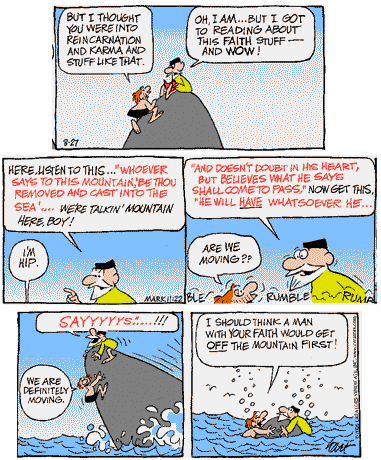
This appears not to trouble the irremediably devout. Cartoonist Johnny Hart continues to find something ostensibly humorous in the doubts of nonbelievers and likes to use the panels of his B.C. comic strip to preach at his readers. Today's installment is unusual in that it goes beyond his customary sermonette (see his stillborn sally at science, for example). Hart doesn't just lament the absence of miracles in contemporary life—he does something about it!


All of you doubters out there should feel properly chagrined now. As we can plainly see, a pagan mountain-sitting guru can, after a brief perusal of a complimentary Gideon Bible, generate so much godawful faith that he can topple his mountain into the sea! Ye of little faith had better sit up and take notice, because Johnny Hart's cartoon god is a mighty god. We know this, because it can perform stupendous miracles on behalf of its believers. Mountains into the sea! Wowee!

If I hadn't seen it for myself, I would never have believed it. See you in the funny papers.

Saturday, June 24, 2006

The witch behind me

An overheard conversation

“He was giving me a bad time, so I put a curse on him. Later that same day he was terminated. Fired. Tell me that was a coincidence.”

A man's voice was coming from right behind me. I was minding my own business—or had been, until then—forking up pasta in a restaurant for a late lunch. Only when my mind registered the word “curse” did my ears prick up and my attention wander away from the novel I was reading (Absolution Gap by Alastair Reynolds).

“Yeah, and that wasn't the first time, either. It's happened so often that I've lost track. There was this one guy who tried to gyp me on a deal. I put a hex on him and within the year he was dead from cancer.”

The man sounded completely sincere. From the murmurs and brief comments in response to the man's narration, I could tell there were two other people with him in the booth behind me: a man and a woman. The story teller's companions gave every indication that they were taking his tale at face value.

“One time this girl I know was having a big fight with her boyfriend and she asked me to put a curse on him. She heard I could do it. I told her, ‘Sure, no problem. Can you give me something that belongs to him?’ She gave me his business card. I didn't take it too seriously at first, but later I found the business card in my pocket and remembered, so I put a hex on the boyfriend. Not even an hour later this same girl called me up and tried to call it off. ‘You didn't do it yet, did you?’ I told her I had and she tried to make a joke of it, that it was only in fun, but I told her it was too late to go back on it. The next day he was called in for an IRS audit that ended up costing him tens of thousands of dollars.”

Now I was diligently taking mental notes and paying no attention to the novel in my hand. The man behind me was blithely telling his companions that he casually kills or impoverishes people whenever it suits him. I was having a bit of difficulty figuring a couple of things out. First, did he really believe he had these powers? And, second, how could he be so casual about the apparent consequences if he believed himself responsible for them? I was eavesdropping on a psychic sociopath.

“My sister says she thinks that Mom was a witch and that I inherited that from her.” For the first time, the man's story elicited more than a mutter or one-word sentence from his companions. The woman said, “Well, I remember that she had that Ouija board.”

“Yeah, that's right. Mom had that Ouija board and some books, too. Books that I read. And I learned stuff. It must be true because things just keep happening. A friend of mine told me that she was planning to go to Reno but usually didn't do very well. She asked me if I could do good things to people, not just bad, and I said I didn't know but I could try. She said she wanted to do better in Reno, so I asked her to give me a hundred dollar bill. She looked in her purse, but only pulled out a dollar. Okay, I figured I could double that pretty easily, so I took the dollar with me and put a hex on it for good luck. Later I drove over to a restaurant and right in the middle of that big parking lot I found a dollar, right on the ground. I said to myself, ‘Well, this must be her dollar,’ so I put it with the one I already had. When she came back from Reno she told me she hadn't done very well and won only a few dollars, so I said, ‘Well, here are two more dollars for you,’ and told her how I got the other dollar.”

I had been wondering if the man was a con artist working some marks, but at least one of his companions already knew him or his family, so I continued to be perplexed. The request for a hundred dollar bill had seemed suspicious, but now seemed just part of the story. I had finished my meal, but I still had some papers on the table that I had been grading before my pasta arrived. I shuffled them a bit and kept myself occupied. The man was telling a story of working sales and support at his place of employment, and the times he needed to put curses on people who wanted free service for out-of-warranty goods and discounts on goods that they themselves had damaged in the store. He couldn't be sure, though, how many of them had died or been audited. Apparently his magical powers were limited in that way.

I gathered my papers and my book and prepared to leave. Since the exit was behind me, it was necessary for me to turn in the direction of the people I had overheard. The hex man was older than I had expected from the sound of his voice, probably in his mid to late thirties, with short hair that seemed prematurely gray. Perhaps that's a side-effect of his psychic powers. He glanced at me briefly as I moved past the table and out of the restaurant.

Jeepers. I hope he didn't put a hex on me.

Tuesday, May 30, 2006

The truth about atheists!

Did you know they're godless?

There's been another round in the never-ending battle between believers and nonbelievers. P.Z. Myers aimed some pointed barbs at Rabbi Avi Shafran, who has resurrected the old argument that morality comes from God. In short, atheists are capable of most any atrocity because they do not, by definition, “fear God.” This is a wonderfully straightforward and simple argument. It is also simple-minded.

We've all see Shafran's argument before. It keeps popping up in various guises, most of them pretty transparent. I was reminded of a particularly cloying example that appeared in the pages of a Central California newspaper at the end of 2004. A student at Fresno State University had submitted a letter to the editor of his hometown paper. I was in the area for a visit to my parents for the Christmas holiday. Thus I was privileged to read the following closely reasoned essay (the reference to PG near the end relates to a local nonbeliever who writes frequently to the newspaper):
A look at atheism using logic

As I am currently typing this letter, siting [sic] in the computer lab at Fresno State and with the fall semester now over for me, I have come to learn a lot of new things in life.

One of the biggest lessons came from one of the most difficult philosophy classes on campus called ethical theory. I learned that it is meaningless for an atheist to claim to be moral without some interacting force, namely a loving God.

I have also come to learn that the Ten Commandments are the basis for human morality without having destruction in society. The last part of the Ten Commandments are boiled down to Jesus's words that we should love our enemy as ourselves.

As a student in Professor W's philosophy of religion class, I found it amazing that Christians are the only group professing these standard morals for society, and these Ten Commandments were not only kept with the advent of the new covenant but simplified by our savior Jesus Christ.

Taking ethical theory has taught me that to claim to be a moral atheist is as meaningless as it gets as there is no intervening force that makes it solid what philosophers call “analytic a priory” [sic]), since morals are determined by human reasoning alone. And as I have learned there are many cultures that approve of sexual and physical abuse, and even murder by their own reasoning.

No one has to be believe [sic] in a loving God, but the main lesson has been told, which to claim to be moral without a belief in God is meaningless.

Philosophically, there are three logical proofs for God's existence. One is the theological argument or the great design theory which is commonly appealed to by many people. Another is the cosmological argument which was appealed to the other day, which is there is no uncaused cause.

Lastly, I want to comment on the problem of evil, and the name calling by some atheists. If everything was perfect then we could not have free will, since our happiness would always be determined. By having evil we come to repent our sins. If one still does not choose to believe in God or they are pluralists like [Professor] W, then having evil lets us work for something in life.

But let me mind the atheist again. They have no morals whatsoever when they claim to have it since their morality has no solid support. Secondly, it is wrong to be putting down one's faith-based belief, and this is a very evil activity, although it looks like PG (don't get me wrong—Christians are sometimes guilty) has calmed down in the past couple of months. He still needs to be corrected.

Shawn C.
See, this is what book-learning can do to you!

As a professor myself, I could not resist getting a little didactic on Shawn's ass. Here's the body of my letter, published a few days later:
Shawn says, more than once, that he has now learned that “to claim to be moral without a belief in God is meaningless.” Apparently he now believes that the nonbelievers in his neighborhood are kept from heinous behavior through mere laziness or perhaps fear of the police power of the state. How fortunate for us all. But isn't more logical to believe that agnostics and atheists share with believers a preference for a well-ordered and moral society?

Shawn also claims to have learned that only Christians espouse the philosophy that “we should love our enemy as ourselves.” Although it is good to hear that Shawn presumably wholeheartedly loves nonbelievers, I doubt that his professors at Fresno State taught him that the golden rule is unique to Christianity. Even the simplest Google search reveals that the golden rule is honored in Buddhism, Hinduism, Islam, Judaism, and other religions. Confucius, for example, said “Do not do to others what you would not like yourself.” It's worth noting that both Confucius and Buddha predate Jesus.

By the use of rigorous logic, Shawn concludes that “If everything was perfect then we could not have free will, since our happiness would always be determined.” This simplistic equation of perfection with determinism suggests that in a perfect world Shawn would not be able to choose what to have for dinner, since only the perfect choice would be possible. A more interesting consequence comes from the fact duly recorded in the Bible that Adam and Eve had free will. The power of free will was given to them by their Creator, so it follows that God created an imperfect world. Shawn may want to talk to God about that.

I presume Shawn is in the early stages of his education at Fresno State, so there is still hope for him. He can take some nice classes in logic from the math department and round it out with comparative religion from the philosophy department. In the meantime, a little Christian humility can keep him from beating his breast in public like the Pharisee in Luke 18.

Professor Zeno
As it says in the Good Book (I mean Shakespeare, of course), “The devil can cite Scripture for his purpose.”

Wednesday, January 04, 2006

People who know

A rant about certainty

We naturally tentative people are at a disadvantage. Instead of embracing absolute truths, we prefer provisional propositions. If the propositions withstand our testing and our doubts, then our acceptance grows. If we are scientists, we might distinguish our most successful propositions with the honorific title of theory. If we are not scientists, or science-minded people, we might prefer our knowledge to be of the revealed kind, with a wonderfully comforting lack of doubt.

The disadvantage I alluded to lies in the arena of argument. The people who know things beyond a shadow of a doubt are often eager combatants. It can be difficult to debate with someone armed with the Truth while your position is based on "what seems true as best we can tell right now" (or that which is viable, as constructivists are wont to say). The people who know have no time for doubts. They say things like, "I know as sure as I am standing here right now" or "As certain as 1 + 1 = 2." (Of course, I agree with 1 + 1 = 2. That is, unless we are in a field of characteristic 2, in which case 1 + 1 = 0. This merely illustrates the necessity of agreeing on terms and context before engaging in calculation or debate. I mention it to irritate the math-challenged people who use arithmetic as a talking point in their invalid arguments.)

The true believers are out in force these days to protest the Kitzmiller decision. Kitzmiller struck down the attempt of the former school board in Dover, Pennsylvania, to push intelligent design creationism into public school science classrooms. The people who know about God and creation and stuff like that were mortally offended and quick to cry out:
[T]he theory of evolution stretches beyond reason to the point of fantasy and cover-up. Some will do anything to deny the existence of a creator God, the true inventor of science and of any accountability to the same.

This statement was published in a letter to the editor of a local paper. The ignorant correspondent went on to declare that Darwin was a believing Christian (not for long!) and that ID is the product of scientists (well, maybe; but rather marginal scientists motivated by their religious faith rather than by any scientific insights). There are many other examples of people who do not hesitate to declare that they know evolution is a hoax. See the instances cited at Recursivity and Corante. You are sure to find more examples in your own local newspaper.

Matters of faith

I admitted earlier that I believe that 1 + 1 = 2. Is that a matter of faith? It flows inevitably from the nature of arithmetic, although that in turn is based on some constructed mathematical foundation derived from some axiomatic base (such as Peano's postulates). It all has to start somewhere. I start with some basic acceptance of logical rules of inference and an inclination to believe that things should fit into a rational framework. Even if I can't see the whole framework. And even if the Intelligent Designer (a.k.a. "God") seems an unnecessary hypothesis.

The famous geometer Edwin Moise was an open nonbeliever who was challenged to defend his atheism. Was he not merely an agnostic? How could he say there was no God? How did he know? As the story goes, Moise was amused by the question and replied, "You have to believe in something."

The Moise anecdote shows that faith can be used in different ways. I used to believe that I had a good way to undermine the faith of a true believer. My idea was to fight faith with faith. Oscar Wilde once pointed out that, "The value of an idea has nothing to do with the sincerity of the person expressing it." When an acquaintance urged upon me his personal exegesis of the nature of Christianity, I replied that most Christians (and all non-Christians) would reject his interpretation and most of them would hold to their own ideas just as firmly as he clung to his. My gambit was predictably a failure. In the grand tradition of true believers everywhere, my acquaintance pointed out that he did not have to take into account the beliefs of people who were wrong.