Showing posts with label farming. Show all posts

Sunday, October 05, 2014

Waste water

Drought denialism?

The Porterville Recorder is a local newspaper down in my home turf of Tulare County. You may have heard of Porterville. The New York Times featured it prominently in a story about the great California drought and its impact on the Central Valley. The situation is grim, with wells running dry and people limited to bottled water for the necessities of life. Farmers with crops had already been told that irrigation water would not be available from the state's interconnected water projects. Hundreds of thousands of acres lie fallow, waiting for the uncertain return of water in this third year of intense drought.

Last month the Recorder published a guest editorial by pistachio grower Lee Cohen that fingered a popular culprit: radical environmentalism.
Water issues seem to have been hi-jacked, ransacked, and co-opted in California by the environmentalist radicals. There is a cavernous, endless void of common sense.

Let me explain. Two hundred percent of the entire Central Valley’s annual agricultural water needs are being flush[ed] straight to sea for a variety of different esoteric environmental reasons. The Central Valley is reeling from the devastation this policy hath wrought.
Anyone who drives down U.S. 99 or Interstate 5 will have seen the signs demanding an end to the “Congress-Created” drought. It's an article of faith among many down in the valley that the water shortage is all some kind of extremist environmentalist plot to coddle a tiny fish.
This water is being diverted to save nonindigenous smelt in the San Francisco Bay. Hundreds of millions of gallons went to this cause. Zero gallons to the Central Valley’s people and farms.
There are pumps at the top of the Central Valley water canal infrastructure which are restricted from running due to an old Endangered Species Act ruling, an outcome crafted, championed, and orchestrated over decades by the environmental movement to protect these minnows.
If only the pumps could be turned on, the Central Valley drought would be over! Those stupid little fish would die, but farms would live!  But “diverted”? No, it's the natural flow through the Delta. Diversion occurs when it's pumped elsewhere. Nevertheless, Cohen reiterates his key point:
The immediate water crisis has been fomented by the environmentalists since there is plenty of water in the north (Remember the 200 percent outflows to the Pacific ongoing today?). The current crisis in the Central Valley could be mitigated immediately if the pumps were turned on and the canals filled.
Apparently Cohen believes that half the water currently being “flushed” into the sea could be diverted from Northern California's abundant supply and shipped south to thirsty farmland. What would happen to the San Joaquin Delta and the San Francisco Bay Area if the water flow were cut in half from its currently drought-depressed levels?

Salt-water incursion, of course. The Delta would die. The Pacific Ocean waters that currently mix in the bay would move further into the Delta. Would it reach the pumps and cause them to start shipping saline solution to the south? I don't know. The damage might not extend that far, although the Delta would suffer severe degradation. But quite apart from the fate of the tiny smelt, the Bay Area fisheries could be taken off life-support because they could not survive with the flow cut in half.

No one should understate the suffering of California's farms and farmers under the continuing drought. Livelihoods and family traditions are being destroyed and only the strongest manage to survive. But the debate over remedies for the drought has been poisoned by paranoid fantasies.
The environmentalists are trying to, in their own words, return the Central Valley to the natural condition it was 200 years ago—a vast ecological basin. They are trying to dry the place up, starve it, reverse the development—a form of radical anti-progress, if you will.
Cohen does not share with us “their own words,” the words of the extremists who supposedly have the state legislature and the court system at their beck and call. If he dredged up a quote—and surely one could be found somewhere—espousing a radical return to “unspoiled nature” before the advent of farming in the valley, Cohen would necessarily find himself citing some fringe figure of minimal authority and negligible influence in today's debates over water policy. The real issue is that water is in catastrophically short supply and farmers are in competition with many others who want and need Northern California water. Cohen says “there is plenty of water in the north” even as the north state's reservoirs have fallen to record lows in water storage.This delusion will not advance the state of the debate.
They take our water and say we can’t dig for more. They care not about the people. They care not about the communities. They care not about the jobs. They care not about the farms. And by dumping water to the sea, they care not about the water. Indeed, environmentalists even care not about the trees.
Cohen rings the changes on his talking points to make sure we don't miss them: “our water,” he says; “dumping water to the sea.” Any drop that makes it to the San Francisco Bay is evidently wasted.

And lest we miss Cohen's qualifications to speak on behalf of “small family farms, which represent more than 90 percent of agriculture in California,” he drops this nugget on the table:
I, a true environmentalist, who grows and cares for 1.5 million pistachio trees, say to all, indeed, these radicals, care not about the trees.
Thank you, small farmer, for enlightening us.


Saturday, November 27, 2010

How red is my valley

Red in the old-fashioned sense

I frequently refer to my old stomping grounds in Central California as the reddest part of the state. By this I mean, of course, that Californians in the Central Valley love to cast right-wing votes and support conservative causes.

Now, to my great surprise, I have uncovered a red brigade calling for collective action and government interference in free enterprise. It's really quite shocking. The conspirators are naturally rather coy about portraying themselves as advocates of statism and a planned economy, but they cannot help but give it away.

One clue lies in their name. Just as countries in the Soviet bloc used to glory in misleading names—“People's Republic,” “Democratic Republic”—the red threat in the San Joaquin Valley marches under the banner of “Families Protecting the Valley.” Sounds nice and harmless, doesn't it? But check out this excerpt from their manifesto:
Current attacks on the Valley’s water take two forms. One is the view that water is nothing but a commodity and must be sold to the highest bidder. This is a foolhardy concept which, if followed, will condemn the United States to depend upon foreign sources with unreliable health protections for its food supply.

There it is, folks. They oppose capitalism. They want intervention in the free market economy of California.

I agree with them, of course, but then I was long ago accused by a certain family member of being a socialist. We socialists love planned economies, you know.

Or perhaps I just see a role for the public sector in setting policy that might forestall the abuses of unfettered capitalism. Remember the robber barons? (They're back, by the way.) If the highest bidder always wins, we fall instantly into a plutocracy. It appears that the members of Families Protecting the Valley have awakened to this stark reality. Perhaps too late.

If the principles of the free market are applied too rigorously to California's water resources, Central Valley agriculture is doomed. People living in the San Joaquin's burgeoning towns and cities will almost certainly pay lip service to the notion that farming is a crucial industry that deserves their support, but don't expect that lip service to turn into votes for growth limits and municipal water rationing. Farm families are hugely outnumbered by the city and town dwellers, and the latter will balk at anything that reduces the flow of water from their faucets (or forces them to drain their swimming pools).

Absent a strong government policy establishing a water allocation program to preserve agriculture in California's arid Central Valley, that agriculture will fall prey to competing demands from the growing urban regions. While many of the townies are in farm-related enterprises, most of the people in Bakersfield, Visalia, Tulare, and Fresno don't think of themselves as farmers. It's not a majority bloc.

Furthermore, the water in the Central Valley is diverted from sources in Northern California. Diversions from the Delta damages those wetlands and blights the fishing industry in the Bay Area. These are legitimate competing interests for California's water (and they had the water first, too). Valley farmers who sneer at fisheries and declare that the fishes should die to preserve farm crops are conveniently forgetting that they're really talking about killing the livelihood of fishermen. The competition is keen and the supplies are short. It's not a pretty picture. 

In a more enlightened age, the state legislature promulgated the California Land Conservation Act of 1965. It was an example of singling out agriculture for special treatment because it was deemed a key state interest (and not just a majoritarian concern). The handiwork of Assemblyman John Williamson, the “Williamson Act” provided tax benefits to agricultural landholders who agreed to preserve their farmlands from commercial development for a period of ten years. Recently the state saw fit to strengthen the Williamson Act with an infusion of money to allow it to continue in operation and to fund tax breaks for more ten-year moritoriums on farmland development.

The Williamson Act is a survivor of the time when the state enacted formal policies to maintain the viability of California agriculture. Now it has gotten all but impossible to act in concert this way. The rugged individualists in California farming who regarded subsidized water as their birthright apparently assumed the situation was sustainable. Naturally and understandably wary of government control, they preferred to pretend to stand alone. In many cases, unfortunately, the lack of sufficiently strong policies to protect family farms meant that they were swallowed up by corporate interests. Agricultural land is now concentrated in the hands of a few large agribusiness companies. Individual family farms continue to dwindle in number and those that survive are perched on the edge of commercial nonviability. While farmers carp and complain about federal programs like the Endangered Species Act, they should have been looking for some similar protection for themselves.

It was the partnership of government and family farms that made the valley bloom. State and federal subsidies for huge water projects irrigated the San Joaquin at bargain prices—once. Today California's urban population is larger and thirstier than the state's farms. By the numbers, they win and farms lose. Clearly, Families Protecting the Valley does not want that to happen, but signs demanding that the governor simply “turn the pumps back on” demonstrate a fundamental misunderstanding of reality in a drought-stricken state. A slow-motion tragedy is unfolding before us while the victims rail at the only entity that can preserve them—at least some of them.

Ironically, Families Protecting the Valley had a prominent place at the big Tea Party event at the Tulare International Agri-Center last July, where banners denounced big government and extolled unfettered free markets. Yet no one objected to the presence of these anti-capitalist interventionists.

Can I get you some water for your tea? Sorry. Fresh out.

Saturday, July 03, 2010

Now hear this!

Trust Dr. Rock Star

Farm life is not necessarily a bucolic idyll accompanied by the soulful lowing of cattle and the melodic twittering of songbirds. The roaring of tractors and other farm equipment may imprint you with less restful souvenirs—like a ringing in the ears.

During my childhood, no one on the farm wore ear protection during long hours in the field, driving tractors to and fro with equipment in tow. Some of the farm gear was unpowered and relatively quiet: discs, harrows, plows, and rakes. The diesel engines of the tractors provided most of the noise. Other devices raised a ruckus of their own, powered devices like balers, whirling choppers, reciprocating scythes, and stalk cutters. Then there were odd devices like the cultipacker, an unpowered farm tool that consisted of a big cylindrical axle festooned with toothed steel rings, which clashed against each other as they rolled across the field. It sounded like a continuous explosion in a cymbal factory.

One legacy of my life as a farm kid is tinnitus—a continual ringing in my ears. It's a mild case, usually easily ignored, but it varies from time to time and I wish it would go away. I unknowingly did my best to avoid it, always letting my brother volunteer for farm tasks that he would happily do while I would regard them as infringing on my reading time. Despite my shirking, the damage was done.

Naturally my ears pricked up when I heard a radio advertisement for a new remedy. Although my doctor had told me there was no useful treatment for tinnitus, hope springs eternal. Had there been a recent breakthrough? The pitchman on the radio cheerfully reported that Quietus would safely provide relief from the ringing, humming, or squealing in the ears that characterizes various forms of tinnitus. Sounded good to me.
Now you can alleviate the ringing with all-natural Quietus, a proprietary formula that helps support healthier cochlear auditory nerve function in the inner ear, to relieve that annoying internal noise.
Oops! I hear buzzwords. Do you hear buzzwords? “All natural”? “Helps support”?

I also smell something. Like a rat.

The male voice of the pitchman gave way to the female voice of a supposed satisfied customer of Quietus:
I like it that it's homeopathic and doesn't require a prescription.
Okay. Got it. Quietus is a bogus nostrum with no medical value (unless you count the placebo effect). Out of curiosity, I visited the Quietus website. That where I discovered that Quietus was “discovered by a drummer.”

Sounds like someone was inspired by Airborne, the supremely successful fraud perpetrated “by a school teacher.” Who wouldn't trust a remedy invented by a rock star? (They're way more credible than mere doctors and researchers.)

The only good part of the Quietus website was the fine, fine (really fine) print at the bottom of the page (complete with the product name misspelled!):
Queitus™ Advanced Homeopathic Medicine. **These results not typical. Individual results will vary. These real testimonials do not represent the typical or ordinary experience of users. They are for demonstration purposes only and do not accurately capture the actual results you will experience. Your results may vary and you may need to use the product for a longer or shorter period of time. Each person’s experience with Quietus is different, which cannot be determined from these testimonials.
It's a lovely bit of cover-your-ass prose, which approximately 99% of visitors to the website will not read (or perhaps even see).

We tinnitus sufferers will have to continue to wait for a genuine remedy from real scientists—perhaps something along the lines of current research, which has succeeded in regrowing cochlear hair cells in mice. In the meantime, one can find a consumer-alert message about Quietus on YouTube (although I must warn you that it has an irritatingly noisy soundtrack!). I'd rather direct you to this trenchant commentary by Dara Ó Briain, who thinks we should “bag” homeopathy. But please don't clap too loudly. My ears are delicate.

Sunday, October 04, 2009

Counting cows

Accidentally in glut

People have been bringing a recent New York Times article to my attention: “From Science, Plenty of Cows but Little Profit.” (If the New York Times is behind a subscription wall for you, try the News & Observer's reprint here.) Just when milk prices crash and dairy farmers are taking it on the chin, science has foolishly tampered with nature and created more cows! As reporter William Neuman explains,
Three years ago, a technological breakthrough gave dairy farmers the chance to bend a basic rule of nature: no longer would their cows have to give birth to equal numbers of female and male offspring. Instead, using a high-technology method to sort the sperm of dairy bulls, they could produce mostly female calves to be raised into profitable milk producers.

Now the first cows bred with that technology, tens of thousands of them, are entering milking herds across the country—and the timing could hardly be worse.
There's less to this story than meets the eye.

It's true, of course, that any dairy farmer who invested in sex-selection technology wasted his money. Money he almost certainly cannot afford in these straitened times. The extra heifers are of no benefit, since he certainly does not need more milk cattle while the market for fluid milk is glutted. Dairy farmers are now receiving about $11 per hundred-weight, while a year ago it was over $19. The dairymen who went into debt to expand their herds at the price peak are now losing those herds at the low point. (My brother, who is a dairy farmer, knows of two men who got out of the business the hard way: one used a rope and the other used a gun.) It's a disaster out there, as depicted recently on ABC World News (“Dairy Farms Disappear”).

The problem, therefore, is real. The sex-selection technology, however, is the merest blip. It might be a significant boon in the future, supposing that there is a recovery in the dairy industry, but in the short run it has minimal impact. You see, each milk cow needs to give birth in order to start lactating. You may remember that fact from basic biology. Perhaps at some point we will overcome that limitation, but for now it still holds true.

This basic law of milk production means that each cow in a milking herd is a mother, implying the existence of a calf. The number of calves isn't going to change. In the past, you had a fifty-fifty split in the number of heifers (female calves) and bull calves (male calves). As reported in the New York Times,
The male calves are usually sold for little money to be raised as meat, and the females are raised as milk producers.
All too true. The occasionally bull calf may be raised to adulthood for stud services, but most of the boys go right to the auction block (along with an excess girl or two).


Such a waste of breeding time and effort, producing all those useless males!

It looked for a moment like the problem of excess males had been fixed. Unhappily, under current circumstances, the fix merely means that we have begun producing useless females—in a one-to-one substitution for the useless males. The excess heifers will be sold off instead of being bred and joining the milk herd. The unneeded heifers will command the same meagre meat-product prices as the unneeded bull calves. The girls will, unfortunately, have cost more than the boys used to because of the investment in sex-sorted semen for artificial breeding purposes, but they won't be adding a single drop to the milk glut.

They'll never be milked.

Saturday, August 08, 2009

Lie to the children

They'll thank you later

With us, it was snakes. Every hollow, every nook, every gopher-hole in the earthen banks of the irrigation canal was most assuredly the hiding place of snakes. Dangerous, sharp-toothed, venomous snakes who were as willing to bite you on land as in the water. So don't even stand on the banks, let alone go wading in the water. Because the snakes will get you!

I'm pleased to report that the snakes never got me, or any of my sibs. Nor did I or any of my sibs drown in the big ditch, unlike some other children I could tell you about. Strange to say, though, it still gives me a frisson whenever I walk the banks of the irrigation canal running through the family dairy farm and spot a hole in the side of the bank.

Snakes!

No. No snakes. Not then, not now, not ever. No snakes.

But I believed in them with a powerful faith that long outlasted Santa Claus. And I kept away from the irrigation canal till I was practically a teenager and it became necessary to drive tractors down the embankment road to run errands.

My niece Becky lives on the family dairy farm, but on a parcel conveniently distant from the canal. One less thing to worry about. She has a different problem.

There's a sump hole a mere hundred yards from her house. As far as her brood of little boys is concerned, that's practically next door. (The intervening space is all open field and dirt road.) It's fair-sized, too. I know. I've paced it off. My stride is almost a yard in length and it took more than 120 paces for me to walk its perimeter.

The boys have seen the sump hole, a fetid pool where water emerges from the drainage system and collects. And all of them know the story that goes with it.

Does the sump hole have snakes? Goodness, no. Nothing so tame as that.

It has a cow-eating monster.

Most dairies are fortunate in that they do not have cow-eating monsters on the premises. In the case of the family dairy farm, however, the monster in the sump hole has reportedly dragged off and devoured at least one cow. My niece's eldest son, who is still of pre-school age, has patiently recounted the story in detail to his great-grandmother. My mother nods her head at the little guy as he narrates how the monster grabbed the cow when it got too close to the sump hole. She confirms to her great-grandson that she's heard that same story. And the cow vanished without a trace. No doubt the monster would also gobble up little boys if they got too close. Big people, as well, no doubt. At least those of us no bigger than cows. We all purport to be afraid of the sump-hole monster.

Snakes were enough to keep my generation away from the flowing waters of the irrigation canal. The children of two generations later may be made of sterner stuff. It takes a submerged cow-eating monster to keep them away from the stagnant waters of the sump hole.

Whatever works, I guess.

I'm not satisfied with the solution, although I admire the scale and scope of the cautionary tale. For one thing, I never worried about the snakes at night although I could see the canal from my bedroom window. I knew they didn't like to wander away from the canal and, besides, they couldn't get in the house. We were safe as long as we didn't go right up to the big ditch.

Monsters are a different kettle of childhood horrors. What's to say it couldn't emerge from the sump hole at night and stalk the countryside? Will mere doors and walls suffice to keep it at bay? It certainly must be hungry by now. It dined on cow well over a year ago. The monster may be restive. And I'd prefer that we not sow the seeds of a bone-deep childhood paranoia. Or night terrors.

Uncle Zee had an idea. He got together with the boys' grandfather.

My brother and I have nearly worked it out, I believe. The sump hole will be getting a chain-link fence. The boys will think it's to keep the big monster in, but it's really to keep the little monsters out.

And safe.

Saturday, August 02, 2008

The sins of the fathers

A family tradition

Dad often finds it irksome that people don't have straightforward solutions to all the problems of the world. It's particularly nettlesome, you see, because he does, and one can endure only so much ignorance on everyone else's part. I know all this, of course, because my father tells me. Never one to hide his light under a bushel basket, Dad scatters his pearls before unappreciative swine. And I say, “Oink!”

My siblings and I have sat at Dad's feet—figuratively, anyway—for many years. Despite ourselves, we have absorbed many of his favorite didactic parables. He recently repeated a story about the good old days when he and his father were partners in the family dairy farm. The moral of the story was that Dad had keener perceptions and wiser responses than anyone else. This is, in fact, the usual moral, whatever the story.

“Your avô had a real hang-up about culling the herd,” recalled Dad, using the Portuguese word for grandfather. “We'd tell him it was time to retire a cow from the milk barn and take her to the cattle auction, but he'd always resist. I'd point out that she wasn't earning her keep, wasn't pulling her weight, but he never wanted to hear that.”

Our grandfather, you see, had a theory.

“As long as a cow was contributing a little milk every day, your avô would just say that every little bit helped. A few drops and he was happy. As far as he was concerned, that was enough. I guess he didn't like to think in terms of return on investment.”

Dad was probably right, and not simply about the impact of low-producing cows on the dairy's bottom line. It was likely that Avô had found it difficult to be a hard-nosed businessman when it came to cows he had raised from the time they were newborn calves. “Every little bit.” Yes, that sounded like the grandfather I remembered. And Dad could not shift a father who was set in his ways.

A completely unrelated epilogue

California is going through another drought season. It happens every few years and is likely to occur more frequently under the double whammy of population growth and global warming. My family is a farm family and its land lies in the state's Central Valley, a geographical region that would be a desert in the absence of California's extensive network of canals and irrigation ditches.

Competing interests are always brawling over the available water resources. The state's water agencies are wondering if fish in the San Joaquin Delta will go extinct unless more water is diverted in that direction. Agricultural interests, of course, are up in arms in fear that endangered smelt in the Delta will reduce their access to irrigation water.

Dad is quite naturally on the side of the farmers. But even more than that, he has a solution.

“We know we need more water, but environmentalists are stopping us from getting it. Fish are not as important as people. Every river in California should have a dam on it.”

Every river, Dad?”

“Yes, every single one. If we want to have plenty of water, we have to stop it from running downstream and into the ocean.”

“Uh, Dad, they've actually demolished a few dams in recent years because they were no longer economically feasible or environmentally acceptable.”

“That's ridiculous! Every little bit of water helps!”

And I cannot shift a father who is set in his ways.

Saturday, November 24, 2007

Poor reasoning

Do as I say, not as I do

No holiday is complete without a homily from the paterfamilias. The target of each lesson is the unrepentantly liberal eldest son. Me. Hope springs eternal in Dad's breast, refusing to abandon his efforts to get me to appreciate the rigorously logical pronouncements of Rush Limbaugh, Ann Coulter, and Fox News. You almost have to admire that kind of persistence in the face of constant disappointment.

It's almost evolved into a ritual. My usual practice is to depart from the family's Central California farm as early as I can manage the morning after the holiday gathering. Mom & Dad have adapted by having breakfast with me at a favorite restaurant next to Highway 99 (my escape route to the north). We chit-chat over bacon and eggs until Dad decides it's time for his lecture.

“You're probably too young to remember the Johnson administration.”

“Dad, I was a teenager during Johnson's Great Society.”

“Oh, yeah. Well, he had this idea that he was going to end poverty.”

“I remember the war on poverty. Johnson would be remembered more kindly today for things like that if it hadn't been for the Vietnam mess.”

“All his war on poverty did was make more people dependent on government. They just want handouts.”

Like farm subsidies? Dairy price supports? Irrigation water from publicly funded dams and canal systems? No, I didn't actually say any of that. Dad wouldn't have appreciated it.

“When you see poor people on TV complaining about their lives, they're always living in a mess. They have no personal pride. You can tell they're just lazy.”

Dad thrives on context-free anecdotes and the infallibility of his personal observations. He's the sort of person who points at an accused criminal on the television and declares, “You can tell he did it!” Only the pope's infallibility exceeds Dad's.


For some reason, Dad doesn't recall (or never knew) that over 20% of Americans lived below the poverty line when John F. Kennedy took office in 1961. After his successor's war on poverty, it had dropped to about 12%. While Dad might disagree, I think Johnson deserves some credit for that.

Saturday, November 18, 2006

Farm boy

It's not your father's dairy

The following essay was originally written a few years ago when I was in an ethnography class in graduate school.

Last week’s presentation on Angus Wright’s The Death of Ramón González prompts me to share some observations with my classmates and teachers. Although I am not a scholar of the “corporatization” of agriculture in California’s San Joaquin Valley, I am an eyewitness. Many key events occurred while I was growing up in the Central Valley during the 1950s and 1960s, although I had no idea at the time of their significance. My comments are based on memory rather than research and my recall is not perfect. Even so, I have limited myself to those impressions that are clearest in my mind and ring true within the patterns of my experiences.

My recollections were initially prompted by the striking photograph reproduced on the cover of Wright’s book: the flag man serving as a marker for the crop-dusting airplane. I was probably about 10 years old (which would mean it was the early 1960s) when some cousins and I wandered from the family dairy to watch the spectacle of the crop-dusting biplane that had been hired to spray the adjacent cotton field. No one was worried too much about being exposed to the dust (or mist; I don’t recall which) that the pilot was laying down over the field, but we definitely kept out of the plane’s way. One boy who didn’t have a choice in the matter was the pilot’s son, who was pulling flag duty at the far end of the field. He was perhaps barely into his teens. Every time his father flew over him and doubled back for the return pass, the boy would pace off a prescribed distance to mark the point toward which his father should fly next time around. It may be difficult for people today to imagine this, but none of us thought of the boy’s job as anything other but exciting; we certainly did not think it was a blatant example of child abuse or endangerment. After all, the spray was an herbicide (for weeds) or pesticide (for bugs). It wasn’t of that much concern for people, right?

This casual approach extended to the seed corn that my cousins and I all saw loaded into the planting machines. While the corn itself was the expected yellow, the kernels were all dusted with a dark red powder, a pesticide. When the bags of corn were poured out, the dust formed pink clouds in the air. It stayed on your fingers if you ran your hands through the corn. It was a commonplace of farming and no one thought much of it. Our fathers would tell us to stay away from the corn mostly because we would get in the way or spill it on the ground through our carelessness. It wasn’t because we were worried about poisons that much. Don’t chew on the corn, okay? That was caution enough.

In those days, my grandfather and his two sons could be successful with 200 milk cattle and a couple of hundred acres of crop land that produced either fodder (hay or corn) or cash crops (cotton). The dairy farm supported my grandparents, my father, my uncle, their spouses, and half a dozen offspring. Today, the family dairy farm is being operated by my younger brother. He needs more than 600 cattle and several hundred acres (both owned and rented) to support his wife and daughters. Even with this dramatic expansion of the operation, he relies on cooperative associations like the Western United Dairymen. Without the clout of such formal alliances, my brother would be swallowed up by a corporate farm organization.

Corporate farming began to be visible to me in the early 1960s. The first clues were nice looking white signs with crisp black lettering. The signs each bore the name of a local farmer, but the sign also carried the name “Roberts Farms, Inc.” The farmer no longer owned his own farm (if indeed he ever had; some of the names were of people brought in to operate the purchased farm). It was initially a low-impact invasion. The farms looked pretty much as they had always looked, but a corporation owned them now. In retrospect, I don’t recall feeling any concern about the fact that an increasing number of such signs were visible during the four years that I rode a school bus into town to attend high school (late 1960s). I suspect that my father and uncle were somewhat more concerned about being encircled.

A very peculiar aspect of the corporate incursion into San Joaquin agriculture is the degree to which its victim, the family farmer, rolled over and played dead—or actively cooperated in his destruction. The Central Valley requires irrigation water to grow its crops. Federal rules created a special water subsidy for family farms no larger than 160 acres. (One square mile is 640 acres.) The limit was routinely circumvented by farm corporations, which would artificially break up their huge holdings into 160-acre parcels and thus qualify each portion separately for subsidized water from the Central Valley Project. Were the real family farmers outraged by this? Maybe some were, but I clearly recall how my father responded every time an attempt was made to enforce the limit. The corporations would send out direct mail and pay for newspaper ads that would warn that the Feds were trying to interfere with farmers. For many small farmers, the corporations had the clout they lacked when it came to fighting with the Feds. Since 160 acres was an impractically low limit even in the 1960s and 1970s, family farmers made an unholy alliance to undercut enforcement of the limitation. That enabled the corporations to save millions upon millions of dollars that they then used to buy out more independent farmers. (In 1982, the irrigation limit was finally lifted to 960 acres.)

Today the transformation is nearly complete. The surviving independent farmers are in strategic alliances and have adopted corporate aspects as protective coloration. My brother, for example, is no longer simply a family farmer. He is a corporation, using a business name to comprise all of his operations— farming, milking, harvesting, hauling, etc. In reality, though, the corporation is simply my brother, my sister-in-law, and my nieces. In order to fend off the corporations, my brother had to become one. He declined to be assimilated.

A cultural side note

My ancestors were subsistence farmers when they lived in the Azores, certainly not the dairymen their descendants became. The biggest industry in these Atlantic islands is fishing, together with many small family farms, some of which have a cow or two. However, like many other Portuguese immigrants, my grandfather’s first job in California was on a dairy farm owned by a relative. By whatever fluke, early Portuguese immigrants started out on dairy farms and they brought over additional family members to work with them. A tradition was established. A few years ago my brother invited me to attend a Western United Dairymen’s banquet in Sacramento, where the organization was holding a conference. While all the speeches were in English, the language I heard at most of the tables in the dining room was Portuguese. Perhaps one of the unifying threads that tie many of the independent dairymen together is a common heritage. I suspect this cultural component, shared by probably a majority of California’s dairy farmers, has given them the cohesion and resilience to survive all these decades in the face of the nearly universal triumph of corporate agriculture.

Tuesday, January 03, 2006

A walk in dairyland

A ditch runs through it

As usual, the Christmas holiday found me back where I was born and raised—the dairy country in the middle of California's San Joaquin Valley. My brother runs the family dairy now, milking about 800 head of Holstein. That does not, by the way, make his dairy particularly large relative to the other dairies in the region.

On Christmas morning, I woke up in the home my parents have lived in for all of their married lives (over fifty years). After a sketchy breakfast (reserving my appetite for the mid-day Christmas dinner), I went for a stroll across my brother's dairy farm. My path paralleled the irrigation canal that provides the farm's southern boundary. The central valley would be a desert if not for the web of waterways that permits farmers to irrigate their crops. The canals vary in size, of course, but the one next to my brother's dairy is typical. Its cross-section is trapezoidal, perhaps 20 feet wide across the top and about 10 feet deep. That's the distance from the bottom of the canal to the top of the bank; the actual water depth is about six feet. There was no water flowing in the canal on Christmas Day, but the water had etched the dirt banks to mark its passage. Recent flows had apparently varied between four and six feet.

Roughly judging the dimensions of the water's cross-sectional trapezoid when the depth was six feet, I estimated that the cross-sectional area was 48 ft2. Ignoring little details like the gradually diminishing height of the water as one goes down the canal, I figured that one mile of canal would hold about 250,000 ft3. What is that in gallons? I don't know, but I could probably figure it out. However, farmers don't use gallons—unless the government makes them.

Farmers use acre-feet. An acre-foot is the volume of water required to cover an acre of land to a depth of one foot. (Of course, it helps if you know what an acre is.) I remember my father and brother snorting in contempt one time when scanning a government form they were required to fill out. Some poor state bureaucrat wanted irrigation data reported in gallons. (There are lots of former farm kids out there. You'd think a state agency dealing with agriculture would hire enough of them to be competent in farm parlance. But I guess not.)

By the way, do you know what an acre is? I have always found it simplest to remember that there are 640 acres to the square mile. To me, this is a better memory device than the rule that an acre is a rectangle one furlong in length and four rods wide. However, you may have noticed that 640 is not a perfect square, so it would be impossible to partition a square mile into 640 perfectly square acres. If we instead use 40 acres as our preferred measure, then we see that a square mile can very nicely be chopped up into sixteen 40-acre parcels. Indeed, this is commonly done, which is why ranches and farms are often conglomerations of 40-acre tracts. Then you'll hear people refer to the "north forty" or something like that by way of identifying a field.

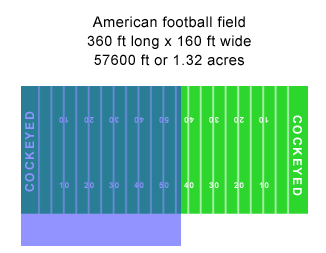
If you're not accustomed to thinking in terms of square miles and acres, perhaps a different comparison would be helpful. The website Cockeyed.com offers many ways to look at an acre. Most people will probably find the comparison to a football field the easiest to grasp. The alternative is to crunch some numbers: A square mile is (5,280 ft)2. If we divide this by 640, we find that an acre is 43,560 ft2. If we divide the volume of water in one mile of the irrigation canal by the square-footage of an acre, we end up with about 5.8 acre-feet. That's a lot of gallons.

Go-it-alone dependency

I have been reading Arax & Wartzman's biography of J. G. Boswell, The King of California. The Boswell family was and is a key player in the development of central California agriculture. One of the great paradoxes at the center of the enterprise is the pairing of rugged individualism with huge government subsidies.

Some of the huge components of California's water control system, like the Pine Flat Dam, involved the expenditures of enormous amounts of personal capital as farming enterprises invested in the future of irrigation, but most of the state's water transportion system is a gigantic public works project. The bottom line is that the government is the indispensable facilitator of the farmer's occupation, even as the farmer typically resents what he often sees as the government's unwarranted intervention in his personal affairs. In theory, at least, federally subsidized irrigation water was supposed to go to modest family farms with at most 160 acres. In practice, the 160-acre limit was routinely flouted or circumvented by pretending to partition large tracts into parcels under the limit. The battle over the limit went on for decades before the large farming operations finally won de jure the struggle they had long been winning de facto.

It is easy to be misunderstood when one points out that government intervention helps to keep California farming a viable proposition, at least on the scale at which it is currently practiced. The inattentive will assume that farming is therefore a cushy occupation, a kind of socialist worker's paradise. That would ignore the intensely hard work of farming and the game of chance and skill that farmers play with Mother Nature each year. The hours are long and the work is hard. As a farm boy, I had it relatively easy because of a brother and cousins who were eager to plunge into the agricultural life. But I know from personal witness (and occasional reluctant involvement) that it is a strenuous existence.

What we have here are self-made men who work within a government-built world. Neither could have done it without the other. The weird amalgam of public works and private effort has been astonishingly productive. Can it be sustained? I rather doubt it. The small family farm is already extinct in the San Joaquin. My brother is operating a dairy farm approximately four times as large as the one our grandfather reigned over. Yet in my grandfather's day the dairy farm provided more than adequate support for three families and paid out wages to employees from four other families (to the best of my recollection). Today the much larger operation supports a significantly smaller number of people.

Farm survival is based on growth. Growth of both crops and size, the crops for cash and the size for economies of scale. Will the trend keep going until the central valley contains only one huge farm? As unthinkable as that is, no one can currently see the next plateau where family farms can be both stable and successful. The fifth generation of our farm family arrived early last year. Will he and his siblings be our last farm generation?